July Border Apprehensions: Another Disastrous Month

Customs and Border Protection reports that Border Patrol apprehended 199,777 persons at the US southwest border in July. This represents an increase of 21,000 over June and was 23,000 higher than our dire forecast of one month ago. Further, July apprehensions were nearly twice the level of the next highest July in the last twenty years, that is, July 2000 of the Clinton administration, when 114,000 migrants were arrested.

July 21 1.png

We can now make plausible forecasts for the balance of the fiscal and calendar year based upon 2000, the prior worst year in US history, and using historical averages for the back end of the year.

For the fiscal year ending September 30th, 2021 will eke out the record as the worst year for southwest border apprehensions, if the precedent of the Clinton administration in 2000 holds. By contrast, if the balance of the year follows historical averages, fiscal year 2021 will rank as only the fourth worst year in US history. That this is even possible is solely due to the efforts of the Trump administration, the last four months of which count for fiscal 2021 and whose apprehensions were much lower than since the Biden administration took office.

July 21 2.png

Calendar year 2021 will almost certainly be recorded, by a large margin, as the worst in US history for southwest border apprehensions. The administration is currently tracking 1.75 - 1.80 million apprehensions at the border, as much as 200,000 higher than the next closest year. Barring a draconian change of policy, a record for the calendar year is all but in the bag.

Inadmissibles -- those presenting at official crossing points without appropriate documentation -- looks even worse, albeit at much lower absolute levels. These are now running at three times the level of March, nearly 13,000 for the month of July. That these numbers are rocketing up month after month strongly suggests that Customs is letting many through without proper documentation. For migrants, presenting at official crossing points without papers appears to be another viable channel for entering the US interior.

July 21 4.png

To all this, DHS Secretary Mayorkas commented yesterday, "If our borders are the first line of defense, we're going to lose and this is unsustainable​...We can't continue like this, our people in the field can​'​t continue and our system isn't built for it."​ To which one agent replied, "​For those of us who have been around here long enough, we don't need to reinvent the wheel. We've had this happen before. We know exactly how to shut it down. We need to make illegal entry illegal."

​I am frankly astounded that Secretary Mayorkas still holds his job. He should have been fired two months ago, and likely will be in the next two months. Time and again, we see the Biden administration forced into policy reversals. Defunding the police proved toxic at the polls, prompting Press Secretary Jen Psaki to rather ludicrously claim that it was a Republican idea. Abandoning Afghanistan is unraveling into tragedy, validating the US military's resistance to pulling out. The Guardian today excoriated the President for asking OPEC to pump more oil: "If this is the stance of the Biden administration then its decarbonisation agenda has been well and truly buried," the Guardian seethed.

All of this was entirely foreseeable.

On the border, too, the administration will eventually be forced to reverse policy. It is hard to see this happening without Mayorkas' scalp.

But the damage will have been done. There has been considerable sympathy on both sides of the aisle for DACA recipients. Biden's open border policy has, however, politicized and weaponized this group by signaling that the administration simply intends to gut border enforcement to undermine US conservatives. This is not about humane treatment, but about amnesty as war by other means. Talk about rebranding! Do my friends at the NILC or fwd.us believe amnesty will pass under reconciliation? And if it does, do they expect Democratic Senator Kyrsten Sinema, who is from Arizona, the home of SB 1070, to vote for any kind of amnesty while the border is hemorrhaging migrants? And then what do they expect of Republicans? Republicans will be able to brush off calls for amnesty with a simple condition: When the Democrats remove the two million illegals Biden's border policy will have allowed in, they will agree to amnesty. As we know, that's not going to happen. As a consequence, the Biden administration's border policy is an unfolding disaster for undocumented immigrants, particularly long-time residents.

Can anyone in the administration at all see one move ahead on the chessboard? Or is it as Democratic strategist James Carville claims: “These [progressive] people are kind of nice people. They’re naive and all into language and identity, and that’s all right...but they’re not winning elections." Is that the level of sophistication of the Biden administration? I hope not, but I fear so.

The Biden Administration doubles down on Open Borders

On Thursday, the White House released a Central American initiative which CNBC described as a "sweeping strategy to address the root causes of migration amid the recent surge in illegal U.S.-Mexico border crossings."

Components of the strategy can be found on the web at FACT SHEET: The Biden Administration Blueprint for a Fair, Orderly and Humane Immigration System and in the related White House press release.

Let's assess the strategy as conveyed in the Fact Sheet.

Wrong from the Start

FACT SHEET: The United States can have an orderly, secure, and well-managed border while treating people fairly and humanely.

This very first sentence of the document is false under current or proposed policy. If a material wage gradient exists across the border -- and it does -- then Central American migrants will have an incentive to evade border control and enter illegally to secure work not otherwise attractive to American workers, but paying multiples of their home wage. In order to prevent this, the US must employ aggressive and potentially unpopular deterrent policies at the border. At best, these are unlikely to bring apprehensions much below 500,000 per year. Alternatively, under a 'nice' enforcement regime, migrants will roll over the border just as they are doing today. In a market in which the number of visas offered is less than the demand for those visas at their issue price (ie, free), a black market will develop, and an administration will be forced to choose between unchecked border crossings and harsh treatment of those who enter illegally. These outcomes are intrinsic to any prohibition, including the prohibition in migrant labor.

The Administration will be judged by Results, not Rhetoric

FACT SHEET: In January, the Biden-Harris Administration launched a broad, whole of government effort to reform our immigration system, including sending to Congress legislation that creates a new system to responsibly manage and secure our border, provide a pathway to citizenship, and better manage migration across the Hemisphere. In the six months since, the Administration has made considerable progress to build a fair, orderly, and humane immigration system.

In six months, the administration has managed to thoroughly undermine border enforcement and call into question its commitment and credibility regarding meaningful border control. Here rhetoric does not matter. Border apprehension counts do. Unless the administration aggressively cracks down on border crossing in the next five months -- and even if it does -- the Biden team could be on track to qualify as the single worst or most incompetent administration in US history with respect to border enforcement.

Border Enforcement Budget and Results

FACT SHEET: Since fiscal year 2011, U.S. Customs and Border Protection’s (CBP) discretionary budget has grown from $9.9 billion to $15 billion in FY 2021. The President’s Budget redirects resources from a needless border wall to make robust investments in smarter border security measures.

The three worst calendar years for border apprehensions in US history will be 1986, 2000, and 2021. In 1986, the US had about 4,000 border patrol agents stationed at the southwest border and apprehensions were 1.6 million; in 2000, there were twice as many agents, 8,580, and apprehensions were again 1.6 million; in 2021, the agent count has doubled again to 16,500 agents, and apprehensions can still be reasonably anticipated at 1.6 million. Do you see a pattern here? Black markets cannot be resolved with an enforcement-based approach. Not in theory. Not in practice. Not at present or in the past, nor in any contraband category, including hard drugs (a horror show just now) and migrant labor. It is not about being "smarter". It is about abandoning fifty-six years of failed, enforcement-based policy and adopting the only proven method to end the pathology: a legalize-and-tax approach.

You'll use our Technology, Thank You

FACT SHEET: The US will facilitate secure management of borders in the region by providing training and technical assistance, supporting the improvement of border infrastructure and technology, and promoting collaborative migration and border management approaches.

A market-based system would be based on smartphone apps. Thus, all the software would be housed in the Amazon or Microsoft secure cloud, and the field agents would use principally mobile phones, the same ones they have in their pockets today. The border security forces in participating countries would also have the same smartphones and the same apps feeding up to the same cloud servers. Thus, if a Guatemalan were detained for illegal entry into Mexico, that person would be visible in real time to US Border Patrol or, to choose a random example, Arizona State Police, and crossing illegally into Mexico might well disqualify a person from obtaining a US work visa.

Today, your phone is your identity and business is conducted on this device. Let's use the state of the art technology that all of us already carry in our pockets and that works across borders. That's the iPhone and equivalents.

Crime Busting

FACT SHEET: Strengthening anti-smuggling and anti-trafficking operations by working with regional governments to investigate and prosecute individuals involved in migrant smuggling, human trafficking, and other crimes against migrants. In April 2021, DHS announced Operation Sentinel, a new operation targeting organizations involved in criminal smuggling.

If only the employees of those regional governments were not paid by those same smugglers for looking the other way. To reiterate: A black market cannot be defeated with enforcement-based approaches, because the success in enforcement creates the excess profits which are recycled to compromise authorities. Corrupting officials is central to the black market business model, and the greater the enforcement, the greater the profits, about half of which have historically been deployed to buy off public officials (or to kill or intimidate them, as the case may be).

FACT SHEET: Bolstering public messaging on migration by ensuring consistent messages to discourage irregular migration and promote safe, legal, and orderly migration.

"Don't come over. Do you have to say quite clearly, 'Don't come'?" This no doubt had a deterrent effect on the nearly 190,000 migrants who took a crack at the border last month.

Root Causes

FACT SHEET: We cannot solve the challenge at our border without addressing the lack of economic opportunity, weak governance and corruption, and violence and insecurity that compel people to flee their homes in the first place.

This is false. The border can be closed by using on-demand, market-based visas -- a legalize-and-tax approach -- and setting the visa volume to correspond to the level of southwest border apprehensions the administration chooses. The history of marijuana smuggling demonstrates that this outcome is entirely possible. However, ending illegal immigration across the border is not the same as ending illegal immigration. Doing the latter involves cleaning up the domestic undocumented labor market, which appears to involve granting legal status to most undocumented Hispanic workers in the country. Closing the border to illegal immigration is comparatively trivial. On the other hand, cleaning up 56 years of bad legacy policy is hard work. Fortunately, the statistics suggest we have 12,500 surplus border patrol agents at the southwest border, and a substantial share of these would be repurposed to interior compliance and enforcement in a market-based approach.

The Root Causes section of the Fact Sheet contains any number of initiatives, including "investing in programs that foster a business-enabling environment for inclusive economic growth" (whatever that is), combating corruption, promoting respect for human rights, and countering violence and crime. As I have stated, only one matters: tying the pay of Central American policy-makers to specific outcomes, notably GDP growth. Without that, the other initiatives will fail; with it, they are unnecessary. Don't push the programs on the host government -- the classic USAID mistake. Instead, give them objectives and let them come to you for advice and support.

Summing Up

The Fact Sheet contains virtually nothing on border control, and instead rolls out a laundry list of minor initiatives which will have no effect on border crossings in the short to medium term. The strategy is neither sweeping nor new and largely reiterates initiatives earlier floated by the administration. Nor will the strategy provide lasting benefit to Central America or deter illegal immigration. It is instead an excuse package attempting to deflect attention from appalling border apprehension numbers. It implies the administration has no intention to reduce the traffic at the southwest border.

Frankly, the strategy feels as though it were written by a junior staffer to have something to float in Congressional discussions regarding proposed amnesty. It lacks -- as does so much of administration policy -- any sense of deeper policy work, including quantitative analysis and measurable goals. It exhibits zero grounding in economics; no awareness of trade-offs or functional linkages; and no understanding of hard-nosed realities.

It lacks intelligence. Back in the Clinton days, one might disagree with figures like Larry Summers or Rahm Emmanuel, but there was no doubting their acumen or indeed, the intelligence of Bill or Hillary Clinton. I struggle to find the 'smartest guy in the room' contingent in the Biden administration. Policy appears more based on hopes, wishes and sentiment, rather than a deeper understanding of either policy options or the mood of the US public. There is no coherent, synthetic vision, merely a desire to be 'nice'. That's not enough.

The Alternative Strategy

Let me close with the strategy the average American might have preferred, as I would have written it:

At times when the US economy has proved particularly strong, it has attracted migrants from Mexico and Central America, willing to risk everything for a chance at a better life in the United States. This has led to historical surges at the border in 1986, 2000, 2019 and again this year. Tackling these events requires actions on multiple fronts, including longer-term strategic initiatives to address the root causes of immigration in Central America. The administration's primary responsibility, however, is to protect and defend the United States border and to curtail illegal entry to the greatest extent possible consistent with civilized norms. We will meet that challenge and commit the administration and the federal government, just as the Clinton administration did twenty years ago, to reducing border apprehensions by half from July to the end of the year.

Biden Clinton.png

I would note that the successful completion of this goal would still see calendar year 2021 as the highest for southwest border apprehensions in US history.

Where will 2021 rank for illegal immigration?

Given the track record of the Biden administration, border policy is likely to represent a pivotal issue in the 2022 election. Indeed, the administration will have to work hard to just avoid the title of 'worst ever for illegal immigration.'

What are its prospects?

We forecast two alternatives, that the balance of the year will look about average compared to the last twelve years (the Obama and Trump administrations) or that it will be as good as the best observed year since 2009. In an average year, the July to December months attain 90-93% of the June level. By contrast, the very best case would anticipate 55% of June's level for the balance of the fiscal year to September 30th; and 46% of June levels for the second half of the calendar year on average. These can be seen on the graph below.

B1.png

Where would these two scenarios put the Biden administration in the historical context, that is, since 1960?

For the fiscal year ending September 30th, southwest border apprehensions at average levels are on pace as the third worst year ever. The numbers would be even more dire save that the Biden administration enjoys a tailwind from comparatively favorable apprehensions numbers during the October 2020 to January 2021 stretch of the Trump administration.

Notwithstanding, the worst years are tightly clustered. If the last three months of the fiscal year came in only 80,000 above forecast, the Biden administration would hold the absolute record for the worst fiscal year at the southwest border. The Epoch Times reports a spike in apprehensions in the Rio Grande Valley in the last week. As a result, FY 2021 numbers could well exceed expectations, and consequently the Biden administration remains in the running for 2021 as the worst fiscal year ever for southwest border apprehensions.

The lowest level the Biden administration could anticipate is 1.4 million apprehensions, which would qualify as the 7th worst fiscal year on record. Still not great, but perhaps good enough to deflect blame to external factors. Nevertheless, the odds of this best case outcome look exceedingly low given the track record of the Biden administration in the last four months.

B2.png

The calendar year numbers loom larger for the administration. If the balance of the year reflects historical averages compared to the respective Junes of those years, ​the Biden administration will post the highest number of apprehensions at the southwest border for a calendar year ever -- by a whopping margin of 250,000! If this happens, the administration will either be pegged as maliciously leaving the border open or as the most incompetent administration ever -- by far -- with respect to border control.

The best the administration can hope for is the third worst calendar year in the historical record, a very unlikely outcome given the circumstances.

B3.png

​It is premature -- but only barely -- to peg calendar 2021 as 'the worst ever' for the Biden administration. ​If the administration wants to avoid heading into the 2022 elections with this dubious distinction, it is high time to start working on Plan B.

I would note with no particular selflessness that a market-based visa program would require 6-12 months to pull together with the various stakeholders. As a consequence, the administration could absorb the worst apprehension numbers by proposing a more sustainable system, under discussion and in process when the fiscal and calendar year numbers are tallied. If a potentially acceptable alternative is in the works at the time, the political consequences of dreadful apprehension numbers may be easier to manage.

June Apprehensions: Towards the worst year ever

On this fine summer Friday afternoon at 2:30 pm EDT, Customs and Border Protection finally deigned to share June apprehensions data for the US southwest border. This showed June apprehensions of 178,416. This was 6,400 higher than the previous month and 63,300 above the next highest June in the last twenty-one years, specifically, 115,100 for June 2020. For the record, the third highest for the month of June in the last two decades was 2005, at 95,000.

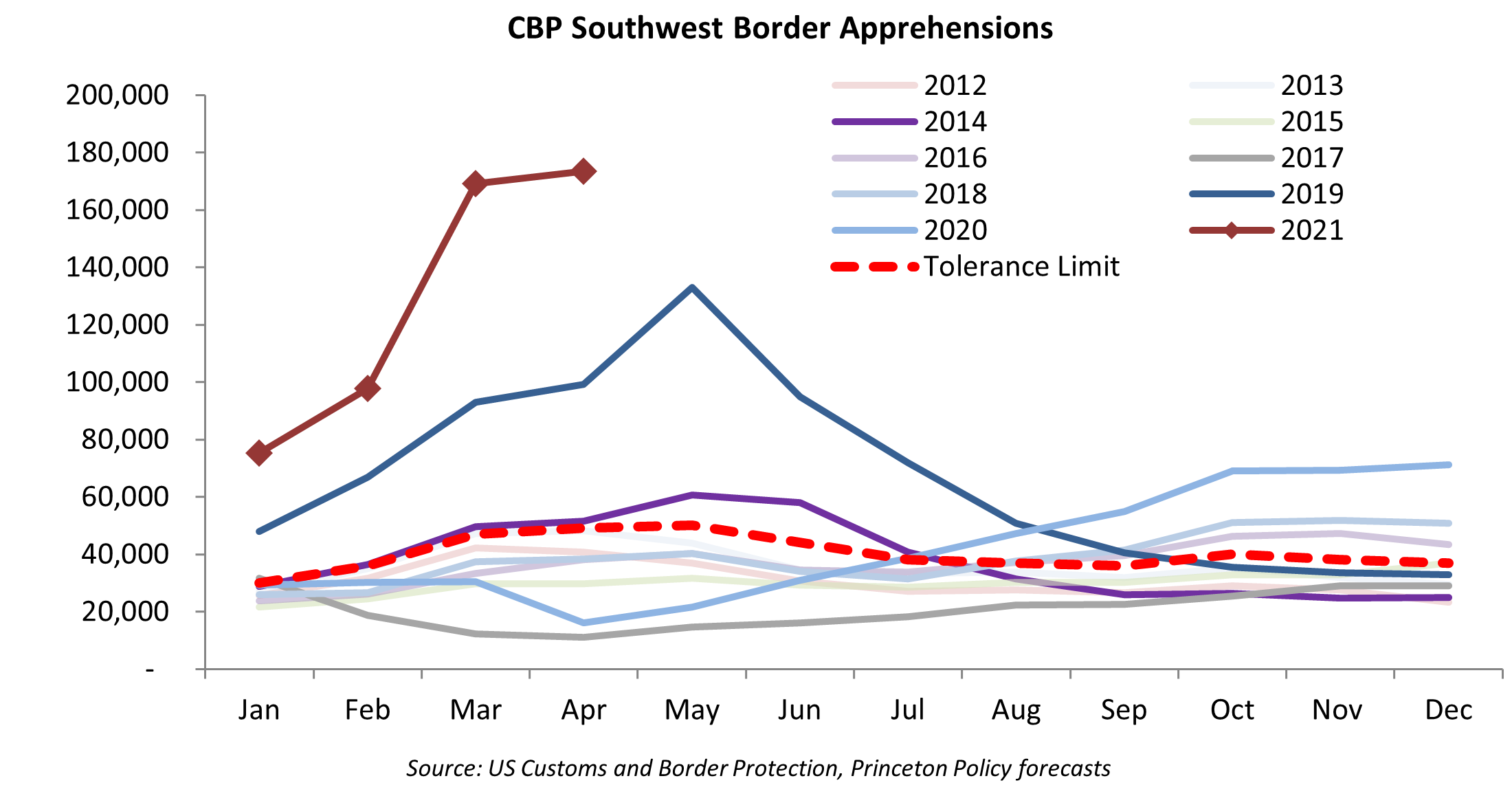
Putting a charitable interpretation on these numbers is well nigh impossible, for several reasons. First, the last four months' apprehensions are ghoulishly high, a stark aberration in the historical record. Southwest border apprehensions under Obama, in pink, and Trump, in blue, can be seen on the graph below. To suggest that somehow the Biden administration lacks the tools of Obama or Trump is risible. The only way to achieve such stratospheric numbers is by a deliberate policy of holding the border open.

The seasonal pattern also shows a premeditated policy. In all but two of the last twenty-one years, June apprehensions were below May apprehensions. The case is just the opposite this year, suggesting that extraordinary factors -- like an open border -- are stimulating continued and counter-seasonal flows of illegal immigration.

June 1.png

Further, the historical comparison with 2000 also suggests the administration is holding the border wide open. While the year 2000 started hot, the Clinton administration was working to suppress border traffic, and indeed, the results can clearly be seen in the 2000 monthly data on the graph below. Apprehensions decreased essentially throughout the year.

In the current case, apprehensions have risen from the January base and stayed high, indeed, increased a bit in June. This tells us that the Biden administration is not taking the steps the Clinton administration did, again suggesting a deliberate policy of keeping the border wide open.

June 2.png

Our forecast for the balance of CY 2021 assumes a decrease in apprehensions following the precedent of 2000. In such an event, apprehensions at the US southwest border would total 1,581,000 for FY 2021 and 1,690,000 for calendar year 2021. The fiscal year figure would be the third worst in the historical record, and for the calendar year, the absolute worst in the historical record by nearly 100,000.

I would note that this implies apprehensions taper off in the balance of the year in a manner similar to 2000. They are showing no signs of doing so at the moment. Therefore, if apprehensions remain elevated near recent levels, both fiscal and calendar year 2021 will enter the history books as records for illegal immigration. By any reasonable measure, only a deliberate policy of holding the border open could achieve such an outcome.

June 3.png

A similar pattern, albeit from a much lower base, can be seen with inadmissibles, those showing up at official crossing points without proper documentation. Inadmissibles are again soaring, more than twice April's level, suggesting that migrants are finding some success on that side as well.

June 4.png

In any country, a leader has two fundamental responsibilities to the public. The first is the protection of the country from invasion from or conquest by external forces. The second is protecting the public from disruptive internal forces, like crime and terrorism. That the Biden administration would deliberately leave the border open constitutes a fundamental dereliction of duty and is shocking, appalling and an affront to the public.

I have no idea what the administration has in mind, but clearly they have decided to play all-or-nothing. Win or lose, it is not a fitting posture for a US president.

Cuba: The Opposite of Communism is Corruption and Authoritarianism

My involvement with illegal immigration stems from my time in post-communist Hungary, which provided both daily and professional experience in black markets, including black markets in labor. In addition, working in a country transitioning from communist to capitalist ideologies afforded a unique opportunity to witness the associated societal impacts. These led me to develop the conservative theory which I use for much of my analysis, including for illegal immigration, improving national governance, and today, the prospects for a post-communist Cuba.

As readers know, we treat the term liberal as 'pertaining to the individual', and conservative as 'pertaining to the group'. People in a group setting often have specific roles. For example, if you are a member of the military, a soldier, you are expected to fight the enemy in that capacity. Moreover, you are expected to fight as though your personal priorities did not exist, to risk and possibly lose your life in the service of the group. This is normally referred to as duty or, in our terminology, as agency. In a group setting, you are supposed to act as an agent of the group as though you as an individual (principal) did not exist. When we use the term 'work', for example, we mean that the individual is focusing all his energies as an agent on satisfying his employer's demands, rather than his own as principal.

In a communist system -- as in black markets -- the agent is typically divorced from the principal. Doing well is not the same as doing good. The cause is simple. Under communism, prices are set below the market-clearing level and private enterprise is not permitted. This creates a shortage economy, resulting in a host of associated pathologies which will also apply to Cuba.

The list:

Corruption

Because the price of a good is set below the market price in a communist system, there is always a buyer willing to pay more than the list price. They will gladly pay this differential to the person selling the good, for example, the clerk or cashier. This is, of course, a bribe and makes the clerk a corrupt person, and they know it. A person selling goods in a communist system will be dishonest virtually by definition, and this is corrosive to both their own psyche and the culture of the broader society. Nor is this behavior limited to a single sector. If you needed surgery in Hungary's universal healthcare system, for example, you had to pay the doctor under the table. (But how much, and when? Expats never knew.) If you wanted to be fed in the hospital, you had to pay the nursing staff on the side for the food. The rot was everywhere.

Cronyism / Insider Dealing

The other option for disposing of below-market priced goods was to reserve them for a favored person, perhaps a relative or friend. In Hungarian, this was referred to as protekció, protection, and it means privileged access to goods, housing or jobs obtained through personal connections. For example, a shoe store clerk might set aside a pair of sneakers for his brother-in-law.

Lying

Because the state-owned companies which characterize socialist systems ultimately depend on government funding, capital expenditures are driven by national budget constraints rather than customer preferences. For example, I once flew the Hungarian national airline, Malev, from Budapest to New York, and the entertainment system was not working. Upon my noting this, the stewardess responded that the system had just failed and would be replaced when the aircraft returned to Hungary. Six weeks later, I flew back to Budapest on the same aircraft, and the system was still broken. I asked the stewardess, and she replied that the system had just broken and would be replaced when the aircraft returned to Budapest. How often had she said that to passengers? Probably hundreds of times, every time knowing she was a liar. Forcing an employee into this sort of behavior makes people bitter and jaded, which many Hungarians were.

Stealing

Because prices were set below market, many state-owned enterprises routinely lost money to be made up from the national budget. As a consequence, however, it was well nigh impossible to tell whether a company was well-managed. Governments are not profit-maximizers, but rather budget-sufficers. No one in parliament knew whether stealing was occurring, or more precisely, much cared. For example, the fuel vendors at Budapest's Ferihegy Airport signed out the jet fuel in liters and sold those liters at official rates. However, fuel expands with the heat of the sun, so they were able to sell and pocket the difference in volume. The CFO of the company could have detected this (fuel should be sold by weight), but his pay was not tied to performance and wage rates were low, so this practice was allowed to continue largely undisturbed. Asset managers for the government were clueless about underlying realities, because, of course, they had no expertise in the business. Nor did they wish to look too hard, for perhaps someone at a higher level was getting a piece of the action, and they feared stirring the hornet's nest. Thievery was therefore ubiquitous at state-owned enterprises, that is, virtually across the economy during the socialist era. Hungarians are not an inherently dishonest people, but many of them were petty thieves, because that was the everyday reality they experienced in a shortage economy with pathetic wages.

Indolence

Employees were in fact often lazy, because they were not paid more for better work; if they worked less, they could not easily be fired (except for political offenses). Meanwhile, customers were paying below market anyway, so if there was a shortage or quality was poor, well, the customers had no choice in the matter. There was no competition. As a result, there was little workplace discipline in terms of efficiency or effectiveness. Part of this was by design. In the PREPA example in the previous note, the company was stuffed with excess employees, which by definition meant that many of them were effectively redundant. They were hired to be lazy, in effect.

Cynicism

Hungarians were extraordinarily cynical. There was always the presumption of a hidden agenda, in our terms, that a given agent was just pretending to be acting in that capacity, and in reality providing a smoke screen to cover their own pecuniary activities as principal. Whatever the official line was, it was all orchestrated to further the personal goals of the people pulling the strings. Of course, the stewardess in the example above would have developed an acute sense of cynicism, as did the passengers who regularly flew on Malev. Anything written in the press was assumed to be a lie, or at best, a distorted half truth. This was captured in the Soviet quip that there was no truth in ‘Pravda’ (the truth) and no news in ‘Izvestia’ (the news), these being the Soviet Union’s leading dailies at the time. The sentiment was wholly shared by Hungarians.

Despondency

All this made people despondent. They drank too much, smoked too much and felt they had too little control over their own lives. Governance for most of the public was about victimization by the communist elite. And that's how the Cubans feel.

A Degraded Culture

These attitudes do not simply disappear when communism falls. For those who grew up in the system, say, above 40 years old when communism fell, their behavior did not change, even though market incentives did. Older managers still treated employees as shiftless, lying, corrupt and incompetent thieves. And moreover, the public continued to believe and expect that governance was about exploitation, as did the political class above them. Therefore, hopes that communism would be replaced with flourishing liberal democracies were largely frustrated. Corrupt and nationalistic regimes were the more common outcome, for example in Hungary and Russia, both of which flirted with more open democracies for a time.

The Outlook for Cuba

The eastern European experience suggests that any post-communist Cuba will not become a thriving liberal democracy, but rather a typical, poorly governed Latin American democracy or a military -- but not communist -- dictatorship*. We can forestall such an outcome by presenting any new government with a system explicitly rewarding economic growth with material, financial incentives at the personal -- principal -- level. That is, after sixty years of communism, we rejoin the agent to the principal -- doing good to doing well -- and establish habits of thinking of governance as helping the country move forward, rather than helping oneself to the fruits of the treasury.

The Centrality of Prices and Markets

Note that all the ills of communism listed above can be traced back to just two sources: a ban on voluntary transactions and the elimination of market prices. It is hard to overstate the importance of voluntary interactions -- free markets and prices -- in establishing a civil society characterized by the conservative virtues of honesty, integrity, responsibility, industry, faith and optimism. Free markets create the habits of and belief in service to others. A free market not only represents the best outcome in classically liberal terms -- the best for the individual -- but also in classically conservative terms with respect to the morale and culture of the group, the country in this case. Prices and markets are that important to both classical liberals (libertarians) and conservatives -- but of course, for different reasons.

The Implications for Illegal Immigration

In my writings on illegal immigration, I emphasize the importance of on-demand visas at market prices for just this reason. These will create both a functioning market and social order. Consider how a market-based system would change the nature of those coming across the border. The current system favors migrants with the most courage to undertake the perilous journey and the greatest willingness to break the law and live for years under effectively illegal conditions. By contrast, in a market-based system, those with the best qualifications will have the edge. These include English language skills, appropriate industry experience, and solid references both from the home country and from US employers. By giving the migrants the freedom to come work in the US when they like, we also provide them the incentive to improve their resumes to compete on non-financial terms. As a conservative, how would I feel about a Guatemalan laborer who speaks decent English and has impeccable credentials? The words colleague, neighbor and fellow citizen come to mind. Paradoxically, a system which provides the greatest initiative to migrants also represents the most conservative alternative, achieved by pushing the incentive to invest in human capital back onto the migrants themselves. (I would note parenthetically how well this would mesh with an incentive system for Central American policy-makers which rewards them for creating GDP growth, part of which would result from investing in human capital.)

Free markets and freely set prices are critical to the health of society, not only in economic terms, but also to ensure essential conservative values. These will be enough to bring dignity to Cuba's people, but the country's politics must also be professionalized, by tying pay to outcomes, to create a Cuba capable of both reaching its own potential and serving as a proud friend and ally of the US.

* President Biden described the Cuban government as an 'authoritarian regime'. This is a mischaracterization. China and Russia are authoritarian regimes. In such regimes, both voluntary transactions and market prices are permitted, but challenging the power of the autocrat is strictly prohibited. By contrast, in a communist regime, both voluntary transactions and market prices are prohibited. North Korea and Cuba are thus communist regimes. Venezuela falls into a middle zone, with prices set below market, but without banning voluntary transactions in other respects. We would expect to see phenomenal levels of black market activities in these latter three countries, but not in, say, China or Russia.

Border Enforcement Trends: Drugs v Illegal Immigration

My friend Jim Chilton sent me a link to his hidden camera videos of smugglers crossing his property. Jim is a rancher with a spread astride the Mexican border, and his property has historically served as a conduit for smugglers entering -- and leaving -- the US. Worth a look if the topic interests you.

The overwhelming share of smuggling across the unsecured border used to be marijuana, and at Jim's ranch, it probably still is. Elsewhere at the border, though, times have changed. Seizures of marijuana by Border Patrol over the unsecured border (that is, not at official crossing points) have declined by 93% since 2012. The reason is simple: We have swapped an enforcement-based regime for a legalize-and-tax system conceptually similar to market-based visas. The legalization of cannabis has made low quality Mexican pot redundant, effectively ending its smuggling into the US. At the same, marijuana legalization has not destroyed America as we know it. A legalize-and-tax regime for marijuana has largely secured the southwest border with relatively minor side effects on the broader US society.

Index Drug Illegal Imm.png

Now, take a look at categories still under enforcement-based regimes. Hard drug seizures are nearly three times the level of 2012. Doesn't look like we're winning the war on drugs, does it? Border Patrol apprehensions of illegal immigrants are even worse, running nearly four times the level of 2012. If we used a legalize-and-tax regime -- market-based visas -- to channel the migrant labor market, the southwest border for illegal entry would look like it does for marijuana, with illegal crossings decreasing by perhaps 90-93%, say, to 40,000 per year from the 1.3 million we project for FY 2021. Therefore, the answer to the question of whether we can use a legalize-and-tax approach to end illegal immigration across the southwest border is 'yes'. Yes, we can. We can end illegal immigation by creating a channel to allow acceptable flows of labor across the border. We don't need walls, legions of Border Patrol agents, or MPP centers. We need a working market-based system.

'Root Causes': Incentive Pay vs Corruption Task Forces

Since the administration is focusing on corruption as a 'root cause' of illegal immigration, let's discuss it.

Black markets and corruption are different manifestations of the same problem, and therefore we use similar approaches in addressing them.

In a well-functioning society, doing good and doing well are largely the same thing. Working hard and faithfully at your job -- for which you are paid -- is both good for the individual and good for society. In some circumstances, though, these two elements are split. Illegal immigration is one such case, where a prohibition means that doing well -- earning money in a job an employer needs done -- nevertheless is not good, because the government has deemed this sort of transaction to be bad and illegal. This then interjects the vocabulary of morality, and the debate devolves into a good-versus-evil framework. (In technical terms, the principal is split from the agent. For those interested in a more formal presentation of the theory involved, see slide 16 of the linked presentation. And if you're interested in where you fall on the political spectrum based on our framework, see slide 4.)

Doing good and doing well are similarly divorced in the case of corruption. Ordinarily, a politician is elected -- hired -- to serve the interests of the community faithfully for the salary provided. Alas, this simple, straightforward definition contains the seeds of corruption. First, there is no agreement on what constitutes 'serving the interests of the community'. Some want redistribution from the top down. Some want efficient, low cost services with plenty of space for individual initiative. Some prioritize cultural cohesion. Politicians can flip among these objective functions at will and therefore cannot be held fully accountable for any of them. For example, the current Biden climate infrastructure initiative can be justified on the basis that it protects society from some indefinite but drastic future outcome; on the basis that it will make us all better off economically; and on the basis that it will provide 'good, union jobs'. So which one is it, really? As a practical matter, enforcing accountability is hard, because there is no single standard by which a politician's performance can be judged.

Furthermore, politicians are typically grossly underpaid. Consider: The US House and Senate majority leaders make less than a first year associate at a top US law firm. The salary of the president of Honduras is about $50,000 / year. Certain groups and persons will find it easy to outbid the public for the attention of politicians, including senior decision-makers, particularly in emerging economies like those of Latin America.

These two factors -- low wages and a lack of specific, accountable goals -- create the preconditions for corruption. Pay is too low and wiggle room is too much.

During her Guatemala visit, the Vice President called for enforcement-based measures to counter corruption. This involves setting up a task force, one supposes within Guatemala in this case, to track down and punish those involved in corruption, and thereby deter such corruption and compel politicians to act in the public interest, however that may be defined.

To even write this down is to question its plausibility.

In emerging economies, corruption takes place in many forms. Police take bribes; municipal bureaucrats shake down local businesses for building permits. However, the corruption to which the Vice President alludes is larger scale, systemic corruption. (Of course, in Central America, corruption associated with narcotics is rife. For those interested, I would refer you to my earlier analysis of the topic.)

Garden-variety systemic corruption is typically associated with government procurement, notably related to infrastructure, defense, and state-owned companies. A relative of mine, an honest and honorable man, was minister of infrastructure in Hungary in the mid-1990s. When his party returned to power some years later, he was again offered the position and turned it down. I asked him why he would decline such an important and prestigious post. He answered, "Steven, literally every person who walked through my door offered me a bribe. It was too stressful. I couldn't take it." These bribes were no doubt offered by companies without respect to nationality, including companies from the United States. A vendor simply cannot risk losing a big contract for failing to offer to grease the right hands.

Such contracts, however, usually require approval on a national level, and therefore all the key cabinet ministers would be involved. The decision would be collective and therefore any payoffs would be collectively distributed. In many cases, certainly in Hungary, ministers have long-standing relationships with each other, often from childhood. In such a construct, an honest official anywhere near the top cabal is a mortal threat. Therefore, only the corrupt would be allowed anywhere near the inner circle. To become part of this circle, one has to become a 'made man', which in this case means that the individual must not only be involved in corruption, but to be witnessed doing so before the others in the group. This is how the cabal buys omertà, the silence of co-conspirators, by ensuring that, should a member turn on them, they also have sufficient information to send the informant to jail. In this sort of system, the entire leadership will tend to be corrupt and honest officials will be actively purged from the senior ranks of government. This is true no less in Latin America than in Hungary.

It is into this sort of environment that the Vice President is proposing an anticorruption task force. One in which a corrupt cabal controls the executive and legislative branches, the army, the police, the intelligence services, often some critical companies, and with a bit of persuasion, the judiciary. One in which the backbenchers in the legislature depend on the patronage and trickle down graft of political leadership and therefore have an incentive to stay in line. An anti-corruption initiative might have success from time to time, but it will consistently lose over the longer term, and it will lose because the issue is not the morality of the players, but rather the structure of compensation. As with the black market of illegal immigration, an enforcement-based approach -- and an anticorruption task force is exactly that -- is doomed to fail.

Nor does a task force address issues which may be both popular and corrupt or which may be legal but thoroughly antithetical to economic growth. Among these are constraints on trade, for example, high import duties. Import duties may protect infant industries in theory, but more likely they provide windfall profits for domestic producers, profits which businesses would ordinarily be willing to share with those politicians who granted the franchise. High tariffs also make it much more difficult to build industries based on imported goods. For example, the high cost of living in Costa Rica is cited as a chief reason for expats to leave the country, and high import prices are a principal driver of expat costs.

Corruption is also often associated with state-owned companies. Take, for example, Puerto Rico's electric utility, PREPA. In in Puerto Rico as in much of the rest of the world, governments are incentivized to set selling prices below market and to stuff such companies with unneeded employees to secure union support and to provide phantom employment for relatives of politicians. If the wife of the governor is hired as a public relations consultant to, say, PREPA, is that corruption? If the Puerto Rican government decides to keep electricity rates below full cycle costs and staff the power company well beyond its actual needs, is that corruption? Or is it popular public policy?

State-owned companies compensate for artificially low selling prices and excess expenses by reducing capital expenditures. Management can always make existing equipment last another year with some patching up. But as a result, entire sectors wither over time. PREPA's generation and transmission network was creaking before Hurricane Maria obliterated it entirely. Without continuous power, attracting manufacturing, hospitality and IT-related industries is hard. An e-commerce business cannot function without the internet. A hotel-based tourist industry cannot flourish when the electricity for air conditioning is unavailable on hot days.

Many factors beyond garden variety corruption influence economic growth, and some of the key issues remain entirely outside the mandate of an anticorruption task force.

One of the interesting features of consulting to emerging country governments, indeed, most governments, is the lack of demand for good policies. Economists and consultants often push good policies, but they are rarely demanded. And the reason is simple: New policies involve risk and effort, and they are often unpopular in the short run. Why should politicians extend themselves if their pay will be the same either way? History shows that they won't. Instead, in Hungary for example, we consistently saw bureaucrats and politicians seeking to maximize immediate political acceptability subject to budget constraints. And it may not be so different here. Consider: As part of the administration's 'root causes' initiative, USAID will provide up to $7.5 million over three years to support entrepreneurs and innovators – including women, youth, and indigenous people -- in Guatemala. Does anyone at all think this will prevent even one person from migrating from Guatemala to the US? Such a feeble offering is no more than a bone to throw at the press to signal political acceptability subject to a very small budget constraint. It is not going to help solve the problem, and it is not intended to. The initiative is merely a symbolic gesture in a void of policy and analysis.

Performance incentives can address these issues. If economic growth creates prosperity, and prosperity reduces the root causes of illegal immigration, then pay for economic growth. Imagine that for each percentage point of GDP growth above some threshold, national elected officials would receive a pro rata bonus. If this were, for example, $25,000 per legislator for each percentage point of growth over 3%, then the incentive program would cost around $30 million per year, assuming Guatemala's GDP growth rate were 10% per annum. A growth rate of 10% for a decade would materially end the economic incentive for Guatemalans to illegally immigrate to the US (which I will discuss under another header).

Incentives also address critical issues which anticorruption task forces do not. The first of these is mission. Legislators are elected to represent the people. But what is that? When a representative arrives at the country's congress, what are they supposed to do? Incentive pay provides a clear mission: the objective of the legislator is to create sustainable prosperity. You would be surprised how far that simple self-awareness goes.

Second, performance pay would create advocacy for growth across the entire legislature, not only in the ruling party or coalition. This will change the balance of power. In the current system, a typically corrupt cabal at the top holds inordinate power. If material bonuses are available at lower levels for performance, and these bonuses are applicable to the opposition as well, then back-benchers and the opposition would have an incentive to support pro-growth policies. Note that this does not directly address the matter of corruption, and as so often in our policy advice, we don't care. Corruption can be a mere transaction cost like legal or investment banking fees. That will not materially affect growth. It certainly hasn't in, say, China. Rather, the issue is the nature of the underlying project. If corruption leads to the building of a bridge to nowhere, then the damage is not the bribe of, say, 5% of project cost, but rather the other 95% of the project outlays. Similarly, in Hungary, excessive demands for bribes across multiple bureaucracies -- in some cases, totaling more than 100% of project costs -- would prevent important projects from progressing at all. Bureaucrats are often not only corrupt and venal, but collectively stupid. Again, a legislature motivated by bonuses would provide a counterweight to such inertia.

A key feature of an incentive plan is that it does not limit decision-maker flexibility. One of the problems of, say, IMF stabilization programs, is their harsh and dogmatic nature, which often undermines their longer term viability. In Hungary, I again and again saw that outsiders did not grasp local politics. Conditions on the ground mattered. An initiative which was impossible in, say, October, would sail through the legislature the following April. Incentives create demand for good policy, but they do not limit decision-makers ability to make bad policy, because sometimes that is what the public wants. Let the locals determine the nature and sequencing of policy, with the understanding that they will be handsomely compensated if they can create sustainable growth.

Importantly, an incentive plan makes polarization and demonization expensive. Imagine, as a hypothetical, that every elected official in the US House, Senate and White House would receive a $2 million bonus if a legalize-and-tax approach to migrant labor were passed. Do you think we might see a miraculous meeting of the minds and a reduction in the victims-and-criminals rhetoric which characterizes this topic? If you extended this bonus to the top 50 people working on illegal immigration in the US, do you think this would help us get over our policy differences at the think tank level? (And the payback period to the federal budget? Seven weeks. A properly run market-based visa program would pay back $1 billion in bonuses in seven weeks.) In Hungary, I worked with communists and fascists, and I can tell you that every one of them would willingly trade their mothers for a decent bonus. Create a financial incentive for cooperation, and even those who disagree with each other -- as is common in business organizations -- will find a way to work together and temper their rhetoric. We do not need to purge fascists to get rid of fascism or sideline socialists to end socialism. We need to change the rules of the game, not the players. Change the rules, and the players are all but irrelevant. Try to change the players -- as with anticorruption task forces -- without changing the rules, and new players will not lead to better behavior. The last fifty years of governance in Latin America should be enough to demonstrate that point.

No doubt many of my readers will be aghast at the notion of pay for performance in governance. These same readers will, however, decry corruption, polarization, inertia and poverty. Moreover, if you are reading this, you have almost certainly given up any hope of good governance in Latin America, probably decades ago. And this may prove true. But until we actually convey our desires in quantitative terms — maximizing GDP growth — and offer material compensation for achieving these goals, we won’t know whether Latin America governance can be improved. So let’s take the basic steps first. I would bet a substantial sum of money that a compensation-based system would work just fine.

Kamala Harris has 'no answers'. Or does she?

The Vice President has been drawing no end of flak for the last two weeks. To start, the Vice President's trip to the border was poorly received. Take, for example, the reaction of Fox's Chris Wallace :

"Well, we did hear one solution. And that is that nobody is going to be able to ask Kamala Harris, 'why haven't you been to the border yet,'" Wallace said during a Fox News panel discussion about the border.

"She has now been to the border. So she took care of that. But on the question which I think most Americans are asking, which is how are we going to prevent hundreds of thousands of people from coming across the border illegally as they have since Joe Biden became president, there really were no answers there," Wallace said.

As an analyst who follows developments on the border, I am frankly baffled at the administration's approach. Is Kamala Harris avoiding the border because the administration's policy is to deliberately let migrants enter the US interior? Is this administration actually running an open borders policy? Read Todd Bensman's take on the issue. It's hard to avoid that conclusion. Therefore, is the issue Kamala Harris's lack of answers, or is it that the administration already has one? It seems the Biden administration is deliberately keeping the border unprotected and open.

This will not end well. The administration's own position is that it 'has no answers' and is impotent and intellectually bankrupt on illegal immigration, or alternatively, that it is actively anti-law enforcement, seen both in gun violence and at the border. This approach risks Jeremy Corbyning the Democratic Party. Corbyn was the leader of the Labor Party in Britain heading into the 2019 election and pegged as unelectable looney left. And, indeed, Boris Johnson trounced Labor on what was supposed to be a re-think of a rash decision on Brexit. Here's the BBC's commentary on election night last December:

On the night, the Conservatives won a big majority, sweeping aside Labour strongholds across northern England, the Midlands and Wales in areas which backed Brexit in the 2016 referendum. Some traditional Labour constituencies, such as Darlington, Sedgefield and Workington, in the north of England, will have a Conservative MP for the first time in decades - or in the case of Bishop Auckland and Blyth Valley - for the first time since the seat was created.

At 33%, Labour's share of the vote is down around eight points on the 2017 general election and is lower than that achieved by Neil Kinnock in 1992.

President Biden's big government policies are reminiscent of those of Neil Kinnock, another failed Labor leader, or say, US House Speaker Tip O'Neill (1977-1987). But communism has since fallen and working class whites have deserted Democrats to form the backbone of the modern Republican Party. It's not 1987 anymore, and the Democrats and British Labor Party have had success when they held the center. Today, the political center appears to run to the right of Mitt Romney, and perhaps even to the right of Liz Cheney. That's how much the world has changed. We can see these trends in, say, Hungary, where the right regularly commands 70% of the vote, or in historically tolerant Denmark, which has turned almost frighteningly anti-immigrant. Western society is aging rapidly, and an older society will be more conservative. The trend line is running against far left Democrats.

The Republicans, if they can get past Donald Trump (not a given) and keep their mouths shut (not a given), could do very well in the midterms, and the Republicans could become the natural party of governance again by highlighting Democrats' chosen policy of helplessness and unwillingness to provide public security, whether on the street or on the border. The Biden administration is painting the Democrats as a party unfit to govern, because they do not believe in governing.

For long-established, undocumented immigrants in the US, this is an unfolding disaster. True, the House passed the American Dream and Promise Act (H.R. 6), but it is going nowhere in the Senate. Meanwhile, the administration's border policy is discrediting the entire concept of amnesty. How should those of us looking for balanced and ordered policy respond to the objections of conservatives? Heritage has argued that any amnesty will encourage a new torrent of illegal immigration, just as it did after IRCA was passed in 1986. By contrast, CATO's analysts argued prior to the pandemic that the danger had passed, that illegal immigration was no longer a problem, and that therefore amnesty would not be an issue. With illegal immigration at twenty year highs, Heritage has won this debate for years to come. Nor will the Democrats have any credibility as negotiating partners. If the left is seen not only as accommodating on amnesty, but actively and surreptitiously undermining border security, will they be seen as acting in good faith for any policy initiative that conservatives might accept?

The left would do well to remember that US illegal immigrant policy is one of 'don't ask, don't tell'. ICE data shows us that, if migrants can successfully make it into the interior, they will enjoy amnesty as a statistical matter as long as they do not otherwise fall afoul of law enforcement. ICE's staffing levels are set to achieve this outcome. But add another 10,000 ICE agents, and the undocumented will be living in an entirely different world. It's not only the Democrats who can subvert the status quo. And should one think the public's tolerance is unlimited, check out events in Denmark.

In all this, where do the advocacy groups stand? What are the NILC or fwd.us doing? If their thinking ends at passing HR 6, they may well be condemning undocumented immigrants to another decade of living in the shadows. Windows to pass normalization for the undocumented are few and far between. The last occurred in 2012, now almost a decade ago. The Democrats have another year to pass legislation. After that, the left is unlikely to control both houses and the executive branch for many years to come. Should the advocacy groups be contemplating a Plan B? Do they need an approach which could work across the aisle, one that embodies problem-solving rather than winning or losing?

Meanwhile, VP Harris's weak performance at the border has metastasized into a full blown crisis engulfing her staff and perceptions of her character and competence. Failure in one policy area has called into question her capabilities more broadly. Could she use a better plan on border policy to shore up her disastrous political state?

One would certainly think so.

Kamala Harris's Tour: Disaster born of Pessimism

The press yesterday continued to pound the Vice President regarding her performance in Latin America.

From The Hill:

Biden allies and even some people close to Harris said they viewed her trip to Guatemala and Mexico as a “disaster,” as one put it. They said they were left wondering why she seemed so ill-prepared to handle basic questions like “Why you haven’t been to the border?”

“It wasn’t great,” said one longtime Biden ally. “A little cringeworthy too. I don’t know how they weren’t preparing for these questions.” Another ally was blunt: “It was terrible. I don’t know how else to say it.”

Slate asks Is Biden Setting Harris Up to Fail?

John Cornyn, Republican senator from Texas, said to me that he feels like Biden handed her a grenade, pulled the pin, and walked away. Politically, no one wants to touch immigration. It’s bad news to try to say that you’re going to fix the problem because it is such a complicated and seemingly intractable problem. That’s unfortunate.

This theme of intractability recurs in the article in The Hill:

Since the border is not a problem that can be "solved," one measure of Harris’s political skills will be how she studies it, issues a report and shunts responsibility back onto the Department of Homeland Security and its Border Patrol with as few people noticing as possible, said Cal Jillson, a professor of political science at Southern Methodist University.

Let's be absolutely clear. ​Illegal immigration is a man-made disaster, the direct and entirely predictable consequence of the Hart-Celler Act of 1965. Illegal immigration does not exist despite government policy, it exists because of it.​ To suggest it is intractable is risible and flat out wrong.

Ending illegal immigration is easy both in theory and in practice. Ad absurdum, we could simply give an H2 visa to whomever shows up at the border. In a more practical vein, the CATO Institute's David Bier recently suggested this approach:

[Many] factors affect migrants’ decisions, including perceptions of U.S. policy. But policymakers should not ignore the strong relationship between migration and jobs. One partial solution to control this migration already has a precedent. Congress should duplicate the success that guest worker programs have had at controlling illegal migration from Mexico. These visas are mainly for workers performing seasonal farm and nonfarm jobs under the H-2A and H-2B visa programs. With the option to enter and work legally more widely available, fewer Mexicans are choosing to cross illegally.

The 'intractable' part is making an offer to Republicans sufficient to induce them to increase the visa count. Because visas are issued vastly below their market value, migrant labor is a cost center for the government, and lawmakers have little incentive to authorize more visas. Why should lawmakers and US citizens authorize more visas when the windfall profits from these go to employers, migrants or recruiters, with the government left to pick up the tab? This then creates the current conundrum: an insufficient number of visas resulting in a black market in labor with all the associated manifestations: caravans, cartels, border jumping, fake asylum claims and the rest.

By contrast, if we allow the price of the work visa rise to its market value and size the visa offering to the quantity necessary to close the southwest border to illegal immigration, Republicans will have achieved their principal goal: ending illegal immigration across the southwest border. Further, if every incremental migrant represents net revenue to the government, Republicans should be amenable to expanding the program to the extent it is functioning acceptably otherwise.

None of this is rocket science. It is not new, strange or unimaginable. It is nothing more than a straight-off-the-shelf, legalize-and-tax policy.

But Kamala Harris does not know this. Like most of the rest of you, she sees illegal immigration as an 'intractable problem', a radioactive topic to be avoided to the greatest extent possible. And so a trip away from the border to Guatemala and Mexico, to chide leaders about their governance standards and lament the 'root causes' of immigration. But she wants no trip to the border, where sheriffs, mayors and border patrol agents -- and, yes, the press -- are going to ask why the Biden administration is allowing the hemorrhage of migrants over the border. Better to limit engagement to a quick trip to Latin America and then go back to your day job. That's why she was so unprepared. Why prepare for something you can't change?

This deep pessimism about illegal immigration is hurting us. It hurts the poor and vulnerable. It creates divisions in society. It means the Vice President has checked out on the topic and has damaged her reputation with the public.

And yet illegal immigration is not hard to solve. ​We need to liberalize the market, to let the visa price rise to its natural level, while understanding that we have to issue enough visas to keep the uncontrolled southwest border closed to illegal immigration.

And you -- you -- should ​sit back, take a breath, and consider that there may be another way to fix this problem. You need to be hopeful, optimistic and open-minded, because it is the conviction that the problem is intractable which is the greatest impediment to its resolution. That's the lesson of Kamala Harris's trip south of the border.

May Southwest Border Apprehensions: The Torrent Continues

US Customs and Border Protection today reported southwest border apprehensions for the month of May.

In May, apprehensions at the southwest border declined by 1,675 to 172,011. This was the highest for the month since 2000, as far back as our monthly data goes.

May 2021 Appre.png

Interestingly, inadmissibles -- those showing up at official crossing points without necessary documentation -- surged in May. These rose by 55% compared to the previous month and are now above normal, with normal defined as the 2012-2015 average.

Three explanations come to mind. First, the organic apprehensions rate may be declining and inadmissibles are returning to normal with the end of the pandemic. That is certainly possible.

Alternatively, some apprehensions may be being reclassified as inadmissibles to make the former look more favorable. That is, with higher inadmissibles, the apprehension rate appears to be declining, if only modestly.

Finally, some of those who would have tried to enter illegally between official entry points may now be finding it productive to try their hand at official entry points. That is, some migrants are finding that they are gaining entry without papers even at official border crossing stations. The rapid rise in inadmissibles suggests that this may be the case.

May inad.png

​For the calendar year as a whole, we are projecting 1.2 million southwest border apprehensions​, much as we have for the last two months. This would make calendar year 2021 among the ten worst years for illegal immigration in US history and place us squarely back into Clinton era numbers.

I would note that any number of immigration analysts claimed that the illegal immigration surge of the 1980-2005 period was over and would never happen again. By contrast, we argued that relative wages, the number of US job openings, and the intensity of border enforcement would determine migrant flows. If the jobs were on offer, the migrants would come. And they are.

Inad Yearly May 2021.png

An alternative Guatemala speech for Kamala Harris

My name is Kamala Harris, and I am the Vice President of the United States.

Let me open by asking you a question: Who would like to work in the US?

[pause]

Who would like to work for any US employer, at any time, whenever you want, for up to nine months per year?

[pause]

Who would like to be able to do that for free?

[pause]

Well, I’ve got you there, because it’s not going to be free. Today, it’s not easy to get a work visa for the US. In the future, it will be easy, but not cheap. But I think the situation will be much, much better overall.

Let me give you a little history and tell you about where we would like to go.

In 1965, the US passed the Hart-Celler Act which ended the circular flow of Mexican migrants to the agricultural fields of California. But the jobs didn’t go away, and the Mexicans kept right on coming, as they had for decades. The border, though, became hard to cross, so migrants increasingly settled in the US without papers. Over time, these numbers became large and year-round and US employers became accustomed to hiring illegal labor. And that pretty much brings us up to date. Today we have ten million undocumented residents, seven million of them from Mexico and Central America. They are in the US illegally because they had no means of entering legally, even to take jobs most Americans did not want.

And they – you – are coming in large numbers again, both during the Trump administration and now during our administration. Why? Because the US has entered a period of demographic transition. Our older population is soaring and our workforce is stagnating. This is opening up vast numbers of jobs, particularly in the categories which can be filled by migrant workers. All of you know that. You know that if you can find your way across the border, you’ll immediately find not only work, but work which pays well.

So what should the US do? Some feel that we should strengthen border enforcement. And some feel that we should be a more humane and welcoming nation, and you know that we are trying to be true to those values in the Biden administration. But all that does not solve anything. It is just more of the same system we have used for more than half a century. The system does not work. It never has.

We need to try something new.

We can end illegal immigration by creating a legal channel for migrants to work in the United States. And that’s our goal. But the question remains, under what circumstances should we allow migrants in? Allowing everyone in will create massive unemployment and downward wage pressures among migrants and undocumented residents. So that won’t work.

We can reduce the number of migrants by charging a tax – a visa fee – to enter and work in the US. But what should that fee be? How many visas should we issue?

Well, if we want Republican support – and we cannot pass this legislation without it – then we have to close the southwest border to illegal immigration at a minimum. Consequently, we have to issue a sufficient number of visas to accomplish that goal, but we probably won’t get many more, at least at the beginning.

But that’s not enough. We also must prevent incoming migrants from creating unemployment and reducing wages. We can do that by issuing those visas at a market price – the price at which you value them. I think all of us here – all of you here – know that the right to work in the US on demand for the employer of your choice is a very, very valuable right. Think about the maximum amount you would be willing to pay for that right, and that’s pretty much how much it will cost. However, if you have passed a background check and can find a US employer willing to pay you enough to make it worth your while, you can come work in the US – come and go as you please – anytime you want. No need for caravans, asylum claims, cartel payoffs, trying to evade Border Patrol, or worrying about deportation. None of it. You decide when you want to work in the US and when you want to be here.

Let me touch briefly on technology, because it is so central to the whole system. We are going to run the system on smartphones like the iPhone, and we'll make sure you have one. This will enable you to keep in touch with employers and it will be your primary interface with the government, for example, to renew your visa or to let us know that you have left the US so we do not charge you for those days. It will also allow us to be in contact with you. We want to create the most transparent, best protected migrant labor market – forget 'migrant', the best labor market of any sort, period – anywhere in the world. We’ll be in contact with you every month to see how you are doing, and you will have to opportunity to sign up for legal services to protect you from visa, workplace and sexual harassment issues, among others. Help will never be more than a touch of the button away.

You’ll need an official bank account where you will be paid. But we will arrange that your family can draw from that same account here with small transfer charges. No more high Western Union fees. And you’ll have health insurance in the US under Medicare. So, yes, the visa will be expensive, but it will come with lots of great features designed to keep you safe, healthy and in control of your own life. It is the future, and it is better. A lot, lot better.

We will be asking Congress for one million of these market-based visas over three years. Perhaps 200,000 of these will be destined for Guatemala. That’s not everything, and almost certainly not enough from the Guatemalan perspective, but it is still a large number and a good start.

Now, let me give you the warning you've been expecting in this speech. You know that the Vice President of the United States is not going to visit Guatemala without some hard conditions. Here it is. If you are detained by US Border Patrol or any other US law enforcement agency after July 1st of this year – about one month from now – you will be barred from the new program for at least five years. And that’s true not only for Guatemalans, but for every other nationality as well, including Mexicans, Hondurans and Salvadorans.

Of course, you’re not going to just take my word for it. So here’s the calendar. We will be working through the details of the program for the balance of the year and hope to have legislation about this time next year. If you’re thinking of taking a shot at the border after the end of June, keep it in mind.

Finally, we have an important condition which will influence the governance of your country. All countries participating in the program will have to accept incentives for their executive and legislative branches that link their pay to the economic growth of the country. In plain words, your political leaders will be incentivized – heavily incentivized with performance pay – to maximize economic growth while minimizing the amount of debt the government takes on. In the medium term, these sums will be paid by the United States from your visa fees under the supervision of the International Monetary Fund and the US Treasury. The faster the economic growth here, the more your decision-makers will be paid.

At the end of the day, the best protection the US can have against illegal immigration is not fancy visa systems, but prosperity in your country. No matter how many visas we issue, that will not solve Guatemala’s problems. We need this country to grow faster. A lot faster. We want the Guatemalan economy to double in size over the next decade. If we reach that target, you will not be so interested in working in the US and we will have less of a problem with migrant labor. We want to make sure your leaders are fully committed to accelerated growth, and we’re going to pay them generously for it. The incentives will be aligned to produce a rapid increase in prosperity here.

Let me conclude by again saying how pleased I am to be here today. With God’s blessing, it will mark the beginning of a new era, both for those of you who want to work in the US and for those of you who choose to work here. We look forward to a better future – a better future for all of us.

Thank you.

Faster asylum claims processing is no solution

The Niskanen Center reports on a bipartisan effort to enhance asylum claims adjudication:

Chiefly due to the ongoing concerns about processing asylum seekers on our southern border, Senators John Cornyn (R-TX) and Kyrsten Sinema (D-AZ) and Representatives Henry Cuellar (D-TX-28) and Tony Gonzales (R-TX-23) introduced the bicameral, bipartisan Border Solutions Act of 2021 last month.

At a high level, the bill establishes four regional asylum processing centers where DHS and partner agencies conduct criminal history checks, identity verification, biometrics collection, medical screenings, initial asylum interviews and credible fear determinations, and provide legal orientation. There are also a fair number of additional protections for children placed with sponsors, including mandating that HHS check in on children within 30 days of their release to a sponsor with a telephone call, and then every two months afterward, and enhancing penalties for trafficking. A pilot program is proposed to increase expediency of the process and efficient review of cases, and there are provisions for increasing personnel across the board: from judges and asylum officers to CBP and ICE personnel.

What is the point of faster asylum claims processing? Is it to more quickly deport those making such claims? Is it to usher claimants into the interior more quickly to facilitate their integration the wider undocumented population? Does the proposal simply hope to provide greater comfort to migrants while they await claims adjudication?

Or perhaps the sponsors think we are overlooking many legitimate asylum claims from the Northern Triangle countries. Many poor people live in bad neighborhoods in the Northern Triangle, but this does not historically qualify as a legitimate asylum claim. Or if it does, then millions of people in the Northern Triangle deserve asylum.

All this once again frames illegal immigration in the perps-or-victims context. ​Is this necessary? Can we not simply treat migrants as people who would like to work in the US for higher wages? Must we put them into some moral category in the process?

More elaborate asylum facilities will not end illegal immigration. They will not address the status of undocumented immigrants. Such an initiative is no more than policy bankruptcy dressed up as constructive engagement, a Hail Mary pass hoping for something, anything.

The simple reality is this: There are lots of menial jobs in the US that our citizens do not want, but which pay seven times the unskilled wage in Honduras or Guatemala. As long as that is the case, migrants are going to find one means or another to get across the border. Closing off one channel (or is it opening one up?) will simply move the action elsewhere, as it always has. After fifty-six years of unbroken policy failure, surely the proposed answer is not 'Try harder'? That's the next big idea?

How about this: Lift the prohibition on migrant labor and move to the legalize-and-tax system which worked fine for alcohol, gambling and marijuana. Let's try something really radical for a change. Something like the textbook, proven policy solution.

April Border Apprehensions: Worst since Clinton

US Customs and Border Protection reported southwest border apprehensions for the month of April earlier this week.

The numbers continue to show a border in crisis. Border Patrol apprehended 173,460 illegal crossers at the southwest border in April, the highest for the month since 2000 during the Clinton administration. In that month, Border Patrol detained 180,050 persons.

April 2021 Appre.png

Based on prior years, January-April Border Patrol data would imply 1.0 - 1.2 million apprehensions for the year as a whole, similar to the 2004 - 2006 stretch.

And the numbers could go higher. In those years of crisis in the early 2000s, indeed for every year from 2000 to 2012 (with the exception of 2007, a year to bear in mind), April apprehensions were lower than those in March. This year, the trend is the opposite, with apprehensions rising 4,200 to April.

The data implies the reason.

An illegal border crosser coming to work in the US has a number of options for attempted entry. These include claiming to be a minor; entering accompanied by family, particularly children; or simply entering alone and taking one's chances with Border Patrol. The quickest, cheapest and least risky option is the entry of an adult male by himself -- if Border Patrol will allow him to enter the US interior. And this increasingly appears to be the case.

During the Trump border surge exactly two years ago, only 30% of those apprehended by Border Patrol were single adults traveling alone, and more than 60% of crossers came in family groups. The key to entry was bringing a child along. Those who arrived with children were let in; those without were largely expelled. Today, the numbers are exactly the opposite. In April, 62% of those apprehended were single adults and only 28% came in family groups. Clearly, entering alone today is far easier than during the Trump surge.

Moreover, the ratio of single adults to total apprehensions rose in April. In March, 57% of those apprehended were single adults; in April, this had risen to 62%, even as both the absolute and relative numbers of unaccompanied minors and families fell. In other words, in April, migrants were discovering that they needed neither to lie about their age nor bring along children to gain entry to the US interior. The data suggests entering the US interior has become easier even as the number of apprehensions continues to rise from already twenty-year highs.

This has any number of implications. The first concerns amnesty. Many analysts, including a number on this distribution list, have argued that granting amnesty to undocumented residents will no longer prompt a surge at the border, because all that ended in 2008. Given that we are now solidly tracking Clinton era numbers -- years when border apprehensions were at their highest -- no reasonable argument can be made that granting amnesty is unlikely to prompt illegal immigration. The US remains a huge draw for the undocumented, and anything that increases the appeal of entering -- for example, amnesty -- is likely to stimulate unauthorized border crossing. As a result, conservative and swing-state Democratic Senators like Joe Manchin and Kyrsten Sinema are likely to treat amnesty as radioactive. They will be in line with public opinion. In a recent Harvard-Harris poll, 80% of respondents deemed illegal immigration to be a very or somewhat serious problem for the US, with 47% saying "very serious". (See more at CIS.) If the border continues to hemorrhage, the public mood will likely continue to deteriorate, and moderate Democrats willing to support any kind of amnesty will be hard to find. Paradoxically, weak border enforcement undermines the case for amnesty.

Second, our model suggests that about 100,000 to 150,000 illegal immigrants are managing to make it into the US interior every month under the current regime, including those the Biden administration is releasing into the country but who will never show up for their court dates. Readers will note that I called for an H2-M visa program which would have allowed in an extra 1 million migrant workers over three years, about 350,000 of which would be allocated for a single year, say, 2021. We are probably already close to that in terms of illegal immigration, and certainly will be by early July. The US is likely to gain at least 350,000 ultimately undocumented residents this year -- and perhaps a lot more. Under a market-based program, in April alone, the US Treasury could have netted $1 billion in visa fees which instead will have gone to the Mexican cartels. We could have had background checks and completed paperwork for everyone entering the country, and south Texas and Arizona could have been spared the chaos at the border. There is a much, much better alternative.

I have warned my friends at Heritage, CIS and FAIR that an insistence on absolute sovereignty at the border is a losing proposition. Right now, conservatives are getting creamed, not because they have to be, but because they are unwilling to confront the reality that it is virtually impossible to beat a black market. The central issue of illegal immigration is a border with wages four times higher on the nothern side than the southern side. Moreover, the US is desperately short of workers at the moment (another Biden special), but in any event, the country will suffer structural shortages in minimum wage categories for the balance of the decade. The migrant who can make it over the border will have a job, and with the incredible upward wage pressure at the low end, maybe a job paying eight times the wages of the Northern Triangle countries. We are not going to beat the black market in migrant labor. We have never beaten the black market in migrant labor, and frankly, have not beaten any other black market either.

Conservatives must come to grips with the sober reality that, if we want to end the chaos on the border and the abuse of our immigration system, we need to recognize the wage differentials at the border and integrate those into a migrant labor model which also delivers on the critical conservative objectives of safety, propriety, conformity and compensation. It's not hard to do, and the Biden administration, working with some key Republicans, should do it.

For now, though, the border continues to spin out of control, with little sign of improvement anytime soon.

Conformity and Illegal Immigration

In designing policy, we employ ideologies in a consulting sense, that is, explicitly incorporating ideological considerations into the policy framework. Both egalitarianism (socialism) and free market liberalism are well understood. By contrast, conservatism has no functional definition, and therefore 'conservative policy' is easily mistaken to mean anything appealing to white, southern Christians.

We use liberal to mean 'pertaining to the individual' and conservative to mean 'pertaining to the group and its members.' Try that definition the next time you use or see the term 'conservative'. You'll find it helpful. For example, our definition makes FAIR and CIS conservative institutions in that their expertise is in membership policy. They are all about who is and can be a member of the group -- the country, in this case -- including the conditions for obtaining membership and sanctions for those violating membership rules, for example, deportation of illegals.

Our framework for ideology is entirely consistent with neoclassical economics and therefore allows us to explicitly incorporate conservative considerations into a given economic policy which may also have liberal and egalitarian (a form of liberal) components. It gives us a bigger toolbox and a new way to view old problems.

*****

In designing a market-based visa policy, I have referred to the ordinary conservative objectives of safety, propriety (legality), conformity (following customs) and compensation (paying one's way). All of these pertain to the relationship of the individual member to the group. (Confirm it for yourself.) In this note, I would like to highlight the issue of illegal immigration and conformity.

Yesterday's Washington Times carried a story about undocumented migrants riding the train across the US border, accompanied by the photo below.

Migrants on Train (April 26 2021).jpg

Is riding a train like that illegal, strictly speaking? Maybe not. But for the middle of the road suburban voter, it is surely inappropriate. It creates a sense of unease about these migrants, that they are rabble, an unwashed horde and a threat to society. Of course, this semi-legal form of transportation is part of the entire undocumented migrant journey, which also finds some illegals packed into tractor trailers or dozens to an SUV. It may not be illegal per se, but it brands these migrants as undesirables. And that branding casts a shadow on Hispanics more broadly. It influences the public's feelings not only about illegal immigrants, but also about race more generally.

In a market-based system, all this disappears, and migrants will use more conventional conveyances. From the Northern Triangle, most migrants -- even those in minimum wage jobs -- will travel to the US by air, just as in the photo below, from the Guatemala City airport.

Guatemaa City Airport.png

If you doubt that, do the math, and you will find flying is actually cheaper than the opportunity cost of trudging up Mexico or even traveling by bus. In a market-based system, those sitting astride the train would instead have passed through the airport. And anyone who flies is more or less a regular person. It changes the public's perception of those people on the train -- even though they would literally be the same people as those flying in. Thus, when I speak of 'conformity', I do not mean how one holds a teacup, but rather behaving in ways that the general public perceives as within societal norms. Riding on top of trains, or crammed like sardines into a tractor trailer or an SUV, is not normal. By contrast, hopping a flight from Guatemala City to Houston (which may have its own sardine-like qualities) is normal.

Therefore, note that a market-based system not only increases legality, it also materially addresses conformity. It allows migrants to conform to standards the US public considers normal. In that, it will improve migrants' standing -- and by extension, enhance the standing of Hispanics more generally -- in the public mind.

There is more at stake here than whether we close the southwest border to illegal immigration or grant amnesty to some portion of long-standing undocumented residents. At stake, in important ways, is how many Hispanics feel about themselves and how they are perceived by society. Legality enables conformity, and taken together, they are foundational for achieving dignity and equality.

Prohibitions and Institutional Racism

The evils of institutional racism in policing has dominated the news in recent days. Much of this appears implicitly attributed to attitudes. By contrast, we believe that black markets, which arise from the enforcement of prohibitions against proscribed goods and services, are the principal source of institutional racism. As undocumented migrant labor is also a black market, we think the topic is worth a closer look.

In all cases, black markets arise from a government attempting to prevent the voluntary sale and purchase of a proscribed good or service. Critically, black markets are businesses, not opportunistic crimes. They have all the characteristics of businesses, including human resources, organization, strategy, manufacturing, R&D, warehousing, transportation, distribution, finance and sales. And like ordinary businesses, black market companies have suppliers, customers and competitors. They are not at all like crimes of opportunity, say, robbing a liquor store.

Nevertheless, black market businesses differ from legitimate businesses in one key respect: they lack the state's protection of property rights. Indeed, the state is actively trying to shut them down. Black markets businesses like the illicit drug trade are therefore compelled to safeguard their own property rights. A drug dealer can't complain to the police that someone stole his cocaine stocks or sue an employee who failed to deliver a package or stole a mattress full of cash. All of these property protection services, which are externalized to the state in an ordinary business, must be internalized in a black market business.

The first order of business is the provision of security to protect the cash, inventory and assets of the firm. And that means men with guns. Economies of scale also matter, therefore black market businesses often require 'turf' where the security forces of a given black marketeer outnumber those of the proximate competitor. In Mexico at the US border, these are called 'plazas', the gateways to the US market. In essence, the lack of legal protection leads black marketeers to create personal security forces -- in effect, armies -- which dominate a specific geographic area. Put another way, prohibitions create local druglords like El Chapo or Pablo Escobar. These are not random events, but rather the deterministic outcome of business processes in an industry lacking formal legal protections. Prohibitions create gangs, mafias and drug cartels.

Corruption, intimidation and murder of police, politicians and the press are also business imperatives. As the government seeks to dismantle black market businesses, black marketeers must take every possible measure to preserve the franchise, and this includes paying off, intimidating and otherwise disposing of threats from the authorities or the public. Prohibition era gangster Al Capone once stated that he spent half his revenues on these activities. Doing so is intrinsic to the survival of the business.

And then there is the matter of human resources. Black marketeers cannot simply advertise for hit men or drug mules on Indeed.com. They cannot sign employment contracts with confidentiality, non-compete or ordinary termination or notice clauses. All potential employees are a source of risk to steal goods or money, or betray the employer to authorities or rival gangs. For this reason, gangs tend to be built around personal loyalties as a substitute for formal employment arrangements. These loyalties are first to family, and indeed, many mafia 'families' are quite literally that, at least at the top. (See the excellent movie, American Gangster, for example). Beyond this come friends from the neighborhood and then people of a similar ethnic background. Importantly, these people show more loyalty to the group than to the dominant society. So it was, for example, with Sicilian immigrants, who demonstrated allegiance to their narrow ethnic community rather than the wider society. As a result, the players in a black market very likely come from a minority group distinct from the dominant society. Moreover, that group will be characterized by poverty and a lack of education. Poverty matters because the relative cost/benefit ratio is more favorable on the lower economic rungs. The risk/reward ratio of drug dealing for a middle class accountant is not particularly compelling. By contrast, for a poor, young black man in the economic desert of the inner city, drug dealing may look more attractive. The risks are worth the reward under the circumstances.

A prohibition, therefore, can be used to predictably undermine minority communities. Such prohibitions will lead to black markets and consequent enforcement efforts. Black market businesses will almost certainly involve poor minorities with loyalties distinct from the majority society. These black markets will require security provided by men armed with guns -- gangs protecting 'turf' -- and this area will be ruled by a government within a government, where much effort is spent on undermining the official authorities like the police and elected officials. Such neighborhoods will be characterized by high levels of violence as various gangs seek to increase their territory. Gang territories will often devolve into 'no-go' zones for the general public and deter the establishment of conventional businesses, leading to urban blight.

Black markets do not explain all the ills of poor areas. Nevertheless, about two-thirds of the murders in Mexico, for example, can be linked to the war on drugs there. The US prohibition in alcohol in the 1920s appears to have led murder rates here to double. If you are concerned about inner city gangs and gun violence, bear in mind these are business imperatives for the drug market, which prohibitions will tend to drive into the poor, minority communities. Guns and gangs are not random manifestations. They serve an essential business purpose. Therefore, if you want to get rid of the guns and gangs, start by lifting the prohibition. Do that, and it will be easier to take away the guns and dissolve the gangs. In such an event, police may feel less threatened, and the risk of tragic encounters between minorities and the police should diminish. Ending prohibitions is the best single way to overcome institutional racism.

And indeed, we are seeing some positive early data. The electorate in Oregon has voted to decriminalize hard drugs. And of course, marijuana is being legalized state by state, and perhaps nationally as well in the coming year.

This is not to minimize the harm of certain prohibited goods, hard drugs in particular. A call for legalization is not a recommendation for unthinking laissez faire policies. Nevertheless, we need to be cognizant of the enormous costs of prohibitions, which are often far worse than the problems they ostensibly seek to solve.

So it is with the black market of illegal immigration. As with other historically prohibited items, it is time to legalize migrant labor. Doing so will end all the horrors of the migrant journey in short order. But it must be done in a fashion which protects US employment and wages and respects the societal considerations of the general public, including conservatives. We believe this can be achieved with a pool of one million H2-M visas over three years offered at a market rate. This is an attainable goal.

*****

I perceive a deep pessimism and lethargy in the policy world, that everything that could be known is known, and that policy must devolve into repeating the worn mantras of left or right. In truth, we don't know everything. We are not at the end of the future. Many new, interesting and constructive policy approaches are available to us. We just have to open our minds a bit to see that the world could be different tomorrow.

Deterring the Migrants the Right Way - The Numbers

The Biden administration is at a turning point. Even now, it is beginning to double down on the enforcement-based policies of the Trump administration. For those who seek legal status for undocumented immigrants, the window is closing. History shows that the opportunity to normalize the status of undocumented immigrants may not recur for a decade or more. If you want to try something new -- perhaps something as radical as the textbook policy solution -- now is as good as it gets.

In our last post, I argued that illegal immigration is materially a black market. The border jumping, wall climbing, caravans, fake asylum claims and the rest arise for lack of a legal channel for migrants to enter the US to work. Create a legal channel, and all the cruel and bizarre manifestations of black markets will disappear by themselves in as little as one month. To combat illegal immigration, the government should do less, not more.

The plain vanilla version of doing less is 'open borders' of the sort championed by, say, CATO or a number of the libertarian economists over at George Mason University. How would that work in practice?

Polls have shown that as many as one-third of Mexicans and Central Americans would want to work in the US, representing a potential pool in excess of 20 million unskilled migrant workers, with the vast majority of these currently earning not more than $2.50 / hour, assuming they are employed at all.

Prior to the pandemic, the effective minimum wage in the US was about $10 / hour, probably higher now. About 20 million Americans work for these wages. Therefore, the pool of potential minimum wage workers from Mexico and Central America (MCA) is about the size of the total minimum wage market in the US, 20 million in both cases. Put another way, there is a large potential pool of minimum wage migrant labor in the MCA countries, even by US standards.

What would happen if these migrants could enter the US at will with a free visa subject only to a background check?

Our pre-pandemic analysis of JOLTS labor market survey data showed 2 million open jobs which could be filled by unskilled, non-English speaking migrants. For the moment, let us assume that all these jobs were open as advertised and filled solely by MCA migrants. What would be the impact on employment and wages?

Let's start with employment, assuming no impact on wages. After the 2 millionth job was filled, the next migrant would show up offering to work for less or willing to provide better service. As a result, we might expect this influx to create unemployment. And in fact, high unemployment would be rational for incoming migrants. Our analysis suggests that those earning $2.50 / hour in the MCA countries would be willing to work for $6.50 / hour in the US, a wage sufficient to cover higher US expenses and an hourly wage premium to make it worthwhile to leave their homes. If they could earn $10 / hour, it would be rational for them to come to the US even if they expected to be unemployed 40% of the time. Further, if they were unemployed 50% of the time in the US, they would still be making as much net as working full time at home. Such unemployment does not represent indolence or some lack of moral character, but rather rational economic behavior: In some cases, it's better to earn a higher hourly wage and work fewer hours, particularly when that wage is four times your normal rate. This implies, however, that open borders with just the MCA countries could draw in 50% more migrants than the jobs available, and assuming two million jobs, that implies one million unemployed migrants hanging about the US.

And this situation could persist for some time. As unemployed migrants are absorbed, those remaining in the large pool of MCA migrants would have an incentive to come to the US with a willingness to remain unemployed for 40% of the time. Unemployed young men have a propensity to get into trouble, and the US public -- even in the vanishingly remote chance that it would ever support an open borders policy -- would be unwilling to countenance the side-effects for more than a presidential term.

Alternatively, open borders could be felt more in wages than employment. Incoming migrants could push down wages to their Relocation Wage, the hourly wage needed to make it worthwhile to come to the US, about the above-noted $6.50 / hour for Mexicans. This would make a mockery of those seeking increased minimum wage laws, with the result that either unskilled US workers would see higher unemployment, potentially much higher unemployment, or have to work off the books at wages below the much-maligned Federal minimum wage of $7.25 / hour. Such pressure could fall disproportionately on the unskilled black community -- a critical Democratic constituency. But even more so, it would affect the unskilled, undocumented immigrant community.

We tend to think of undocumented residents and illegal immigrants as being the same. But in many ways they are not. Most undocumented immigrants have been in the US for fifteen years or more. They are established here, with long-standing jobs or businesses. They quite possibly have raised their own children here, who may be both US citizens and think of themselves that way. They are closer to undocumented Americans than migrant Mexicans or Central Americans. Importantly, most of them are earning $10-12, not $6.50, per hour. In many cases, incoming migrants could easily displace the incumbent undocumented working population. As a result, open borders with the MCA countries promises to be a disaster for undocumented US residents. Thus, there is a very good chance that the 2,000,001st migrant is not displacing another recent migrant, who is also willing to work for $6.50 / hour, but rather a long-established undocumented resident costing his employer $12 / hour. Open borders, therefore, should yield one million unemployed unskilled Hispanics, but the brunt could be borne disproportionately by those who arrived before the Great Recession. By implication, long-time undocumented residents and incoming illegal immigrants are not one interest group. They are two interest groups, and at high levels of migrant entry, have diametrically opposed economic interests.

If open borders would be unacceptable, perhaps we could stem the flow of migrants with a modest visa fee. In his book 'Open Borders', GMU economics professor Bryan Caplan suggests an entry fee of $1,000, equal to about 50 cents per work hour. What would be the effect?

Caplan Cartoon Visa Price.PNG

It certainly would not discourage any of those migrants coming across to take those two million jobs, as they would still earn far above their Relocation Wage (the US wage necessary to induce them to leave home). It would, however, influence both wage pressures and the number of unemployed migrants in the country. At the extremes, it would reduce migrants' willingness to remain unemployed to about 35% of the time or reduce the effective minimum wage from $10 to $7 / hour for those jobs which unskilled migrants could fill.

Hourly Impact.png

What if we raised the visa fee higher? For example, a fee of $2 / work hour would see the optimal unemployment rate fall to around 22% -- still very high -- and the maximum wage impact would be $1.50 / hour, that is, reducing wages to $8.50 / hour for jobs which unskilled migrants could fill. Even a $2 / work hour fee would not be sufficient to protect incumbent workers and sustain public support.

If, however, we let the visa rise to its market value -- which we estimate around $3.50 / work hour -- the incentive for unemployment falls to zero and the wage impact is also zero. That is, migrants would have to earn the prevailing US minimum wage of $10 / hour to cover both the visa fee and their own Relocation Wage (which includes a premium for coming to the US). This allows virtually no unemployment and no undercutting of prevailing wages. This is the expected result of the bidding process for visas.

Therefore, protecting the domestic workforce -- primarily the undocumented Hispanic workforce -- from migrant competition requires a market value for our proposed H2-M, market-based visa. This minimizes disruption to domestic labor markets and helps ensure public support for the program. If you want to protect the undocumented resident population of the US, then you want incremental visas to be issued at a market rate.

Moreover, the market price is essential to end illegal immigration. Let's go back to where we started:

Caravan.png

The migrants depicted above are willing to clash with Guatemalan security forces because they believe they will never have access to a US H2 visa. Practically speaking, they are right, because the US government issues H2-A and H2-B visas far below their market value and therefore demand vastly outstrips supply. If the US government issues our proposed H2-M market-based visas below market value, they will immediately stock out, no different than the H2 visas today. Remember, even in a market-based visa system, no more than 5% of the migrants in the picture above will receive an H2 visa of any sort, including an H2-M visa, at any given point in time. We maintain order in the market, however, by ensuring that H2-M visas are available on demand, in unlimited quantities, 24/7. And we can do that at the market price -- but not below it.

This changes the calculus for the migrants. The question becomes not 'Can I get over the border?' Of course, a background-checked Honduran could run the gauntlet as he does today, but it would be far easier to simply buy a visa online and book a flight to Atlanta. Therefore, the question will be instead, 'Can I find an employer willing to pay me enough to cover both the visa and my Relocation Wage?' We have a term for this in the United States. It's called 'a job search'. By this means, we convert a border security problem into a garden variety labor markets issue. The pressure moves away from the border and to the employer, where it organically belongs.

Of course, if we fail to issue enough visas, regardless of price, we will see illegal immigration revive at the southwest border. Therefore, we set a target for southwest border apprehensions, say 150 / day, and we issue more visas if the apprehensions rate exceeds this level. This underlines the chief philosophical difference between, for example, CIS and ourselves. CIS is aiming for absolute sovereignty. The US government is allowed to dictate the number of visas, and MCA citizens should respect that decision on US soil. The US government is the absolute sovereign on US territory.

By contrast, we think 56 years of futile attempts to stop illegal immigration suggests that absolute sovereignty is not feasible under real world conditions. We believe instead in constrained sovereignty. This begins with the premise that only a fool would get between a poor man and his job. Don't fight titanic economic forces. Instead, focus on channeling such flows to maximize the ordinary conservative objectives of safety, propriety (following the laws), conformity (following customs), and compensation (members should pay their own way). A market-based visa system can deliver all of those at a high level. A very high level. But the price of this approach is that the government is shaping flows, rather than mandating them. In a market-based system, if we need more visas to end illegal immigration, we issue more visas. It is in this sense that sovereignty is constrained. Notwithstanding, our analysis suggests we can close the southwest border to illegal immigration with a 3 x 350,000 tranche of H2-M visas (about 1 million incremental visas over three years) on top of the 300,000 H2-A and H2-B visas issued in 2019. As a conservative, would I gamble 1 million visas (that's $18 bn of revenue to the Feds over three years) for a shot at ending illegal immigration and normalizing the status of undocumented Hispanic immigrants?

Absolutely.

*****

President Biden is already beginning to turn to those Trumpian policies many of my readers decried as despicable and inhumane, notably resumption of construction of the border wall in places and the enhanced use of Mexican, Guatemalan and Honduran troops to better seal their borders. The Biden administration is doubling down on exactly the use of force depicted in the photo above. This is dreadful policy, but the inescapable result of an enforcement-based approach to illegal immigration.

We can do better, and I think we might find the necessary Republican votes to get there.

For my readers who are pro-migrant and on the left -- and some of you have close ties to the administration -- you are at the crossroads. You can propose something new, something with hope for a better future for millions of south of the border and the prospect of normalization for seven million undocumented Hispanics in the US. Or you can wait and hope that, ten years from now, we will not still be spinning our wheels in the rut of the last half century, wasting vast taxpayer resources in a barren and cruel effort to keep poor migrants from filling jobs needing them in the US.

Deterring the Migrants - An Enforcement-based Approach (Part I)

The Biden administration is facing the dual challenge of both deterring migrants from entering the US illegally and doing so without resorting to draconian enforcement measures. Today, we consider the options using the current enforcement-based (volume-limited) policy.

Under the current system, the US government sets the number of visas, H2's in this case, and then attempts to enforce the border around that quantity. For example, the cap count for FY 2021 for H2-B visas was set at 66,000. Because these visas are issued far below their economic value, supply is artificially low and demand vastly exceeds supply. As a consequence, the overwhelming majority of those who would like to work in the US have no realistic chance of ever obtaining a visa.

And that yields the picture below.

Caravan.png

This photo from earlier this year depicts a caravan of Honduran migrants clashing with police in Guatemala. It is easy to see the picture as simple chaos, a mob without meaning. But that's not the case. To understand the dynamics, we can imagine ourselves in the Hondurans' shoes and consider their goals, motivations, and values. Clearly, these migrants want to go work in the US. They are not tramping up Central America because they love the Dodgers or want to visit Disney World. These migrants are enduring at best great discomfort, and at worst, risking not only their own lives, but those of their spouses and children. We might reasonably characterize them as 'highly motivated'. They are on the road to change the very course of their lives.

What is their belief about their chances to enter the US legally? It must be effectively zero. Why would anyone walk a thousand miles if they thought they could simply apply for and receive an H2 visa? They wouldn't. Rather, these people do not believe they have a shot at any H2 visa at all. Ever.

As a result, their downside is limited to the journey's discomfort and the risk of injury, crime victimization and death. If they succeed in entering the US interior, they are better off; if they fail, their losses are limited to the trek itself. Because these migrants have no hope of legal entry into the US, the prospect of apprehension at the US border is not a meaningful deterrent. In an enforcement-based framework, therefore, the US is short of both carrots and sticks to influence migrant behavior. The US cannot extend the reasonable expectation of obtaining a legal visa, and therefore the prospect of apprehension at the border and losing visa eligibility is not a meaningful deterrent. Instead, the administration is reduced to pleading: "Don’t come over," President Biden said during an interview with ABC News' George Stephanopoulos. “Don’t leave your town or city or community.”

Clearly, migrants weren't listening. It is naive and insulting to think that they would. Just look at the photograph. For these migrants, the decision is existential. They will make their choices based upon conditions on the ground, not based on pronouncements, laws, exhortations or niceties. No one is going to walk weeks to the US border and then concede to Border Patrol that they are really 21 when they have the prospect of entry if they claim to be only 17 years old. Migrants will work the system as it exists. If those ahead of them report that they were able to enter the United States, the following migrants will continue to push on.

So what policy options does the US have? First, all options are subject to political constraints. As I have elsewhere noted, the political limit for southwest border apprehensions is a maximum of about 40,000 / month. Above this level, the press will be talking of a crisis, and an administration will be bleeding political capital. That limits the scope for humane policies, and by and large, any given US administration -- be that of Bush, Obama, Trump or Biden -- will be forced back into volume constraints. Those Guatemalan police on the photo above are a volume constraint, as are migrant camps in Mexico or deportation from the US. They all seek to reduce the number of migrants entering the US interior.

This enforcement-based approach has delivered political and policy failure for every administration since Nixon. It does not work, and it never has. And it never will. Why would it? Any reasonable economic or market analysis will show it doomed to failure. (So why do Niskanen and Rand continue to promote it?) As a result, today's policy framework dictates that the Biden administration will be reduced to measures the left will consider mean and inhumane -- unless the administration is willing to invest its political capital in levels of apprehensions too high for the political tolerances of prior administrations, both Republican and Democrat.

The Public's Tolerance for Border Apprehensions

How many apprehensions at the southwest border will the US public tolerate before treating it as a 'crisis'? Put another way, at what level do migrant apprehensions become a political problem for an administration?

As it turns out, this number can be reasonably estimated. As a rule of thumb, Americans will accept southwest border apprehensions less than 500,000 / year as normal, that is, about 40,000 / month. If we allow for seasonality, then 50,000 / month is acceptable in the peak season of March to May, and 30,000 - 40,000 / month for the rest of the year, as we show on the 'Tolerance Limit' line on our graph below.

Tolerance.png

Using this framework, we can easily identify the respective border crises of Obama, Trump and now Biden, as well as incipient surges in late 2018 and again in late 2020 (and a pre-Trump surge in late 2016). The model accurately shows those periods when the media and the analyst community viewed border apprehensions as being at crisis levels.

If the Biden team wants to put the border crisis behind them as a political matter, they should be targeting no more than 50,000 monthly apprehensions at the southwest border to May and 40,000 / month thereafter.

We are a long way from there.

It wasn't Jacobson's fault, either.

White House border coordinator Roberta Jacobson became the first administration victim of the border crisis, with Reuters reporting that she "will retire from her role as coordinator at the end of this month." The border situation is not Jacobson's fault, just as it was not that of Homeland Security Secretary Kirstjen Nielsen, whom President Trump fired during a similar border surge in November 2018. Readers will recall my note on the matter.

Rather, the problem is the underlying construct of border policy. Under an enforcement-based approach as we have today -- one endorsed by the likes of Heritage, Niskanen and Rand (but not CATO) -- migrants must necessarily be treated as either criminals or victims. They are criminals because they cross the border illegally, lie about their age or motivation, work without permits, obtain fake social security cards and evade taxes. In most cases, at least three of five of these are true. These acts are justified in the eyes of the left, however, because migrants are 'victims', fleeing gangs and poverty, and migrants must be handled by sympathetic asylum courts while the administration conducts shuttle diplomacy to address the 'root causes' of illegal immigration. Thus, the current policy framework forces migrants to be treated as either sinners or saints, criminals or victims.

If illegal immigrants are to be treated as 'saints', then the result is 'humane' policy which involves losing control of the border and a political crisis for the administration. Hence Ms. Jacobson's scalp.

The implied alternative, however, is a replacement who is going to be tougher on illegal immigration. We have seen this film before. The number of Border Patrol agents increased 14% under President Obama. The Biden administration will be forced into something similar -- and rather Trumpian -- as I have said before.

One would think that, in 2021, after three decades of increasing border staffing, yet another migrant surge would encourage decision-makers to consider alternatives beyond firing the scapegoat du jour. Not yet, apparently.

Let me once again reiterate that we could obtain vastly better outcomes by migrating to a compensation-based, rather than enforcement-based, approach. And let me add that hickjacking governance in Central America to serve US interests -- that is, to 'address the roots causes of illegal immigration' -- is also a trival matter. But you're not going to see the opportunity peering through a moral lens projecting migrants as either criminals or victims.

CBP March Southwest Border Apprehensions: Worst since 2001

US Customs and Border Protection issued March apprehensions and inadmisibles numbers today.

Border Patrol apprehended 168,195 persons at the southwest border in the month of March. This was slightly less than preliminary figures reported by the Washington Post last week. Notwithstanding, this is still the highest since March 2001, the first year of the Bush administration, when Border Patrol recorded 170,580 southwest border apprehensions.

At the current pace, apprehensions for calendar year 2021 could be forecast at 1.2 million, following the precedents of 2005 and 2006. The comparison may prove apt. Then as now, the stock market was hot and real estate prices were heading well into bubble territory. We have contended that black markets, like other markets, are demand-driven. Migrants look to jump the border when they know jobs are waiting for them. A hot US economy -- particularly one with work discouraged by fear of the coronavirus and generous unemployment benefits and stimulus payments -- may prove an irresistible draw for Mexican and Central American migrants looking to fill the gap in a tight US labor market.

As a result, barring a major modification of Biden administration policy, we might expect a level of illegal immigration this year not seen since the Great Recession. The situation is fairly described as a border crisis and a rolling policy disaster.

There are better ways to handle the situation.

March appre 21a.png

*****

Inadmissibles have also begun to creep up. As the pandemic begins to pass and vaccines become more widely available, inadmissibles -- those who present themselves for legal entry at official crossing points but lack appropriate documentation -- are likely to begin to return more typical levels.

March inad 21a.png