The 12 Amendments: Regime Change in Iran

This document lays out a vision for regime change in Iran based on constitutional reform.  The US administration will find this a challenging approach, but the rewards are great.

The Problem with Regime Change

The United States and Israel both declared regime change as a key goal at the outset of the Iran conflict. The results have been instructive in what does not work. Bombing eliminated the incumbent leadership but produced more radical successors. Demands for unconditional surrender and the right to name Iran's new leaders were rejected. A naval blockade of the Gulf of Oman has imposed economic pain without producing political capitulation.  Iran has not been starved into submission.

The Israeli prescription for regime change has settled on a strategy of periodic intense bombardment — of military assets, governance institutions, and civilian infrastructure — designed to destroy Iranian organizational capacity and return to bombing whenever recovery appears imminent. Known colloquially as “mowing the grass”, this is the Gaza model applied to a country of 90 million people. It is a strategy for destruction, not transformation.
Most Americans understand regime change differently — as the replacement of a dictatorship with a functioning democracy. On that definition, the administration’s current approach offers no path to success. Bombing does not produce democracy. Blockades do not write constitutions. If the goal is a democratic Iran that no longer threatens its neighbors, finances proxy armies, or pursues nuclear weapons, a different instrument is required.

Iran's Democratic Foundation

Iran has something that most countries targeted for regime change do not: a functioning elected parliament. The Majlis — Iran's 290-member legislature — has operated continuously since 1980, holds genuine elections, and produces real political competition within its constrained space. It is the institutional foundation upon which a functioning democracy can be built without starting from scratch.

The current Speaker of the Majlis is Mohammad Bagher Ghalibaf — the key figure who led Iran's negotiating delegation in Islamabad on April 10 (since removed). Ghalibaf is a former mayor of Tehran, a certified Airbus pilot, a professor at the University of Tehran, and a four-time presidential candidate. He is a pragmatist by the standards of the Islamic Republic and has demonstrated willingness to engage with the United States when the incentives are right. He is also a man who has watched two consecutive IRGC commanders killed by Israeli missiles in the past year. Ghalibaf understands the stakes.

The Majlis is the counterparty for democratic transformation. Its 290 members represent genuine constituencies with genuine economic grievances. And under the National Prosperity Fund framework, described separately, those 290 members would receive $500,000 per year in direct payments tied to continued economic normalization — giving them strong personal financial incentives to support constitutional reform. 
The Theocratic Obstacle

In addition to the Majlis, Iran has another, dominant layer of governance.  Iran's 1979 constitution designated the Supreme Leader — now Ayatollah Mojtaba Khamenei, wounded and partially isolated following Operation Epic Fury — as the supreme authority over the military, judiciary, state media, and all major policy decisions.  His word is decisive.

He is supported by the Guardian Council, whose six senior members are Supreme Leader appointees.  The Council vets all candidates for office and vetoes legislation it deems contrary to Islamic law. Together, the Supreme Leader and the Guardian Council have systematically blocked democratic expression for forty-five years.

The most dangerous theocratic force is the Islamic Revolutionary Guard Corps — Iran's Praetorian Guard. The IRGC controls Iran's intelligence apparatus, missile programs, and an estimated 40-50% of the Iranian economy through its construction conglomerates, energy interests, and black-market networks. It finances and directs Hezbollah, the Houthis, and Iraqi militias. Two consecutive IRGC commanders have been killed by Israeli strikes in the past year — Hossein Salami on June 13, 2025, and Mohammad Pakpour on February 28, 2026. Ahmad Vahidi, the current commander, is engaged in what appears to be a palace coup — limiting access to the injured Supreme Leader and positioning the IRGC as the dominant power in the current vacuum.

The IRGC is the primary obstacle to reform. It stands to lose the most in a democratic transition.  At the same time, it has no answer to Iran's structural economic crisis — 40-45% annual inflation, currency collapse, 80% state ownership, price controls, and the kind of institutional exhaustion that preceded the fall of communism in Eastern Europe. Its leadership knows the current system is failing. That knowledge is a source of both danger and opportunity.

The Constitutional Solution — 12 Amendments

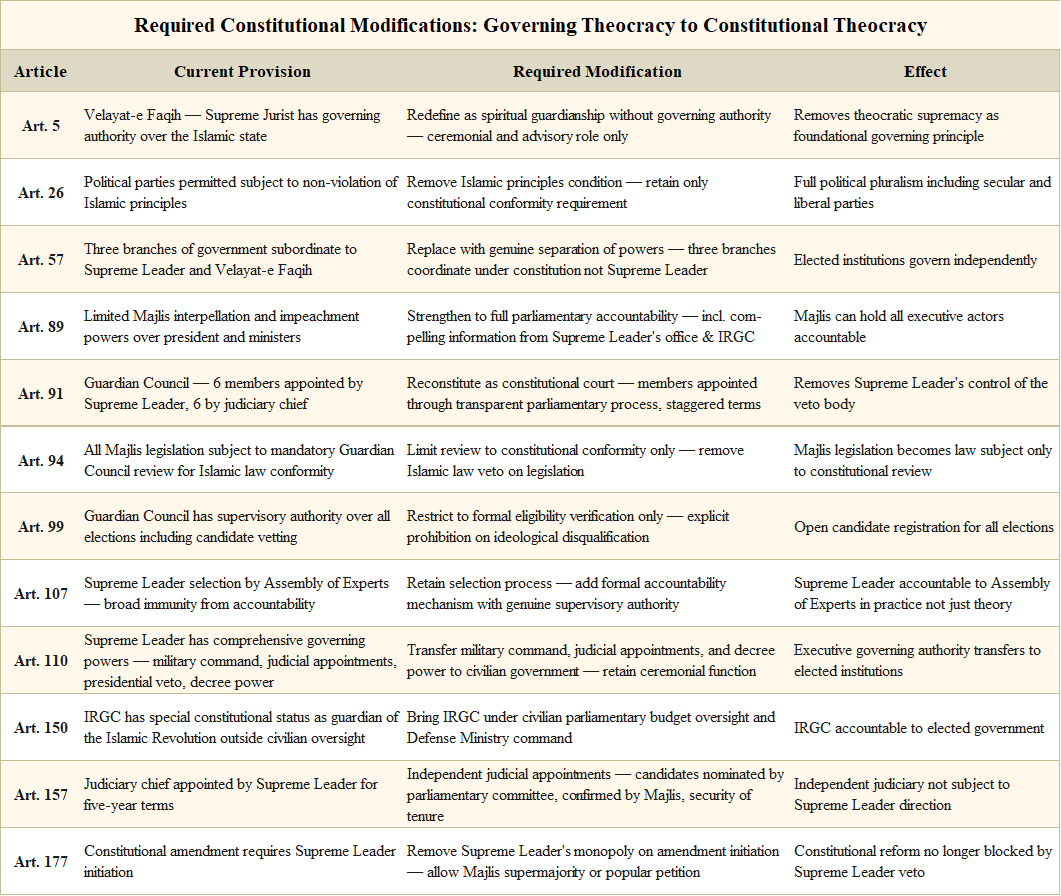
A democratic Iran does not require a new constitution. It requires specific modifications to the existing one. Twelve articles stand between the Iran that exists and the Iran that is possible. If passed by a Majlis supermajority, these 12 amendments would convert Iran from a theocratic dictatorship into a constitutional theocracy — a system with historical precedent, theological grounding in Shia jurisprudence, and genuine democratic substance. The resulting constitutional structure follows established international precedent:

—   The Supreme Leader becomes the head of nation and the faith, with ceremonial authority, but no governing power, analogous to the British monarch

—   The President becomes the ceremonial head of state, appointed by Majlis vote rather than popular election, analogous to the Hungarian or Italian president — above partisan politics, without governing authority.

—   The Speaker of the Majlis becomes Prime Minister, the head of government, elected by Majlis. He governs through Cabinet on all executive matters including budget, economic policy, foreign affairs, and defense. This is standard parliamentary democracy.

—   The Majlis is the sovereign legislature, Iran’s parliament with all rights and duties implied

—   The Guardian Council is reconstituted as the supreme court, reviewing legislation for constitutional conformity only. Members appointed through parliamentary process. No Islamic law veto. No candidate disqualification. 

This is not the only possible model. But it is a coherent, achievable, and historically grounded one.

Why This Works

The Majlis has every reason to say yes

For the 290 members of the Majlis, the 12 Amendments is an offer that transforms their institutional position from a constrained rubber stamp into a genuinely sovereign parliament. Combined with the NPF's $500,000 annual payment per member, the personal and institutional incentives are aligned. Ghalibaf, who has sought the presidency four times and been blocked each time by Guardian Council interference and Supreme Leader preference, becomes Prime Minister under the new system — the governing head of state of a normalized Iran. The proposal converts his political ambitions from a source of frustration into a path to genuine power.

The Iranian public is ready

Iran's protest movements — 2009, 2019, 2022-2026 — have demonstrated consistently that a substantial portion of the Iranian public wants exactly what the 12 Amendments offers. The missing ingredient has always been a specific, achievable constitutional program rather than the vague call to "rise up." The 12 Amendments gives protesters, reformists, and ordinary Iranians a concrete agenda to organize around, specific articles to demand, and a named counterparty — the Majlis — responsible for acting. Six years of 40%+ inflation, currency collapse, and institutional failure have created a population with strong material incentives to support economic and political normalization.

The IRGC faces a credible threat

The IRGC will resist. Its entire institutional existence — economic empire, proxy network, political dominance — depends on the current system. But resistance carries a cost that has recently become concrete. Two IRGC commanders have been killed by Israeli missiles in the past year. Ahmad Vahidi, the current commander, is acutely aware that his predecessors' titles did not protect them. The US and Israel can credibly extend that threat: pass the 12 Amendments, or face the same targeted pressure applied to those who actively obstruct democratic transition. No need to bomb bridges and powerplants — just remove the specific individuals who stand in the way of a reform that serves Iranian, American, Israeli, and global interests.

This is not a threat that needs to be spelled out in diplomatic communications. It is a background reality that every IRGC commander already understands. Combined with an Iranian economy that the IRGC cannot fix and a Majlis that is financially motivated to move, the institutional calculus shifts.

Europe and the American public can support this

A proposal to transform a dangerous theocratic dictatorship into a constitutional democracy through specific constitutional amendments — rather than through bombing civilian infrastructure — is a proposal that European allies and the American public can endorse. It reframes the Iran conflict from a destructive military campaign into a constructive democratic transformation. President Trump, whose public support on the Iran war is weak, gains a historic achievement — the democratization of Iran — rather than an inconclusive military campaign. The political upside is significant.

The Ask

The ask is simple and specific. The United States and its allies call on the Majlis of the Islamic Republic of Iran to pass, by supermajority, the 12 constitutional amendments described above within a defined period — 90 days from ceasefire. The Majlis Speaker, Mohammad Bagher Ghalibaf, is identified as the responsible counterparty. The economic benefits of normalized relations — sanctions relief, frozen asset releases, the Gulf Stabilization and Reconstruction Fund, and NPF payments — are explicitly linked to Majlis action on the amendments.

IRGC commanders and Guardian Council members who actively obstruct the Majlis's exercise of its constitutional authority face targeted individual consequences. Those who stand aside face no consequences and receive NPF payments on the same basis as other designated decision-makers.

This is not a simple approach. It requires the United States to assert a position and hold it over weeks to months. It requires sustained engagement with the Majlis as a democratic institution, sustained pressure on the IRGC as an obstacle to reform, and sustained commitment to the economic normalization that makes the reform agenda viable.

A democratic Iran is an enormous strategic prize — one that resolves the nuclear threat, ends the proxy war, reopens Hormuz, and removes the primary source of regional instability. It represents an opportunity that arises once in a century. The 12 Amendments is the most direct path to that outcome available.

 *****

The 12 Amendments: Regime Change in Iran

*****

Princeton Policy Advisors is an independent policy advisory firm. This paper represents the analytical views of its authors and does not reflect the official position of any government or institution.

Iran: An OPEC of One

President Trump appears to be preparing a declaration of victory and an exit from the Iran conflict — one that would leave Tehran in uncontested control of the Strait of Hormuz. This would be a strategic catastrophe of the first order.

Control of the Strait is not merely a military prize. It is an economic chokepoint through which roughly 20 million barrels of oil pass every day. An Iran that controls that passage without challenge controls, in effect, the production quotas of every Gulf exporter without an alternative outlet—and by extension, global oil prices. OPEC has spent fifty years trying to achieve what Iran would acquire overnight.

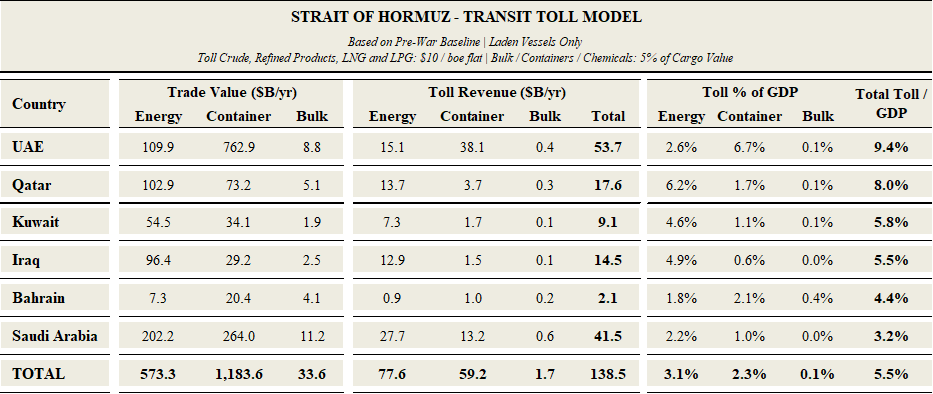
The math is stark. At a toll of $30–40 per barrel on 20 million barrels per day, Iran's daily revenue from the Strait alone would approach $800 million — nearly $300 billion annually, equivalent to 60 percent of Iran's entire current GDP. 

Unlike OPEC, which has always struggled with cheating among its members, Iran ​could enforce discipline with absolute authority. Any producer that exceeded its quota would face an immediate and credible threat of closure. At a target price of $120 per barrel, Gulf exporters would still receive $80 ​/ barrel — more than they have seen recently. They may well acquiesce.​ Oil prices will never return to pre-war levels under such a regime.

It gets considerably worse. Iran and Russia together would effectively control ​t​wo-thirds of global oil exports. That is not merely an economic position—it is a geopolitical weapon of the first rank. Tehran could close the Strait in response to an Israeli military action, a Western sanction, or any provocation it chose to define as such. It could demand the resignation of a government. It could hold oil flows hostage to the terms of the Ukraine war. Western Europe, wholly dependent on imported oil, would find itself negotiating its energy security with Moscow and Tehran simultaneously.

Israel's position would be particularly precarious. Any strike on Iranian nuclear facilities would invite immediate Strait closure, with reopening conditional on Israeli reparations and facility reconstruction. The nuclear deterrent that Israel has relied upon for decades would be neutralized by an economic one.

And Iran would not stand still. Flush with toll revenues, Tehran would rearm at scale—acquiring the best missiles, drones, aircraft and naval vessels available outside the American arsenal. Within a year, Iran's military would be materially stronger than it​ was before the war.

President Trump should disabuse himself of the notion that walking away from this conflict while the Strait remains closed is a viable option. It is not. The choice is among three paths: unconditional withdrawal and the consequences described above; a full ground invasion for which there is no public appetite and no coherent plan; or a negotiated agreement. ​ You will find our version of a workable agreement here.

A Concept for Ending the Hormuz Crisis

The Hormuz crisis clearly needs a re-think.  This analysis represents our view of an agreement which could be quickly agreed by both the US and Iran.

To be clear, if the US can restore by force 75% of the pre-war flows through the Strait of Hormuz by April 15th – latest April 30th – then it should do so and not negotiate.  That simple. 

If the US cannot achieve that goal with a high degree of confidence, then every passing day strengthens Iran’s position, and the US must prioritize a quick deal over an optimal outcome.  This seems the case.  Time is of the essence.  The BBC has reported gas station lines in Sri Lanka, following rationing in Slovenia earlier.  Within a couple of weeks, rationing will spread more broadly in Europe.  By the end of May – but certainly before Memorial Day – expect it in the US.  For the next several weeks to months, the US and Israeli position will be steadily eroding. The US needs a deal now.

A quick deal implies making an offer the Iranians could plausibly accept today.  It therefore must be simple, attractive and easy to negotiate, that is, deferring topics that might require months or years to agree. 

Below, we present the Iranian and US positions and our view of a reasonable agreement.

Ceasefire Timing

The US has proposed maximalist positions.  It wants Iranian compliance before a ceasefire.  This seems implausible and therefore a waste of time.  Expect a deal and a ceasefire to be simultaneous.

The Nuclear Question

The US wants a commitment that Iran will never pursue nuclear weapons, that no material will be enriched on Iranian soil, that all enriched material will be delivered to Saba on a schedule to be determined by the parties and that Natanz, Isfahan and Fordow will be decommissioned or destroyed.  This is fanciful.  What if the Iranians say that they will consider it and welcome meetings to discuss during the summer?  The global economy will be in ruins by then.

The Iranians, of course, want no limits on their nuclear activities.  This, too, is a non-starter.  They know the US will not agree to that in blanket form.

Our proposal calls for Iran’s nuclear development sites of Natanz, Isfahan and Fordow to remain off-limits for the next three years.  No Iranian would be permitted to set foot on any of those sites for the duration of the agreement.  That will effectively limit nuclear progress in the interim but does not force Iran to make permanent concessions which it would reject without prolonged negotiations.  Sealing the three sites is a condition that is easy to understand, easy to monitor, and relatively easy to agree, because it is 1) time-limited and 2) does not preclude all nuclear work. Given the time required to restore operations after the agreement expires, Iran’s key nuclear sites will be out of action for about five years.  That may not be optimal, certainly for Israel, but it is better than nothing. 

Oil and Gas Sanctions

The Iranians want full immediate relief from sanctions.  The US proposes phased relief.  Three is nothing wrong with the US proposal, save that it may take weeks or months to negotiate.  Whatever the US proposes, Iranians must be willing to agree it within, say, one week.

Our proposal calls for effectively full relief immediately.  The Iranians will obviously agree and this relief will, in effect, count as a kind of reparations.  Full relief takes this item off the table as an obstacle to a quick re-opening of the Strait.  This applies to SWIFT sanctions as well.

Frozen Assets

The Iranians want their $100-$120 bn in frozen assets immediately released.  The US wants releases based on compliance milestones.  The Iranians are unlikely to accept delay in receiving at least some portion of their frozen assets.  We have proposed $25 bn released on signing; $25 bn on the first anniversary if Iran honors its commitments; and the balance released as a function of the National Prosperity Fund, more on which later.

Reparations

The Iranians want reparations.  The US refuses.  We believe that the Iranians will not open the Strait without material reparations, which the US cannot grant due to the requirement for Congressional authorization and domestic political realities. 

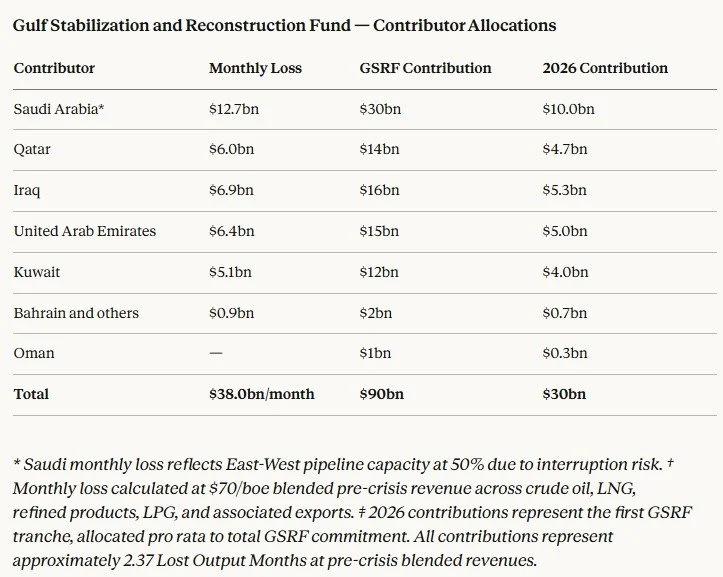
We finesse this issue through a Gulf Reconstruction and Stabilization Fund, a $90 bn vehicle funded by the Gulf oil and gas exporters and representing about two months of lost revenues (Lost Oil Months, or LOMs, as we call it).  The exporters will be unhappy, but the contribution is looks workable and the up-front cost is not unattainable.  

This allows the US to avoid the reparations issue, even as something like reparations are paid to Iran.

The Strait of Hormuz

The Iranians want to set up a toll across the Strait of Hormuz. This is unacceptable to both the US and the international community. The various forms of payment — the lifting of sanctions, the GSRF, and free oil exports — compensate Iran for agreeing to free transit across the Strait.

Proxies

Iran would like recognition of proxies like Hamas and Hezbollah.  The US will resist it.  We finesse this by offering that both sides will restrain their proxies – Hezbollah, Hamas and the Houthis on the Iranian side, and Israel on the US side – from aggressive actions for the life of the agreement, ie, three years.  This is really a stand-down agreement, rather than a permanent solution.  Tying the Hormuz Agreement to recognition of the various parties would take years.  The US does not have the time; it is best to keep the topic off the table.

The Iranians should also agree to withhold any military supplies, aid or support to Russia during the agreement.

Regional Security

Iran would like recognized control over the Strait of Hormuz and the eviction of the US from the region.  Neither will happen.  In truth, Iran does not require de jure recognition when it has demonstrated de facto control over the Strait.  If Iran insists on formal recognition, it will peg itself as a problem needing a solution, very possibly a military solution.  Given Iran’s control of the Strait in practice, formal recognition would not appear critical in this round.  Everyone now knows that Iran can close the Strait at will.

Regime Change and the National Prosperity Fund

Regime change can happen on three levels: personnel, systems, and incentives.  The US has attempted regime change in Venezuela and Iran by eliminating top leadership.  However, the underlying regimes remain in place in both countries. Only personnel have changed.  In Iran’s case, incoming Iranian leadership appears all of younger, more energetic and more radical than the late Ayatollah Khamenei. 

Many observers of both Venezuela and Iran were hoping that regime change meant a return to democracy, or at least a regime better aligned with western values.  It has not happened, and the Trump administration does not seem particularly interested in this outcome in either country.

Finally, and importantly, regime change can be achieved by changing behavior of existing leadership.  This can be accomplished through coercion, partly as has been achieved in Venezuela, or through altered incentives.   Our proposal focuses on changing incentives.

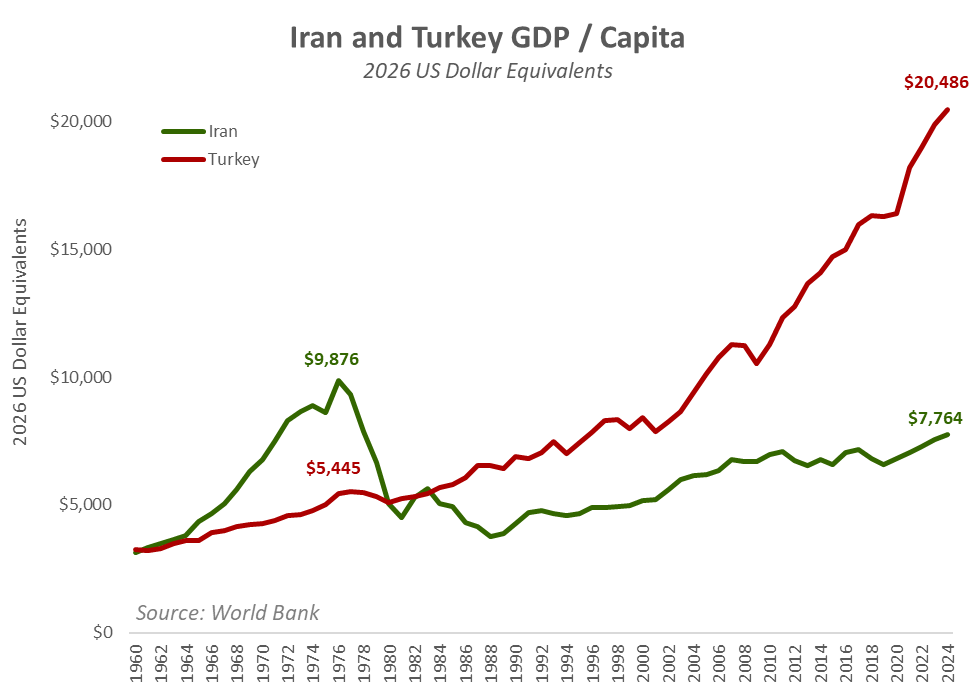
One of the striking features of Iran is its chronic economic under-performance.

Iran’s GDP per capita, in real terms, remains below its level of fifty years ago, towards the end of the Shah’s reign.  For purposes of international comparison, Turkey at that time had only 70% of Iran’s per capita GDP.  Today, it is 2.6x that of Iran.

By any reasonable measure, Iran’s economy has been woefully mismanaged since it became a theocracy in 1979. 

Instead of improving the condition of the public, leadership is militaristic.  Iran’s leadership defines that country’s prestige not by its own achievements, but in negative terms, in its ability to harm Israel in particular.

Our proposal seeks to provide a counter-weight by tying benefits from the agreement, notably releases of frozen assets and flows from the GRSF (above), to GDP growth.  The top 500 decision makers will be generously compensated to produce prosperity.  Prosperous countries can, of course, go to war, but most pariah states are poor.  For example, North Korea, Cuba, and Venezuela are grindingly poor compared to their neighbors or their historical prosperity.  A focus on growth almost by definition implies a tendency towards openness, rule of law, a respect for individual rights, and peace in international relations.  

This is the gist of our proposal, called the National Prosperity Fund, which seeks to encourage constructive behavior from Iran’s leadership by rewarding them for creating prosperity while not constraining policy options. 

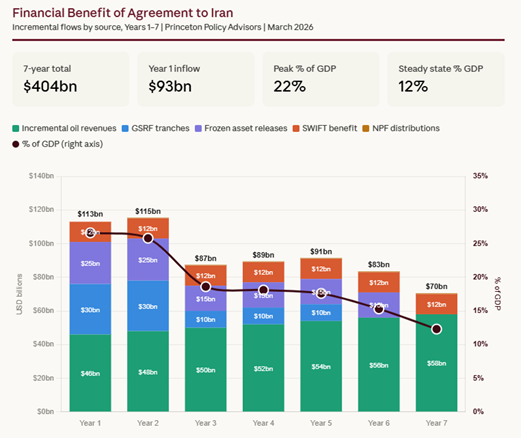
Summary of Financial Benefits

In aggregate, the financial benefits to Iran are notable, cumulatively $400 bn over seven years if Iran abides by the agreement. 

Cheap, Fast or Good

In negotiating with Iran, the US will face that project management truism: “You can be on time, on budget, or on spec — pick two." Given the situation, the US needs a quick solution that is acceptable, even if the cost is relatively high.  That’s the essence of our proposal, one which opens the Strait, does not require reparations from the US, inhibits Iranian nuclear development, stops Iran from attacking Israel directly or with proxy forces, and does contain an element of regime change.  It may meet a minimum standard for the US.  Iran can also claim a win: It gains substantial funding, sanctions relief, an end to hostilities for the next three years and does not irretrievably compromise its nuclear ambitions, even if it puts the program on ice for a few years. 

On paper, both parties could live with this deal.

The Coming Oil Shock Recession: A Primer

With the Strait of Hormuz closed, the press is full of discussions of 'oil shocks', and wild oil price forecasts are being tossed around.  What does it all mean?  And what’s an oil shock anyway?

Economic shocks arise from oil’s unique characteristics.  For practical purposes, oil in the form of gasoline, diesel and jet remains the monopoly fuel for transportation.  Moving people or goods, especially over longer distances or in quantity, requires oil.  Remove the oil, and neither people nor goods can move as much as before, contracting economic activity.  Oil is mobility, and mobility is fundamental to the functioning of the economy.

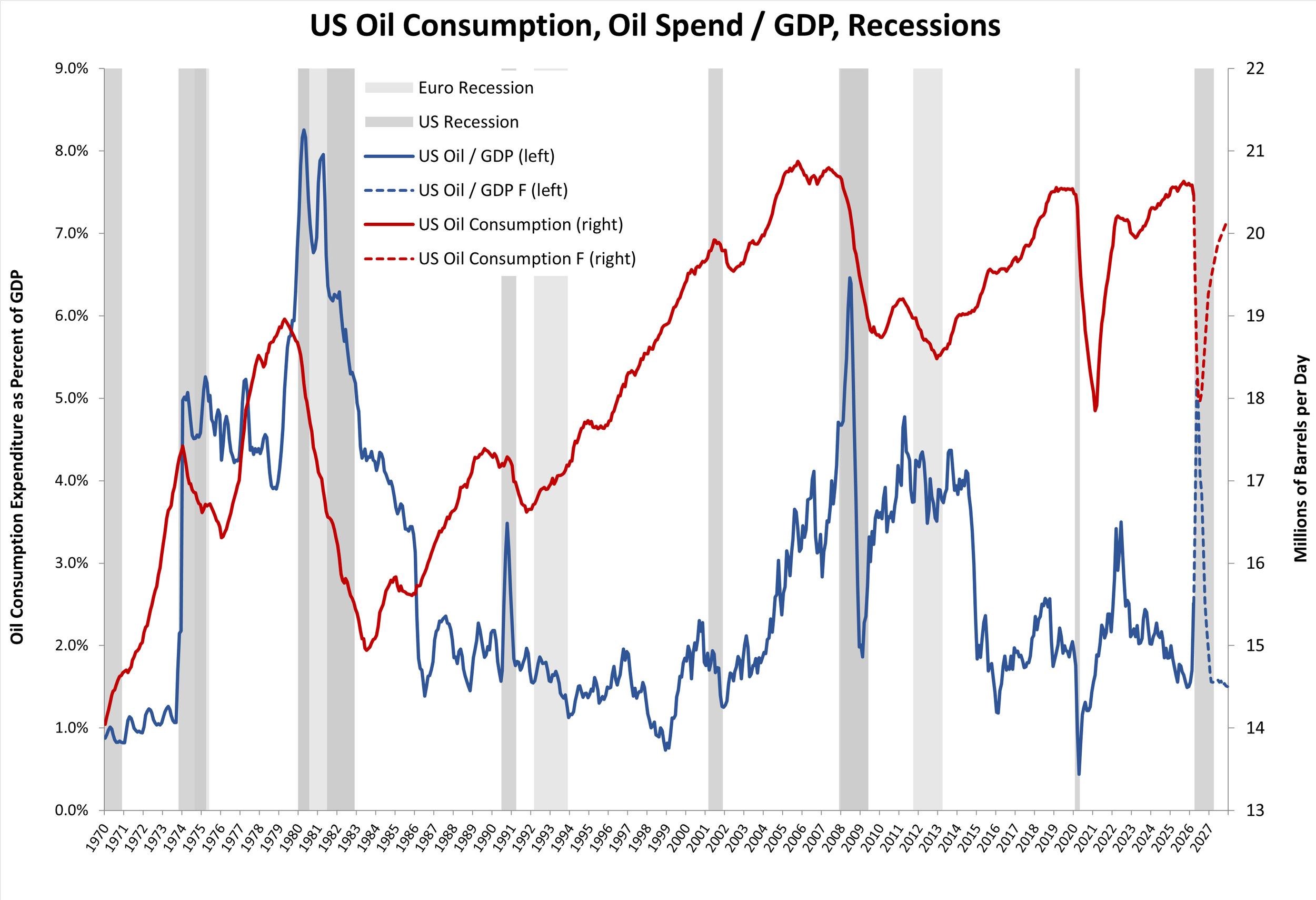
The 'shock' aspect refers to suddenness.  In some cases, adjustment can be gradual.  For example, oil prices were consistently high from 2011 to 2014, and OECD oil consumption fell gradually over that period.  In the current episode, the US will have to cede 8% of its oil consumption in April alone, and almost 10% in May.  Adaptation through efficiency gains over such a short period is impossible. Instead, people make do with less, and do so almost immediately.  For that reason, oil shocks tend to be coincident with recessions.  A sudden loss of oil immediately reduces economic activity, the very essence of a recession.  Expect Europe to be in recession during April, and the US to be in recession by May.

Has the oil shock already started?  Well, sort of.

Markets have three elements: supply, demand, and stocks (inventories).  If supply decreases, markets can be balanced by reducing consumption or, alternatively, by drawing down stocks.  So far, most of the adjustments appear to have come from inventory draws. 

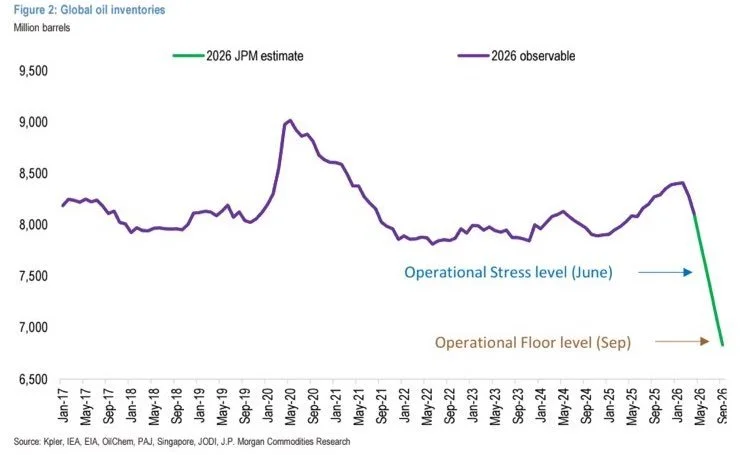
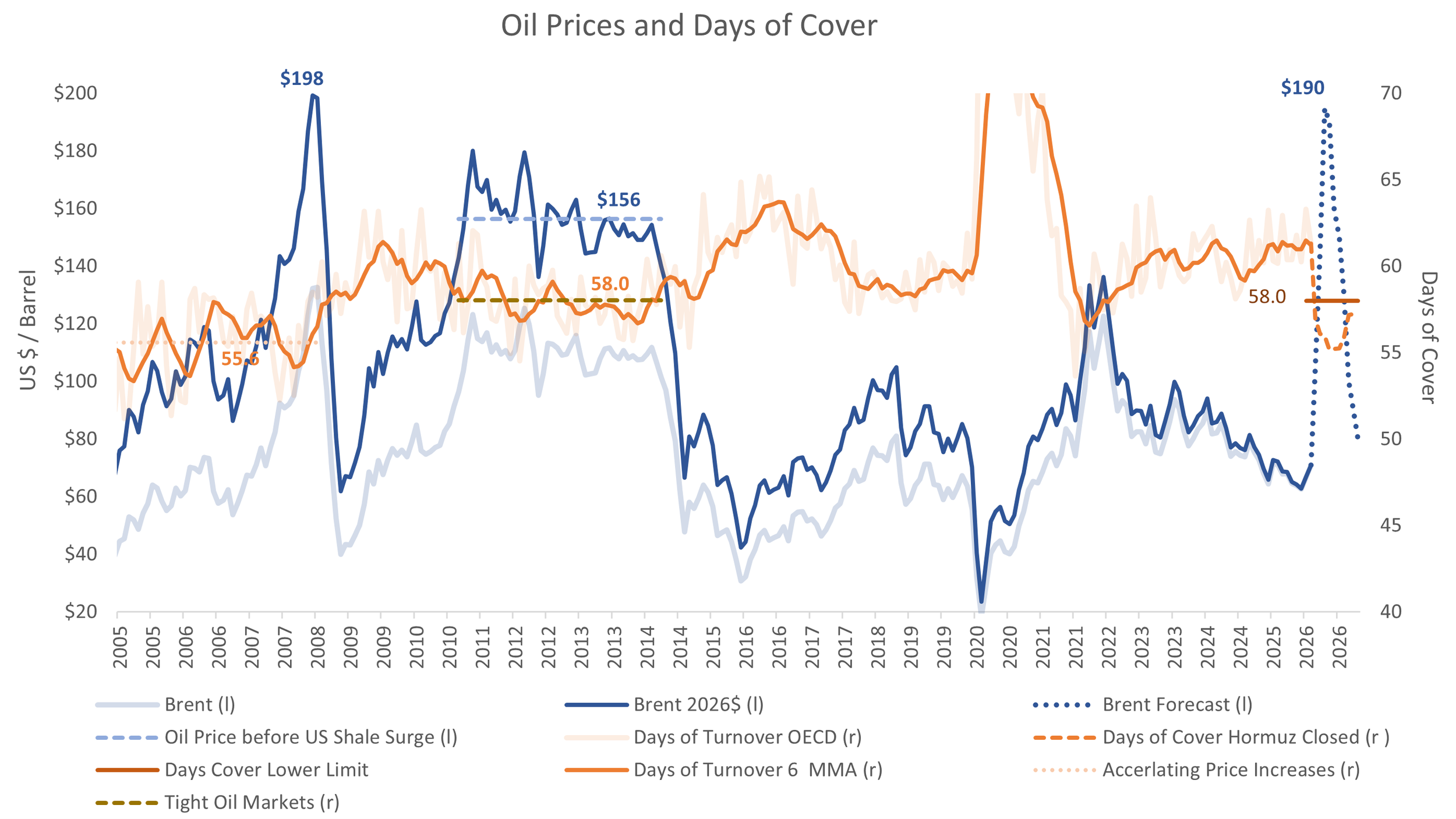
Of course, this cannot continue much longer.  Our analysis suggests that advanced country (OECD) inventories will fall to about 57 days of cover by the end of the month. These are below customary level of 60 days for refiners and other oil market participants.  Consequently, the window to sustain consumption through inventory draws is closing.  By April, it will be effectively closed and adjustments will have to come from reducing consumption.

In Asia, the process has already started.  Poorer countries like India, Pakistan and Bangladesh are curtailing refiners, extending school holidays and moving to work-from-home and four-day workweeks.  Large-scale flight cancellations are beginning in long-haul markets like New Zealand. 

These curtailments and cancellations will expand and spread to Europe by the end of the month.  They will hit the US during April. 

Oil Prices

It is not hard to find stories about US resilience to oil shocks because oil consumption is only a small part of GDP and therefore not a problem.

This misses the point.  Global oil production will be down by 14% -- 14 mbpd – in April.  This loss of supply must be allocated to consumers around the world in some proportion.  Given that the US is 20% of global oil consumption, it will not be spared.  All other things equal, we might assume US oil consumption will fall by its pro rata share, about 2 mbpd, or 10%.

The question is therefore the oil price necessary to reduce US consumption by 10% over 60 days. 

While oil prices are high in recent terms, they are not particularly high by historical standards, nor are they high enough yet to materially dent consumption.  For example, from 2011 to 2014, Brent averaged $110 / barrel—$156 / barrel in inflation-adjusted terms—and global consumption grew by 3%.  Prices will need to go much higher to destroy demand.  

We can estimate the necessary oil price by a few different means.  The first is to look at historical oil shocks adjusted for inflation and growth of the US economy in the interim.             

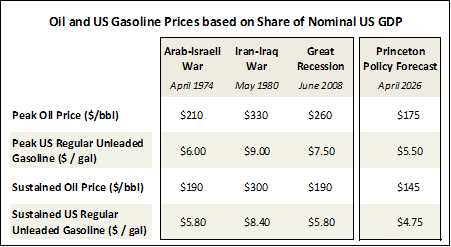
With these adjustments, we can look to three prior shocks for guidance, notably the first modern oil shock of the Arab-Israeli War in 1973-1974; the Iran-Iraq war during 1980-1982, and the oil shock of the Great Financial Crisis of 2008.  Adjusted for inflation and GDP growth, these suggest oil prices in the range of $210-$330 / barrel at peak and a sustained price about $20 - $30 / barrel below that.

We can also estimate the price by surveying the public, even in small and informal samples.  Those I have interviewed said they would curtail their driving by 10% if gasoline prices doubled.  This suggests unleaded gasoline at $5.50 / gallon for the US average, and that is in fact our forecast for the end of April.  This equates to $175 / barrel of crude oil, a bit below the historical peak for prior oil shocks. 

Our average unleaded price for April is forecast at $4.50 / gallon.  Given that unleaded averages $3.90 / gallon in the US at writing, $4.50 / gallon is not at all inconceivable.

Recession

Oil shocks and recessions are essentially synonymous.  Reducing oil consumption reduces economic activity and a reduction in economic activity is a recession.  In the data, they occur simultaneously.

Is a recession coming?

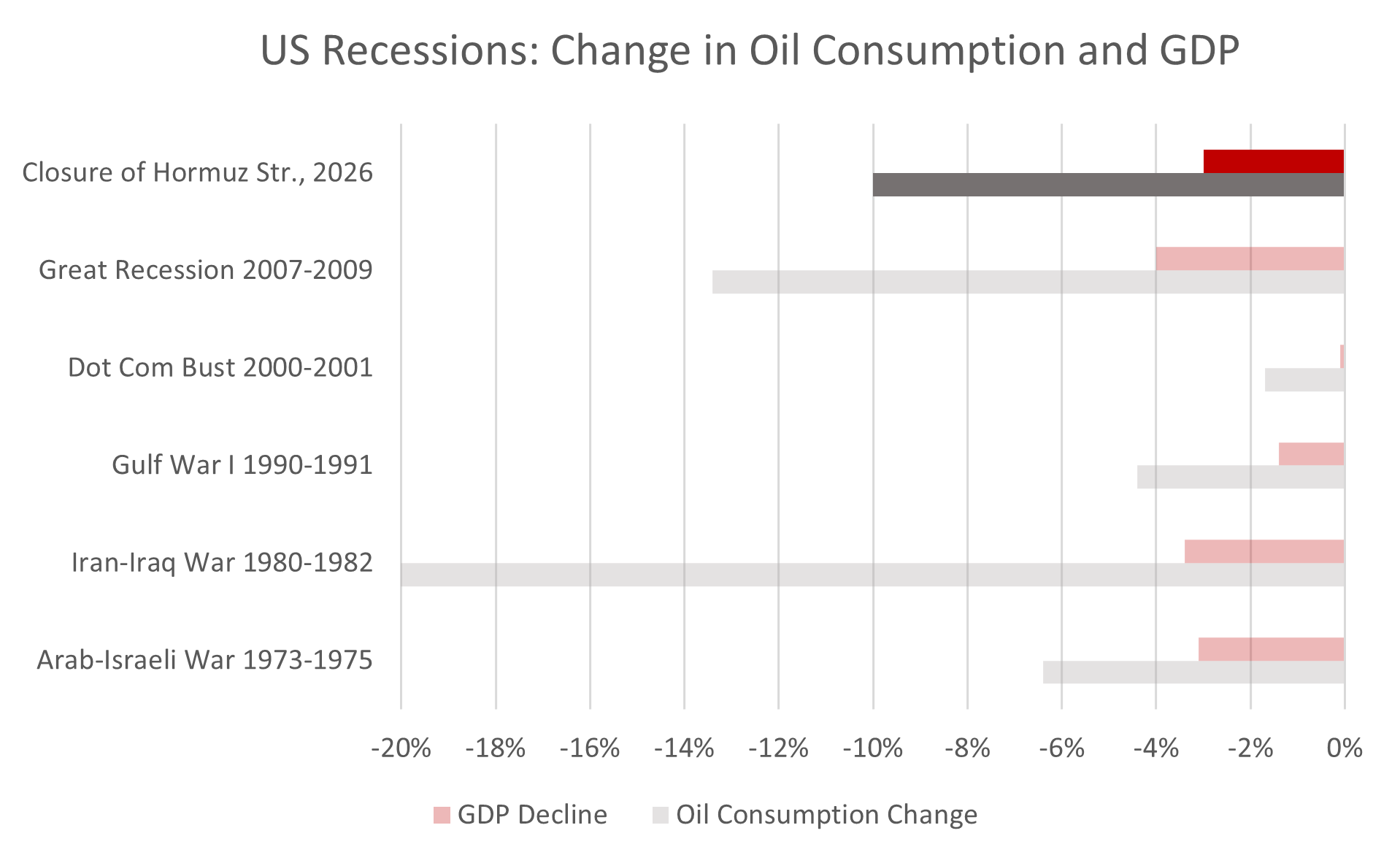
The short answer is ‘yes’.  Historically, GDP has fallen by about a third of percentage decline in oil consumption.  If we assume US oil consumption will fall by 10%, then we might expect a recession with a GDP decline of 3%.  This is in line with prior oil shocks, particularly those of the 1970s, and a typical decline for recessions in general.  The public will experience it as a stiff and unpleasant downturn.  Recessions almost always are.

In any recession, the question is not only magnitude, but duration.  How long could the coming recession last?

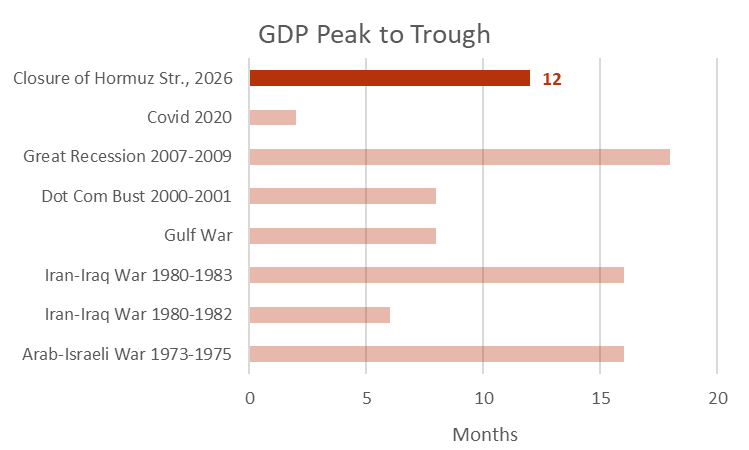
The recessions of the 1970s oil shocks – the best precedent for the current crisis – lasted 6 to 16 months from peak to trough, per NBER dating.  We use the average of 12 months for our forecast.  If the crisis continues unabated, expect the US to fall into recession during April and the economy to continue to deteriorate through March 2027. 

Let me close with the customary disclaimers.  Our forecast assumes that the Strait of Hormuz remains materially closed.  It may open for any number of reasons, including successful US military action, the collapse of the Iranian regime and resistance, or policy decisions made by Iranian leadership. 

Further, our timing expectations may be off, but probably not by much.  In addition, the allocation of demand adjustments may prove more unequal than we expect.  The US may require smaller, and East Asia, for example, may require proportionally greater adjustments than we project.  Finally, these forecasts assume that the Saudi East-West Pipeline remains fully operational at 5.5 mbpd.  The Iranians will likely try to put it out of action.

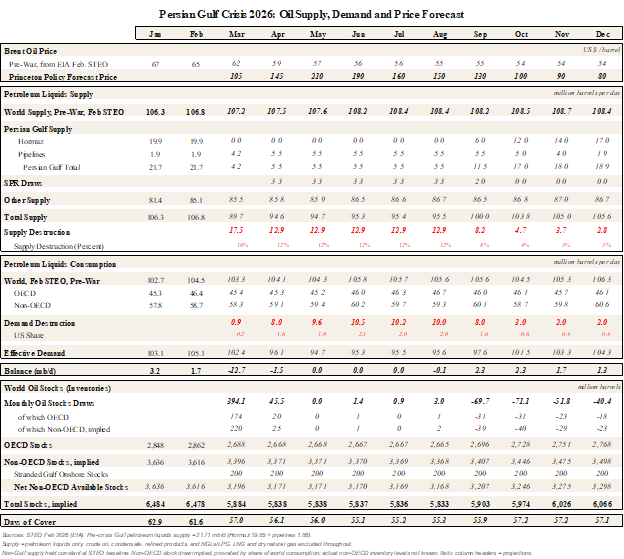
For those interested in our current quantitative model, here it is:

Iran War: 25 mbpd at risk; Pipes, SPR don't help much

The press has generally reported that 20 mbpd, about 1/5th of global oil consumption, is at risk if the Strait of Hormuz in the Persian Gulf remains closed.  The numbers are potentially larger.  Further, don't expect either existing Middle East pipelines or releases from strategic petroleum reserves to materially change the picture.  

Let's do the math. 

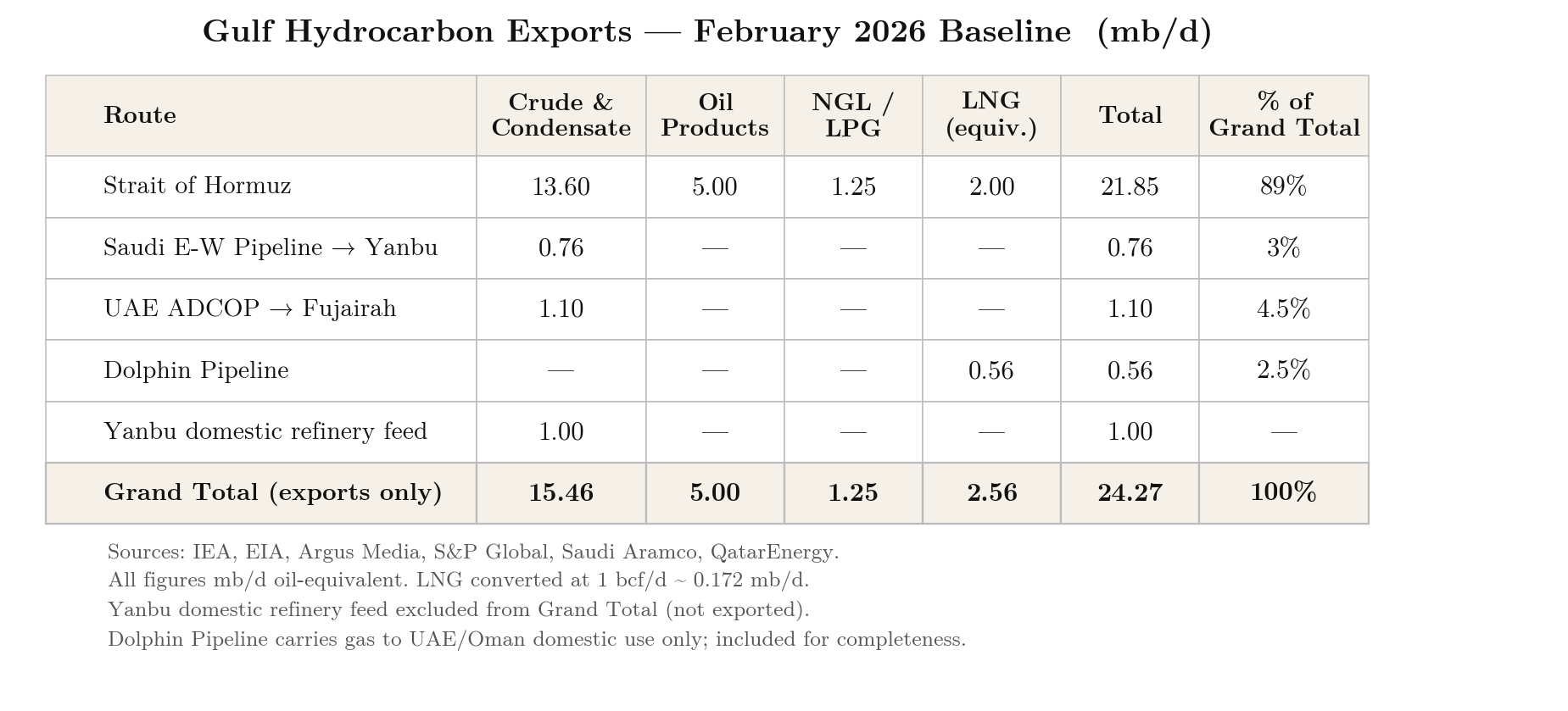
Tanker Trade: Pre-war, about 22 mbpd (million barrels per day) of petroleum liquids transited the Strait of Hormuz.  Of this, about 14 mbpd was crude oil, and 5 mbpd was refined product like gasoline, diesel and jet fuel.  

In addition, 1 mbpd was natural gas liquids (NGLs) like propane, butane and ethane transited the Gulf.  NGLs are typically by-products of natural gas --not oil -- production and are rarely used for transportation.  

Finally, the equivalent of 2 mbpd of liquefied natural gas (LNG) transited the Strait in February.  LNG is natural gas which is cooled and compressed into a liquid state, allowing transport via specialized tankers.  LNG is used principally for power generation, home heating and cooking, and various industrial applications.  As with NGLs, LNG is not a transportation fuel.  

Pipeline Transport: Before the war, about 3 mbpd of oil was also transported from the Persian Gulf via pipeline.  

In total, about 25 mbpd of crude, products, NGLs and LNG were shipped from the Persian Gulf via tankers and pipelines immediately before the war.

Diverting Hormuz Flows to Pipelines

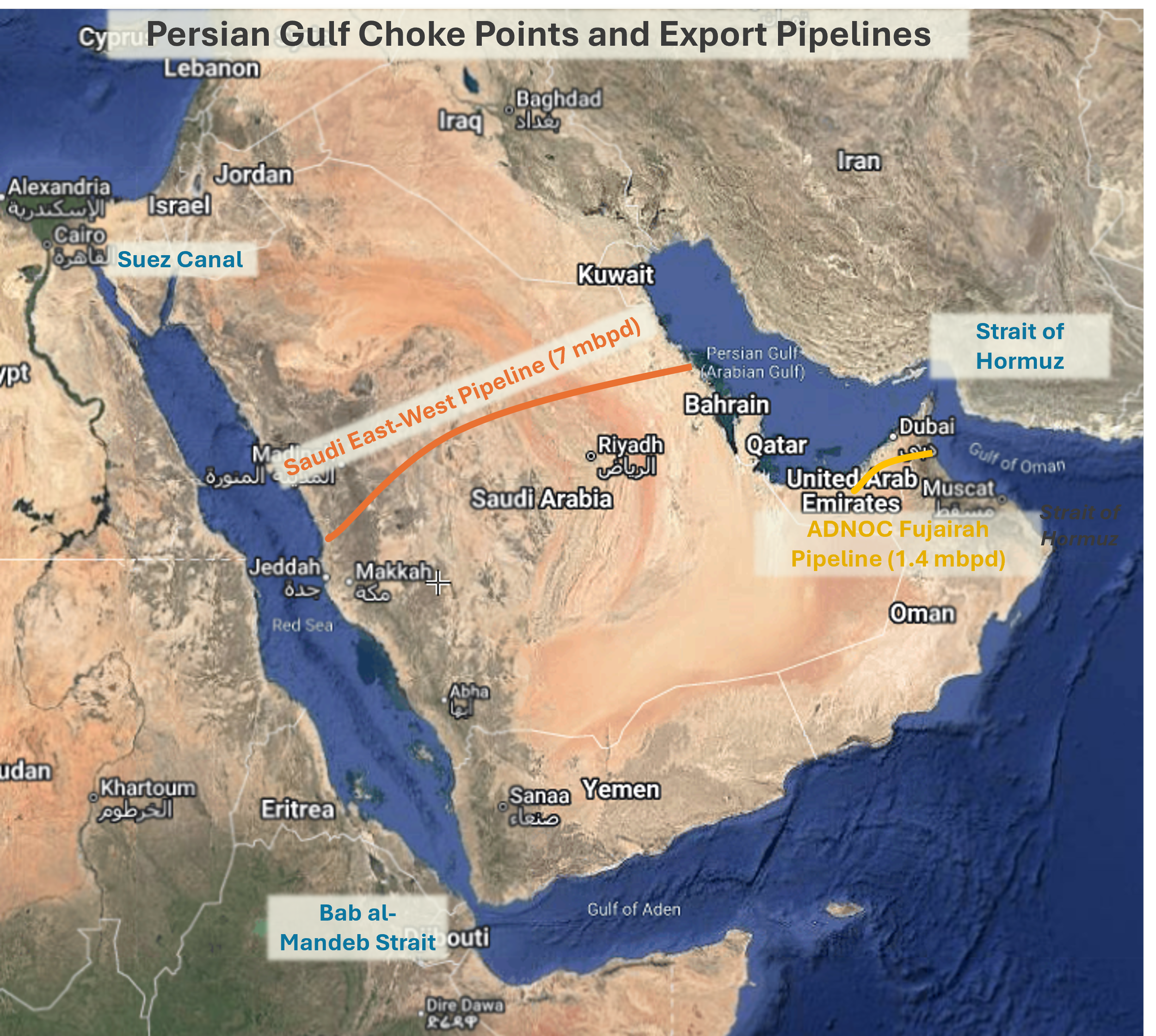
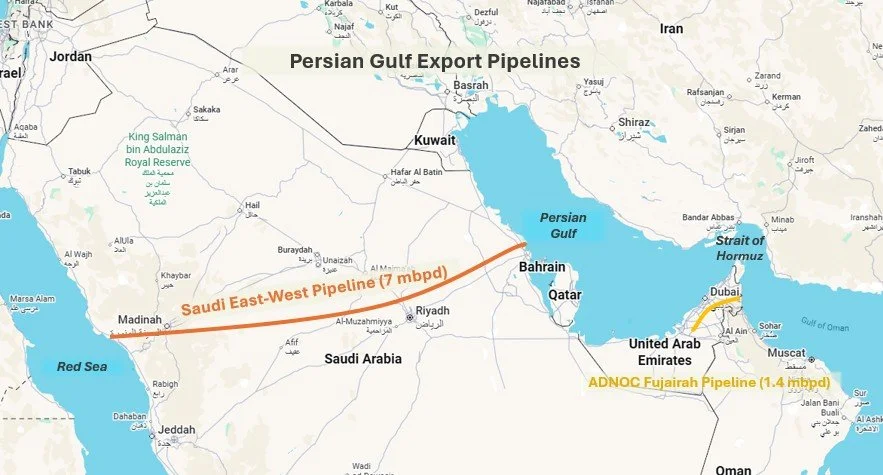
How much could pipelines offset the closure of the Strait of Hormuz?  The Saudi East-West Pipeline, with a capacity of 7 mbpd, runs to the port of Yanbu on the Red Sea.  In February, the pipeline carried less than 1 mbpd and thus would seem to have 6 mbpd of spare capacity.  However, Yanbu is thought to have loading capacity of only 4-4.5 mbpd; consequently, the pipeline's incremental export capacity probably does not exceed 4 mbpd.  

The UAE also has an export pipeline to Fujairah, just beyond the Strait of Hormuz.  This pipeline has a capacity of 1.4 mbpd, but was near full capacity in February.  

All the export pipelines together probably represent no more than 4 mbpd of incremental capacity in practice, that is, they would offset no more than 1/5th of the losses from the Strait of Hormuz.  

Spare Oil Production Capacity

To this we could add spare global oil production capacity of 4 mbpd.  However, all of this is materially located in the Persian Gulf.  As a result, there is no accessible spare capacity available.

Releases from Strategic Reserves

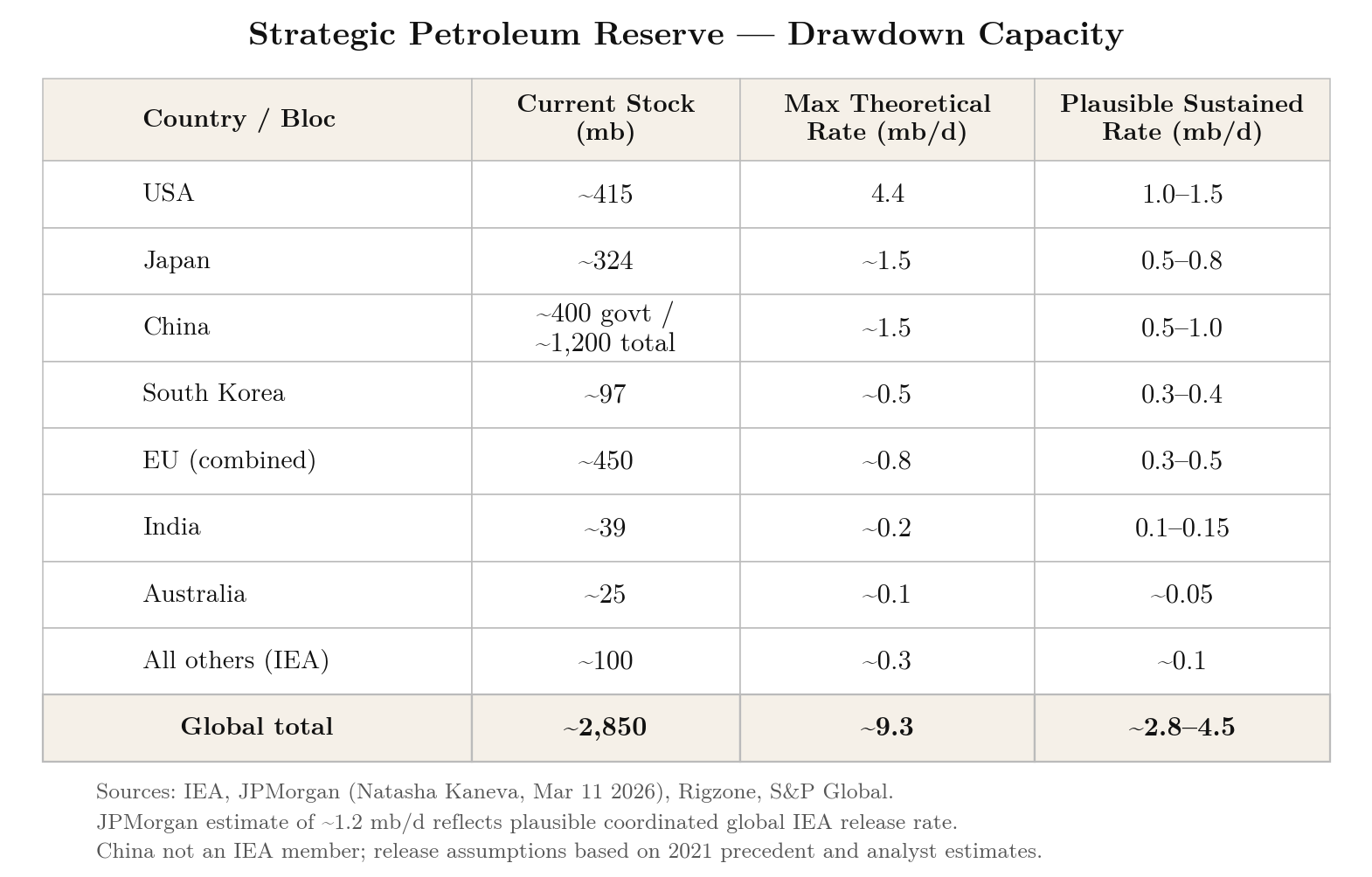
Finally, many countries have strategic petroleum reserves (SPRs).  For example, the US SPR contains more than 400 million barrels of crude.  Assuming all countries decided to deploy their reserves, the maximum theoretical SPR draw could reach 9 mbpd.  The actual number is likely much lower.  Most analysts surveyed by Rigzone projected SPRs to contribute 2-4 mbpd to supply, and even that with some delay.  

The Bottom Line

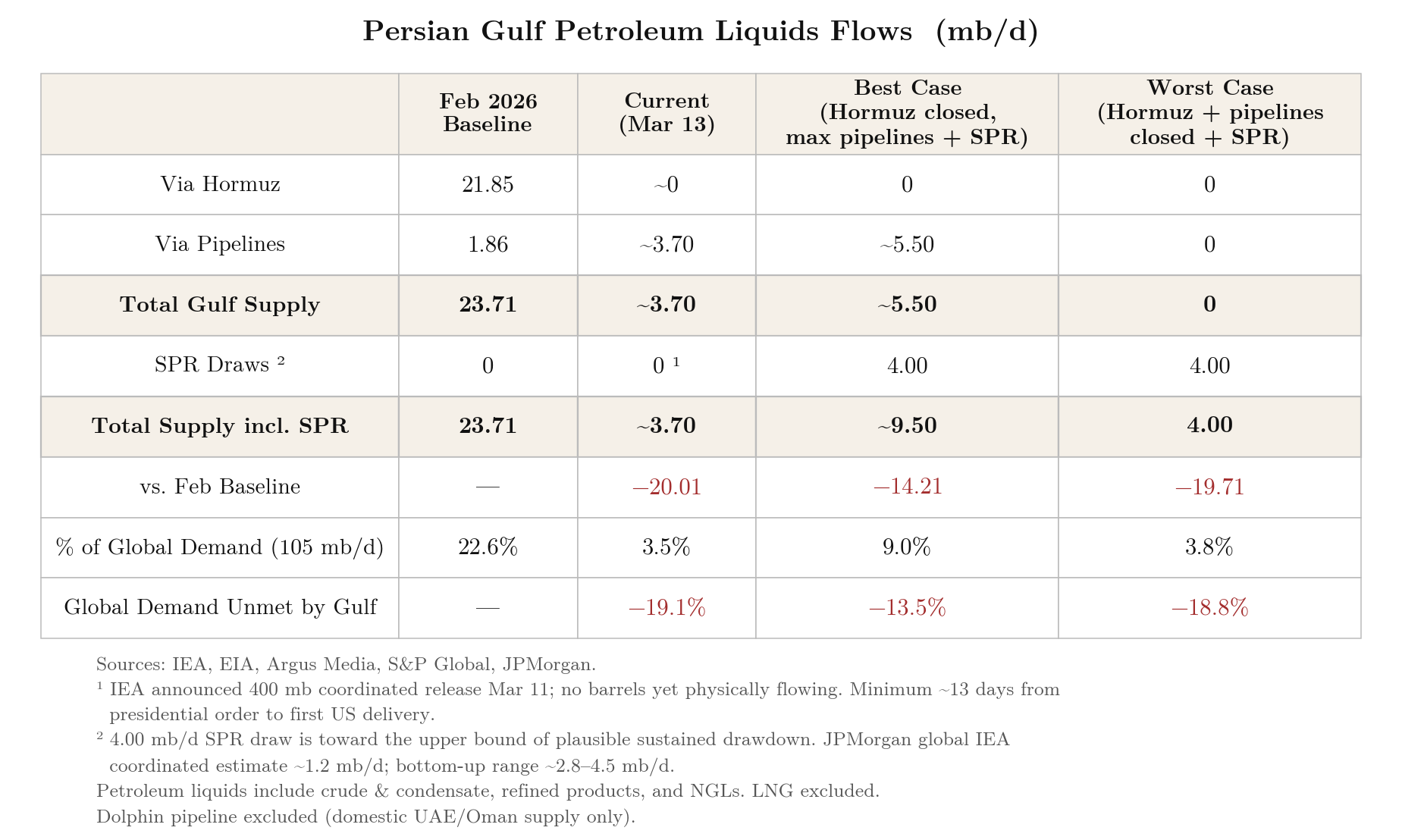
If the Strait remains closed, in the best case, oil exports could be redirected through spare pipeline capacity and supply could be augmented with SPR draws of 4 mbpd.  Even in this scenario, however, global supply would still be down 14 mbpd, representing 14% of global consumption.  By historical standards, this volume is three times that sufficient to induce an oil shock recession.  

Finally, there is a worst case scenario in which Iran not only blocks the Strait, but also succeeds in disabling the region's vulnerable export pipelines.  In such an event, even with SPR draws of 4 mbpd, global supply would lag demand by nearly 20 mbpd, or 19% of global oil consumption.

In summary, neither pipeline exports nor draws from strategic petroleum reserves will compensate for the closure of the Strait of Hormuz.  Not even close.  Indeed, the barrels at risk are greater than just those transiting the Strait.  Iran may well be able to knock out the Saudi East-West and UAE Fujairah pipelines, raising the total outage to 25 mbpd, nearly a quarter of global oil consumption.  

The Paris-based International Energy Agency (IEA) has described the closure of the Strait of Hormuz as the “largest disruption to crude supplies in the history of the global oil market." That is no exaggeration.  If the US military is unable to clear the Strait within the next 30 days, expect a crushing oil shock recession.

$7 Gasoline; WTI $200; Hegseth out?

Brent oil prices have blown through warnings of $100 oil, with panic at the White House over rising gasoline prices.  It can get so much worse.

Let's start with oil prices.  By recent standards, $100 Brent seems high.  But it has been much higher -- and for a long stretch.  From 2011 to 2014, Brent averaged $110 / barrel, $150 / barrel in inflation-adjusted terms.  Despite high prices, oil consumption still grew by 3% during that period.  If the Strait of Hormuz remains closed, global oil consumption will have to fall by 12.5% within months.  To achieve this outcome, we estimate that pump prices would have to at least double and possibly triple, that is, US regular unleaded would rise to $6-9 / gallon, equivalent to $180-$300 / barrel on a Brent basis.  

Further, the global economy has historically fallen into recession with oil shocks no greater than 4% of supply, that is, about 4 mbpd in current terms.  Closure of the Strait implies a loss of 12.5 mbpd, three times the threshold for a global recession.  Consequently, even if two-thirds of Persian Gulf flows could be restored, a global recession is still probable.  Moreover, oil shocks hit quickly, often sending the global economy into recession within 30 days.  Expect Europe to be in recession by April.

The reported panic at the White House is somewhat puzzling.  The closure of the Strait of Hormuz is quite literally the base case for any scenario involving a major war with Iran.  This risk has been well understood for decades and would have featured prominently in any advice provided by US intelligence or the military to Defense Secretary Hegseth and President Trump --  likely many times in both written and verbal form.  Further, such advice would also have noted that US military resources might struggle to counter the risk to tankers even if Iran's military is substantially degraded.  Iran can strike vessels with air and sea drones, submarine or ship torpedoes, mines, missiles, and other assets.  Attacks can be conducted on an improvised scale using motorboats and first person drones like those used in Ukraine.  Furthermore, Iran has a 1,000 mile coastline on the Persian Gulf and another 500 miles on the Gulf of Oman, south of the Strait of Hormuz.  Imagine the US Navy trying to protect tankers in a stretch of coast from Martha's Vineyard in Massachusetts to Jacksonville, Florida.  That is the distance in question in the Persian Gulf alone.  Iran can attack tankers virtually anywhere in the Persian Gulf and well beyond.  To underscore the point, Iran has reportedly struck a tanker with a missile in Iraqi waters, 600 miles from the Strait of Hormuz.

The closure of the Strait of Hormuz and the resulting surge in oil prices should come as no surprise to the White House.  It is exactly the expected case scenario.

In light of rocketing oil prices, one might expect the President to declare victory and call the military home.  But here's the thing.  The Iranians may not re-open the Strait reciprocally.  The attack on Iranian leadership was so cynical, and the attack on the country so massive and brutal, that Iranians seem more likely to rally around the flag and gird themselves for desperate resistance, an "eat grass" strategy.  That is, Iranians may decide they are prepared to suffer—to eat grass, so to speak—rather than yield to the Great Satan.  In the event of a prolonged closure, Tehran may plausibly place three conditions on re-opening the Strait:

  • A lifting of existing sanctions

  • Reparations of, say, $150-250 bn, and

  • The resignation of President Trump, Secretary Hegseth, and possibly, the entire Trump administration (some regime change payback)

Today, such demands may seem inconceivable, but events are moving fast. Secretary Hegseth’s political future already looks dicey. The longer the closure lasts, the more the Iranians will demand.

As pump prices rise above $5 / gallon in the US, the Trump administration and Congressional Republicans will face intense public pressure.  Depending on the course of events, Republicans may contest a November election without a safe seat anywhere in the country.

Of course, all this depends upon US and Israeli military capability to assure safe passage for tankers, and Tehran’s ability ability to maintain some semblance of internal order and unity, the availability of weapons after the US and Israeli onslaught, and Iranian leadership’s underlying intentions and negotiating strategies.  Be that as it may, the Strait is now closed, and prospects for re-opening remain uncertain.

The Price Cap at the start of the new Trump Administration

With the new administration taking office, it’s time to revisit the Price Cap on Russian oil exports.

The Price Cap and Embargo as currently structured have failed. They need to be modified, and in doing so, $50 bn in annual Russian oil revenues can be redirected to Ukraine, enough to fund much of the war, all of reconstruction, and repay the US and other allies at least a portion of the support provided.

Let’s take a look at where matters stand.

Oil Prices

Brent has moved in a relatively narrow range in the last half year and is trading near 10-year lows around $75 / barrel. Weakness in the Chinese economy is the most likely cause.

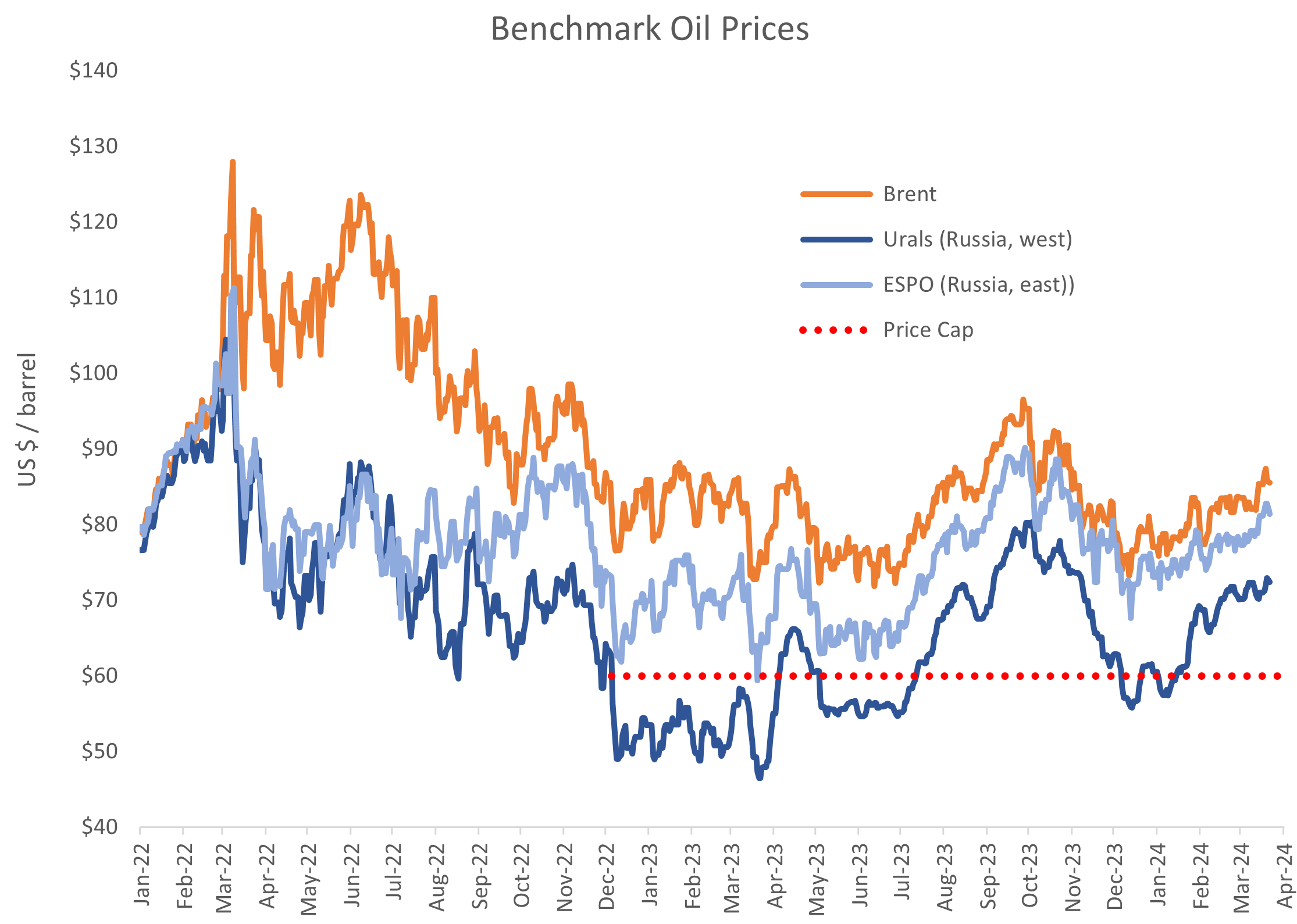
Urals, Russia's western crude oil export price, is holding around $70 / barrel and has been trading above the Price Cap of $60 / barrel since mid-2023, that is, for more than one and a half years.

At $68 / barrel at Friday close, the current Urals price is the third highest for the date in the last eleven years and well above the $56 / barrel the Russians received from 2015 to 2021 on average.  Thus, Russia is earning currently $12 / barrel more under sanctions than it did before the war without sanctions.

The Urals discount, the difference between the Urals and Brent oil prices, has stabilized around $6 / barrel. The current discount likely reflects greater logistics costs over longer transit routes and certain formal and informal transaction fees to facilitate the trade. As the graph below shows, the efficacy of the Price Cap lasted no more than six months, which both theory and the historical record would anticipate. A prohibition -- an enforcement-based regime -- shows initial success, but motivated buyers and sellers find alternate trading mechanisms to resume trade. Every time one route is closed, another is opened in what I have described as the Whac-a-Mole syndrome. The graph suggests that Russian oil traders achieved near total circumvention of sanctions more than one year ago.

Russian Oil Production

Russia has ceased reporting its oil production and export data, and as a result, the publicly available numbers are a mix of analysis, speculation and outright disinformation. The US EIA reports that Russian oil production has fallen to about 10.5 mbpd, compared with 11.3 mbpd on the eve of the war three years ago. Had there been no war, Russian oil production might reasonably have been expected to rise to around 12.2 mbpd.

Thus, current production estimates represent a reduction of 14% compared to the levels which Russia would have seen absent the war.  This is consistent with the 15% reduction to the counterfactual that we have seen under prohibitions.  For example, during Prohibition in the 1920s, per capita alcohol consumption in the US fell 15% compared to the level prior to the ban.  

Russian Oil Exports

Russian oil exports are even more murky than production numbers.  For example, the European IEA sees Russian crude and product exports at 7.3 mbpd for December, essentially unchanged since the start of the war.  By contrast, the 2024 Energy Institute Statistical Review of World Energy (formerly the BP Statistical Review) reported Russian exports down by more than 1 mbpd in 2023.  This is consistent with the EIA's view of Russian oil production, which sees production down 0.8 mbpd and Russian domestic consumption up marginally compared to the pre-war period.  As exports are materially the difference between production and consumption, the US EIA implies a decline of exports around 1 mpbd, consistent with the Energy Institute Statistical Review and at odds with the IEA's view that exports are essentially unaffected by the war.

Notwithstanding, the point is not to argue uncertain data, but to concede that neither Russian production nor exports have been crippled by sanctions.  This comes as no surprise, as it is entirely consistent with both black market theory and the dismal track record of other historical prohibitions across a range of contraband and countries.

The Shadow Fleet and the Failure of Sanctions

The imposition of sanctions in 2022 prevented western companies from transporting Russian oil in their tankers at prices above $60 / barrel. In response, the Russian government and its affiliates established their own ‘shadow fleet’ to avoid sanctions, recently estimated around 600 tankers. Of these, 276 have been sanctioned by various jurisdictions, with 213 sanctioned by the US alone.

The Biden administration sanctioned relatively few shadow fleet tankers until after the Democrats lost the election, at which time the number of sanctioned tankers quadrupled, from 54 to 213.

The Brent oil price shows why such sanctions, which could have been imposed years earlier, were delayed until after the election. The increase in the number of sanctioned vessels led to a short-term restriction in Russian supply and a surge in tanker rates, translating into a $10 / barrel increase in the price of oil in a matter of days.

No politician or bureaucrat in the advanced economies would wish to take credit for raising the price of gasoline at the pump. This includes President Trump, who has publicly called on Saudi Arabia to reduce oil prices and backed down when his proposed tariffs were set to increase fuel prices in the US Midwest.

This paradox is the central problem for Ukrainian decision-makers and analysts who continue to push sanctions on Russian oil production and exports. Ukraine’s allies simply do not want higher oil prices, and they would rather see Kyiv fall than push through a 50 cent increase in the price of unleaded on their constituents.

As a result, the sanctions regime — the Price Cap in particular — remains as porous as a sieve and no amount of carping from the Zelenskyy administration is going to change that.

The lamentable part of the story is that is was all predictable far, far in advance. My readers will know that I highlighted these risks six months before the Cap was even implemented. This was no accident. Politicians love prohibitions, and therefore sanctions on Russia were almost certain to be in the form of prohibitions, which would then predictably fail, as they have done.

Fixing the situation is a straight-forward matter, a topic for future post.

Rigs and Spreads April 26: Unchanged

The US oil business remains as uneventful as I have seen it since I started covering the sector 17 years ago. Very little has changed since last September, including rig and spread counts and oil production.  It’s frankly a bit strange in an industry characterized by massive swings, both up and down.  Of course, stability is preferable.  Nevertheless, the history of oil tells us that it is unlikely to last too long.

  • Rig counts

    • Total oil rig counts: -5 to 506

    • Horizontal oil rig counts: -2 to 457

  • Frac spreads: -3 to 257

  • DUC inventory has largely stabilized at 16 weeks of turnover

The Alternative is sinking Russian Tankers

It's been a wild week.  Over the weekend, Iran unleashed a barrage of missiles on Israel; the world awaits the response.  President Trump is in the dock, in a criminal trial he looks set to lose.  Speaker Johnson finally appears ready to introduce various funding bills for Ukraine, Israel and Taiwan, even as the Clown Show tries to take him down.  And meanwhile, the US Secretary of Defense, Lloyd Austin, admonished Ukraine to observe proprieties and not make waves as the country fights for its life.  The US appreciates that the situation may be desperate, but for goodness sake, please do it quietly! Those attacks on Russia refineries could increase fuel prices and inconvenience all of us.

Ukraine has been facing the twin challenges of an excessively timid Biden administration and a wildly dysfunctional Republican conference in the House.  Barring a vote to fund Ukraine this weekend -- and even with it at some point -- Ukraine may be compelled to try to restrict Russian oil exports through the Black Sea.  A combination of Russian, western and other tankers export almost $10 billion of Russian crude from the Black Sea every month.  That equals the entirety of Russia's defense budget.  The oil continues to flow only because the US and western Europe so desire.  In essence, the US is protecting Russian oil exports and allowing Russia to fund the war thereby.  

Ending this trade would materially degrade Russia's ability to conduct the war.  It would also raise oil prices comfortably to $150, and perhaps as high as $200, per barrel.  This would push Europe into a steep recession and would similarly punish US consumers.  Indeed, US drivers would lose $60 bn / month in added gasoline and diesel costs, with the price of regular gasoline reaching perhaps $6 / gallon ($8 in California).   US government support of $60 bn for Ukraine for the entire year would look like peanuts by comparison.

Should that happen, Kyiv would be in a position to shift the blame firmly onto the MAGA Republicans in Congress.  Does Marjorie Taylor Greene prefer $6 gasoline to supporting Ukraine?  Kyiv can put her to the test.  

A strike on a Russian tanker would also panic the White House, prompting a swift and desperately needed restructuring of the Price Cap.  Ukraine will not win the war without it. 

Attacking Russian tankers is, of course, a politically risky option.  A very risky option.  On the other hand, certain defeat at the hands of the Russians is a much higher price to pay.  If push comes to shove, the Ukrainians need to shove.  Marjorie Taylor Greene and the MAGA Republicans need to decide if they want to own $6 unleaded as the Ukraine vote reaches the House floor.  

Oil Prices

Brent crested $90 last week, but is trading down a bit, $87 at writing.  Nevertheless, copper prices continue to surge.  Thus, either copper has to retrace, or Brent might be expected to rise to $96 / barrel.  

Urals has closed up, much as expected, to $78 / barrel, $18 / barrel above the Price Cap.  

The Urals discount, the difference between Russia's western crude oil export price and Brent, has compressed to around $11 / barrel, again, much as expected.

Urals is now at the highest level for this date in at least nine years.

Despite US fretting, European gasoline and diesel prices do not appear materially affected by Ukraine's attacks on Russian refineries.

Overall, oil prices are developing much as expected and against Ukraine's interest.  The easiest, though high risk, way to motivate a desperately needed and vastly overdue restructuring of the Price Cap would be an attack on an oil tanker carrying Russian crude in the Black Sea. If the House fails to fund Ukraine and the White House declines to revisit the Price Cap, it might come down to that.

Not good.

Trends are running markedly against Ukraine this week.  House Speaker Mike Johnson must put Ukraine funding on the table right now, as the situation is becoming critical.  And Ukraine won't win the war without a restructuring of the Price Cap.  That's the moral of the story for this week.

Oil Prices

Oil prices really took off this week, with Brent closing above $91 / barrel on Friday.  This is the highest since September. 

One might be tempted to attribute this wholly to Russian and  OPEC+ supply production cuts, but in fact, it's not just oil.  Copper has had an even better run, closing on Friday at $4.25 / lb, the highest in fifteen months.  Copper and oil covary, and as such, copper is implying the 'fair value' of Brent should be about $93.  Therefore, oil seems to have some upside potential. Taken together, oil and copper are indicative of a strong global economy.

China is the exception.  Iron ore and steel prices are hovering near five years lows, although not at exceptionally low levels.  Such prices are heavily influenced by Chinese real estate and infrastructure construction, and both are struggling just now.  

In any event, oil prices are evolving as leading investment banks have anticipated.  I would add that US shales will not come to the rescue this time, with the EIA forecasting largely flat US oil production over the next several months.

Following on the Brent rally, Russian oil prices are also showing life, with Urals closing the week above $75.  The Urals discount, the difference between Russia's Urals oil export price and Brent, averaged nearly $16 / barrel for the week.  This is likely the result of delays in reporting, and we might expect the discount to close back to $14, with a tendency towards $12.  Urals at $80 / barrel is within sight.

Finally, the Urals price is not only well above the $60 Price Cap and rising, it is also testing nine-year highs.  This is a lousy situation for Ukraine, but entirely predictable and the direct result of poor decision-making in both Washington and Kyiv.

Finally, EU fuel prices appear largely unaffected by Ukraine's continuing attacks on Russian refineries.  Notwithstanding, expect gasoline and diesel prices to follow crude oil prices up, as is normally the case.

So, to sum up the takeaways:  While Russian and OPEC supply cuts may be lifting oil prices, they are not the only factor.  A strong global economy appears equally responsible, suggesting that oil prices could continue to rise, just as a number of analysts have been forecasting.  Urals is already $15 above the Price Cap and $4 / barrel above the budget numbers used by the Russian central bank.  The Urals discount is likely to compress further, pushing Urals closer to $80 over the next few weeks.

Meanwhile, the Ukrainians are running low on ammo and anti-aircraft missiles, just as the Russians have developed a more effective glide bomb and reports are surfacing about a 300,000 man assault by the Russians on Kharkiv.  It's now or never for Speaker Johnson on Ukraine funding; and Washington and Kyiv had better start contemplating a near-term restructuring of the Price Cap if Ukraine is to prevail.

Putin: Oil to $100 to Elect Trump

JP Morgan strategists see "Brent crude heading toward $100 a barrel this year without countermeasures to balance Russia’s decision to cut production".  As I noted last week, Russia looks to cut production by roughly 500,000 bpd, complementing OPEC cuts of similar size.  Barron's notes: 

“The shift in Russia’s strategy is surprising. At face value, and assuming no policy, supply or demand response, Russia’s actions could push Brent oil price to $90 already in April, reach mid-$90 by May and close to $100 in September, keeping pressure on the U.S. administration in the run-up to elections,” J.P. Morgan’s Natasha Kaneva said [in a note issued on Wednesday, March 27].

This is a curious, but not surprising, development.  To date, the Kremlin has not pursued oil price maximization to finance the war.  Therefore, the motivation now is likely different, and from the Kremlin's perspective, much more compelling.  As Barron's and others point out, oil price increases appear designed to encourage US voters to reject Biden and elect Trump.   This in turn reflects two implicit beliefs from Putin.  First, the choice of US leader appears of paramount importance.  That is, Putin believes Russia cannot defeat Ukraine unless the US abandons Kyiv.   While this may be news in Republican circles, I have stated on several occasions that NATO's population is six times and its GDP is a staggering twenty-fives times that of Russia.  Russia's taking on NATO would be akin to a 10 pound child taking on a 250 pound man.  I take Putin as a reasonably intelligent man, and he appreciates Russia's odds are unfavorable if NATO, and in particular, the United States stands beside Ukraine.  Electing Trump, therefore, is a key Kremlin priority.

Second, Putin appears to place supreme confidence in the actions of Trump were he re-elected.  Why?  Why would a Russian autocrat feel he can exercise absolute dominance over an elected US president?  Why does Putin believe Trump and the US will be subservient to the Kremlin's wishes?  When, in the entire history of the United States, did a US president crawl before a two-bit dictator?  

Russia has been exploiting Republican paralysis in the US Congress to attack Ukraine at a murderous pace for the last six months, but at a high cost.  According to Ukrainian official numbers, eliminated Russians now exceed 440,000, tank losses are approaching 7,000; armoured personnel carrier losses exceed 13,000; and more than 11.000 pieces of Russian artillery have been destroyed.  Can Russia sustain this pace?

If one wants to assess the Kremlin's state of mind, there is no better source than Viktor Orbán, Hungary's Prime Minister and Putin's NATO mouthpiece.  Last month, Orban suggested that Ukraine be left as a neutral buffer state between Russia and Europe.  This can be taken as a Kremlin trial balloon to seek a settlement to the war.   On March 15th, Putin added this:

"For us to hold negotiations now just because [the Ukrainians] are running out of ammunition would be ridiculous. Nevertheless, we are open to a serious discussion, and we are eager to resolve all conflicts, especially this one, by peaceful means."

In other words, Putin will discuss peace, but because the US is refusing to arm Ukraine, Putin wants better terms.  Nevertheless, Putin is signalling that the war is beginning to wear Russia down.  He is feeling for an exit, one which can only be achieved if the US abandons Kyiv.  Therefore, Putin's strategy fundamentally depends on his influence over the Republican Party, and the Republican Party today is the creature of Donald Trump.  As Putin feels confident in his ability to control Trump, re-electing Trump is central to Russian strategy.  Hence the drive for $100 oil.

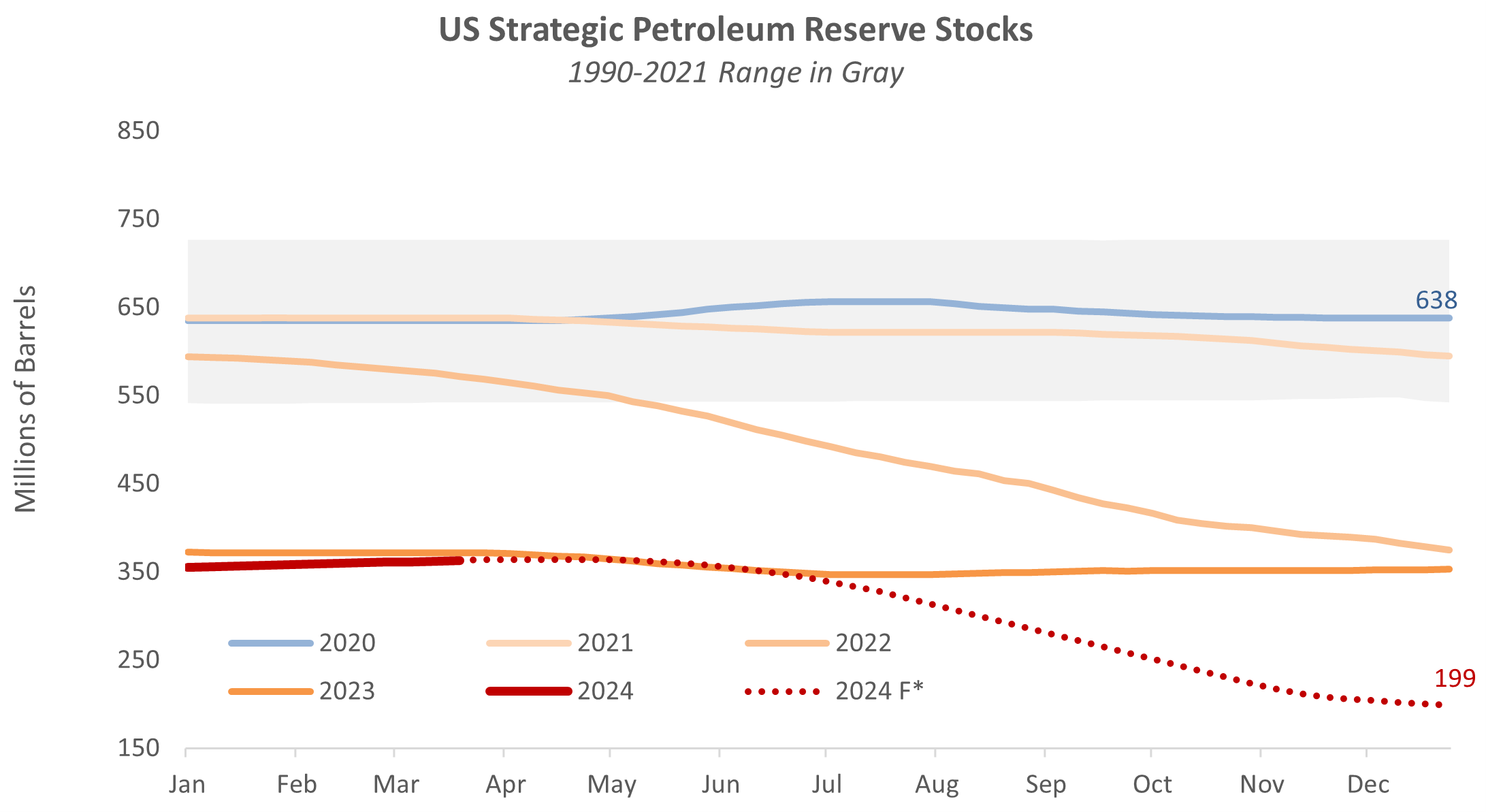
Some analysts have suggested the US could once again tap its strategic petroleum reserve to counteract Russian and OPEC+ production cuts.   Is this feasible?  The SPR was drawn at the pace of 1 mbpd in the early stages of the war, about as much as would be required to offset announced OPEC+ production cuts.  As the graph below shows, such draws are not unprecedented, even in recent history.

Source: EIA

On the other hand, the SPR is depleted.  The Biden administration has drawn down the reserve to only 55% of its normal levels.  To counteract OPEC+ production cuts, we forecast the Biden administration would have to further reduce the SPR to about 200 million barrels, only ten days of US oil consumption and less than one-third of customary levels.  In principle, this is possible.  As a political matter, and more importantly, as a matter of prudent management, such draws appear problematic.  

* Forecast assumes SPR is drawn at a pace of 1 mbpd to counteract Russian and OPEC+ oil supply cuts

Source: EIA, Princeton Policy forecasts

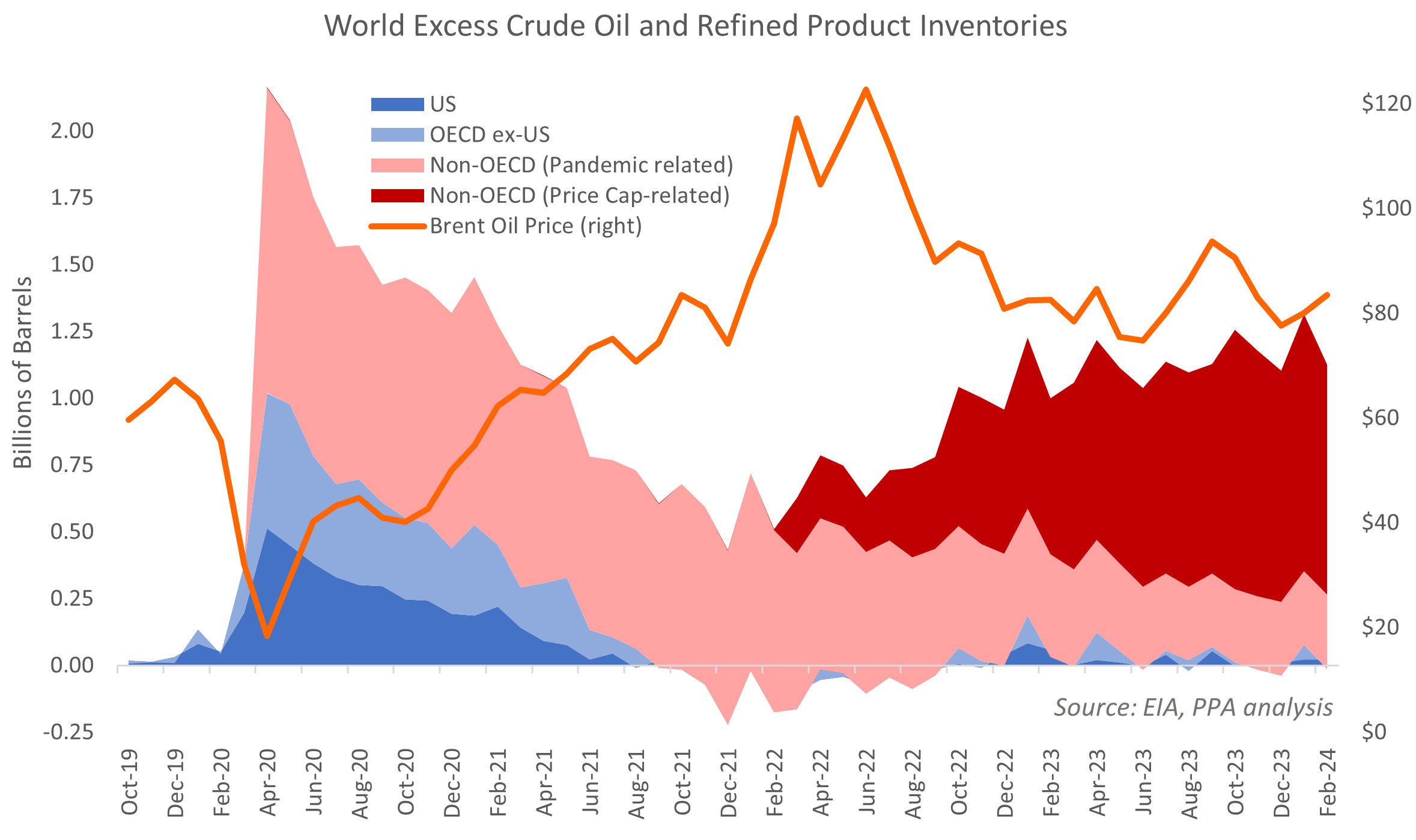
Importantly, the US would be drawing its strategic reserves even as massive amounts of excess crude are parked in the non-OECD countries, most notably China.  As I noted earlier, excess crude inventories soared during the pandemic, largely owing to collapsed consumption.  By late 2021, however, the US and other OECD countries had largely recovered, and inventories, as measured by days of turnover, had returned to normal levels.  Not so in Asia.  China's delayed re-opening kept excess inventories elevated, and the Russia-Ukraine war started before such excess crude inventories were fully run down.  Instead, the Price Cap and Embargo offered an enormous incentive for Indian and Chinese traders to hoard oil, which they do to this day, to the tune of about 1 billion barrels above normal operating needs.   Thus, the use of the SPR to counteract the Russia and OPEC+ production cuts would have the effect of gutting US strategic reserves even as Asia, and most notably China, is awash in speculative, excess crude, in addition to their own strategic reserves.  And, of course, all this is happening in the context of a European war with serious risks of spreading to East Asia.  Raiding the SPR to win the November election looks like bad policy and may even prove to be bad politics.

Source: Princeton Policy analysis of EIA STEO data

Meanwhile the Ukrainians continue to attack Russian oil refineries, reportedly causing a 4% loss of throughput and a 25% increase in Russian fuel prices.  European Union fuel prices appear largely unaffected, although the Biden administration worries about retaliation against western energy infrastructure.  

Source: European Commission, data through March 25

The dysfunction between Washington and Kyiv regarding policy towards the Russian oil business is essentially attributable to the misspecification of the Price Cap and Embargo.  Were the Price Cap appropriately designed and implemented, Brent would effectively be capped at $75 / barrel through the US election in November.  The excess inventories in Asia are all stored at logistics hubs and can easily be sold and delivered for consumption.  The greater the OPEC+ production cuts, the faster excess crude inventories would flow into the market.  Further, any increase in the price of oil would be beneficial to Ukraine, as a properly structured Price Cap mechanism would fully capture the value of the increased price.  Brent at $100 / barrel would translate into an incremental $80 billion to Ukraine per year.

Finally, I would note the Kremlin's hostility to the US in attempting to raise oil prices to inflict damage on US consumers and tilt the US election.  I would also bring attention to Business Insider's investigative piece on Havana Syndrome, which increasingly looks like attacks by Russian security services on US government employees and officials during peacetime.  For those who think Russia is America's friend, I encourage you to read the article.

******

Oil Prices

Brent continues to show strength, closing on Monday at $87.75.  Urals, Russian western crude oil export price, remains at $72, albeit with a lag in reporting due to the Easter holidays.  Expect Urals to rise by $2 / barrel in the next few days.  

If Brent crests and holds above $90, the Urals discount should shrink closer to $12 / barrel from the $14-15 discount seen in the last several weeks.

​The Urals oil price remains the highest in the last nine years bar 2022.

Bottom line: Both Kyiv and the White House need to re-open the issue of the Price Cap and restructure it to Ukraine's and the Biden administration's advantage.

Go ahead, bomb some refineries

This week's news revolved around Ukraine's successful campaign against Russian oil refineries.  Since the beginning of this year, Ukraine has hit more than ten major oil refineries and depots, some of them more than once.  This appears to be causing disruptions inside Russia, and consternation at the White House, which has called on Kyiv to cease such attacks for fear of raising global oil prices.  Kyiv has rejected such demands, declaring that Ukraine has "an absolute right to deplete the Russian army," according to the Daily Wrap.

Let's take a look at the numbers.  Brent closed on Friday at $85.50, which is a bit higher than recently, but nothing special.  ING Bank sees Brent at $87 for Q2, and given that Brent is almost there right now, oil would appear range-bound for the moment.  Copper prices, which tend to covary with oil, also suggest Brent only marginally above current levels.  

The risk of Ukrainian attacks on refineries is not on crude oil prices.  Refinery attacks do not affect crude oil production.  Rather, they constrain the ability to convert that crude oil into refined products like gasoline and diesel.  If Russian refinery capacity is reduced, the Russians will simply export less refined product and more crude oil.  For the moment, the Ukrainian strikes affect only a small portion of Russian throughput and are not influencing European fuel prices, as the graph from the European Commission below shows.  If the crude is not refined in Russia, it will simply be exported as crude and refined elsewhere.

Source: European Commission

The graph above does, however, show that European pre-tax fuel prices are about 50% higher than before the war, owing principally to the Price Cap and Embargo.  

The greater risk to oil prices are announced production cuts. Russia will cut its oil supply by almost half a million barrels per day in the second quarter of 2024, according to the Moscow Times.  Russia's Deputy Prime Minister Alexander Novak said that Moscow plans to reduce its output by 350,000 barrels a day (bpd) in April, by 400,000 bpd in May and then 471,000 bpd in June.  These cuts are reflected in the EIA's forecast for Russian production, which anticipates the Russian crude oil supply to decline by 530,000 bpd from January to June and bottoming at 10.3 mbpd before returning to previous levels in mid-2025.  

Russian supply reductions are part of a larger OPEC+ production cut of 1 million bpd announced in late November.  As oilprice.com opined, "Saudi Arabia and allies like Russia would prefer to see Donald Trump reelected, and they may therefore try to drive prices up ahead of the election. It will be harder for President Biden to win reelection if gasoline prices are skyrocketing ahead of the election."

The simple response to this is a restructuring of the Price Cap.  The Price Cap has led to hoarding of crude oil stocks.  If oil is selling below the market price -- and Russian oil is -- then traders will load up with as much as they can store, knowing they have profits locked in.  We estimate global excess crude oil inventories (those above the level needed for the everyday operation of refineries) at 900 million barrels.  This is only 200 million barrels below the pandemic peak, when analysts were expecting the entire oil sector to collapse.  Put another way, excess crude inventories are at all but historic highs. 

Source: Princeton Policy estimates using EIA STEO data

A restructuring of the Price Cap and Embargo would allow this oil to re-enter the market, as it would redirect the excess profits currently captured by Chinese and other oil traders to a G7 controlled entity.  This would eliminate the incentive of traders to hoard inventories above normal levels, and they would consequently liquidate most of the excess crude.  We can also estimate the pace of liquidation based upon the post-pandemic experience, which was 1.5 mbpd.  As a rule of thumb, each incremental supply of 1 mbpd will reduce the price of oil by $10 / barrel.  Thus, releasing excess crude inventories would be expected to knock $15 / barrel off the price of Brent for approximately 18 months, implying a Brent price around $70 / barrel.  For purposes of comparison, the average price of Brent from the peak of excess pandemic inventories in May 2020 to the end of liquidation in Dec. 2021 was $57 / barrel, about $67 / barrel adjusting for the impact of lockdowns.  Therefore, the expectation for $70 Brent and $65 WTI is plausible with a restructured Price Cap.  Further, Urals would be pushed down to $55 / barrel, well off the Russian central bank's forecast of $71 / barrel for 2024.   The Urals discount, which today stands at $14 / barrel and has averaged $12.50 over the last two months, might be expected to expand modestly to $15 / barrel, with all of that captured by the G7.

For the time being, Ukrainian strikes on Russian refineries appear to have no effect on diesel or gasoline prices in Europe, and the Biden administration should therefore yield to Kyiv's priorities in the matter.  By contrast, announced production cuts by Russia and other OPEC+ members represent an appreciable risk of higher oil prices.  The answer to that challenge is a much-needed and vastly overdue restructuring of the Price Cap.   As the Biden administration has been slow on the uptake, the Ukrainians may ultimately be forced to take the matter into their own hands and sink a Russian oil tanker in the Black Sea.  Now that would concentrate minds. The Price Cap would be restructured within days.

Open Borders; Black, Hispanic wages to $5; Easy win for MJ

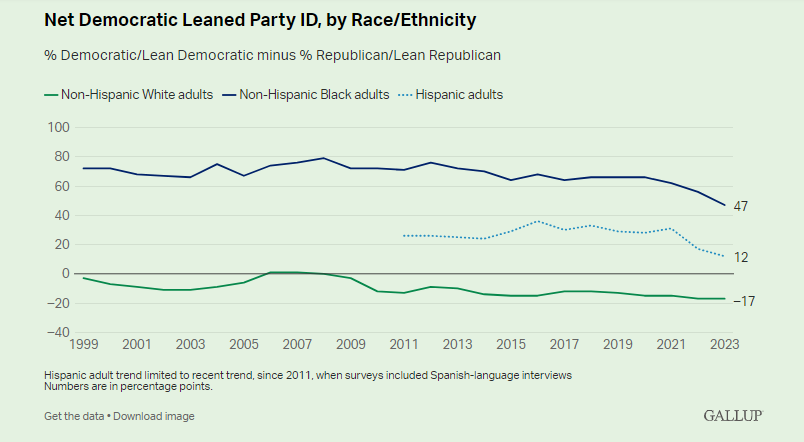
President Biden and former President Trump both visited the US southwest border last week, each trying to claim the high ground with voters on border security.  For now, President Trump's position is far superior to that of President Biden.  Indeed, if policy stays as it is today, disaffected black and Hispanic voters will cost Biden the election.  Under the circumstances, House Speaker Mike Johnson is well-placed to take an easy win.

Understanding Illegal Immigration

To understand illegal immigration, we need to consider the motivation for migrants to enter the US. Living conditions in Central America are the primary driver.  Many there are very poor by American standards.  Cross Catholic Outreach describes the situation in Guatemala:

In Guatemala, about one in four people earn less than $3.65 a day [$0.46 / hour], and nearly 60 percent of families fall below the poverty line.  Many Guatemalan families are currently forced to take refuge in makeshift shelters built with inadequate materials such as mud, cane and tarp. Many also go without basic sanitation services. In fact, roughly one-third of the rural population does not have access to adequate latrines or toilets at home, a dangerous issue that contaminates local water and puts lives at risk.

Housing of the Rural Poor in Guatemala, Source: Guatemala Housing Alliance

The World Bank paints a similar picture of poverty in Honduras

Honduras remains one of the poorest and most unequal countries in the region. In 2020, as a result of the pandemic and Hurricanes Eta and Iota, the share of the population living under poverty (US$6.85 per person per day at 2017 PPP) reached 57.7 percent.

Rural, low income housing in Honduras; FPProjects 2020

Many Central Americans are destitute.  Yet, as hard as it may be to believe, Central America is not exceptionally poor by global standards.  Unskilled wages average $1.50 / hour in Guatemala and Honduras, but they are only $0.50 / hour in South Asia (India, Pakistan, Bangladesh) and $0.25 / hour in parts of sub-Saharan Africa.   As impoverished as parts of Central America may seem, they are still middle class by the standards of much of the rest of the world.  Even China is not much better, with a minimum wage of $2 / hour outside the large cities. 

These realities drive poor Latin Americans and others to leave their home countries and migrate to the US, legally or illegally.  Once such migrants are in the US, they will remain until they are indifferent between staying in the US or returning to the conditions shown above.  That is, if borders are open, migrants will continue to come to the US en masse until their standard of living in the US, all things considered, is no better than in their home countries.  

This has yet to occur, however, and for a good reason: border enforcement.  Border enforcement has historically prevented most undocumented migrants from entering the United States.   As a result, the demand ​in the US for undocumented migrant labor has generally exceeded its supply.  Consequently, illegal immigrants have not encountered great difficulty in finding work at wages near those prevailing in the US, rather than those in their home country.  This​ mirrors the dynamics of the illegal drugs trade.  The great fortunes of the Colombian, and later Mexican, cartels were driven principally by the drug enforcement efforts of the DEA, Customs and Border Protection, and other agencies.  Those who were able to smuggle drugs across the border enjoyed outsized profits because drug interdiction kept supply well below demand, leading to high prices and elevated profits.  Illegal immigration is no different.  It is border enforcement, and resulting high wages, which makes illegal entry so attractive.

In an Open Borders model, as currently practiced by the Biden administration, migrants can enter the country largely at will.  Border Patrol and Customs are no longer limiting supply through enforcement.  As a result, the equilibrium will not be the US unskilled wage, as it was prior to the Biden administration, but rather the migrants' home country wage.  Over time, the living conditions of illegal immigrants (asylum seekers) and their competitors -- principally earlier waves of illegal immigrants and some low income blacks -- will tend to deteriorate, and do so in predictable ways.

Open Borders and Wage Levels
I have written frequently about the Relocation Wage, the wage necessary to induce a migrant to come to the US.  This is the migrant's home wage, plus an adjustment for higher living costs in the US, and perhaps a premium to induce migrants to leave home.  In Central America, the unskilled wage is $1.50 / hour.  Add to that $3 / hour higher for higher living costs in the US, and migrants would need to earn $4.50 / hour at a minimum to come to the US.  If we include a premium to induce relocation, unskilled migrants would move to or remain in the US for, say, $5 / hour, that is, about 30% of the effective minimum wage of $14-18 / hour in the US.   

If Open Borders persists for an extended period of time, migrants will continue to arrive until those with whom they compete face either falling wages or a loss of employment.  Of course, not everyone sees it this way.  My friends at the CATO Institute, for example, might argue that migrants create their own employment, and indeed they do.  The relevant question, however, is the maximum pace of absorption without disrupting either prevailing wages or employment levels.  As my prior analysis showed, in a typical good year, the US can create around 2.5 million new jobs.  By implication, the US is unlikely to be able to absorb much more than 1 - 1.5 million incremental, migrant workers annually. 

At the same time, quite literally billions of people could be induced to move to the US even at wages much lower than those prevailing.  For example, even if US unskilled wages were $5 / hour, unskilled Indian workers could triple their income by moving to the US, even after allowing for a higher cost of living here.  That is, the pool of potential migrants vastly outnumbers -- by a factor of perhaps 1,000 to 1 -- the US ability to absorb them. The US would require centuries, and perhaps millennia, to absorb the potential pool of migrants without damaging its own labor markets.

Those most exposed are low wage blacks and Hispanics.  A New York Post story illustrates the impact on undocumented Hispanic immigrants who arrived earlier:

Longtime migrant workers are disgruntled with new waves of arrivals to New York City who they say are undercutting them — claiming anyone hiring them should “get the f—k out of here”. “If you can get the work cheaper you are going to use those guys. You are not going to pay $200 when you can get [it for] $40. Anything you give them, they’ll take it."

Unskilled blacks are similarly affected.  According to a 2007 study by the National Bureau of Economic Research, black employment is more sensitive to an immigration influx: “For white men, an immigration boost of 10 percent caused their employment rate to fall just 0.7 percentage points; for Black men, it fell a full 2.4 percentage points.” As Brian Mullins, cofounder of the Black American Voter Project, sees it today: "From construction to stores, even the guy washing the windows, it’s a migrant charging less than the black men.”

Nearly half of US blacks and Hispanics could be affected.  A recent Oxfam study reports that 46% of Hispanic, and 47% of black, workers earn $15 / hour or less.  For nearly half the minority electorate, unchecked immigration is a bread-and-butter issue.

Source: Oxfam: The Crisis of Low Wages in the US (2022)

Unemployment and Crime

The issues extend beyond hourly wages.  The poor migrant will be in principle indifferent between earning $5 / hour with full employment, or $15 / hour with 67% unemployment, or some combination thereof.  Therefore, open borders may, and likely will, lead to high levels of migrant unemployment which, from the migrant’s perspective, is still preferable to returning to their home countries.  This portends the rise of the US equivalent of the French banlieues, blighted neighborhoods with low assimilation and youth unemployment rates in the 40-50% range

Unemployed young men are prone to get into trouble, notably joining gangs and entering the drug trade.  For example, the Miami Herald reports that a Venezuelan criminal gang that for the past few years has been extending its operations and causing havoc throughout Latin America has made an appearance in South Florida.  Other migrants will turn to begging or scrounging.  In New York, the mayor has instituted a curfew for migrants due to complaints about panhandling.  The Chicago Tribune reported migrants were digging through trash bins in search of food.

Impact on Social Programs

To most Americans, migrant poverty, homelessness and unemployment will seem a terrible and intolerable social ill.  This will lead to initiatives to improve the lots of newly arrived migrants. Unfortunately, accommodating migrants will cannibalize social services and welfare programs targeting low income Americans.  For example, the principal of a high school in New York City had to defend housing migrants in school as students went remote. Indeed, New York City data shows over 116,000 migrants have flocked to the Big Apple since last spring and most are making ends meet working in the illegal underground economy — many while still living rent-free at taxpayer-funded hotels and shelters.

A Growing Backlash

All this is causing a backlash in the black community.   As Chicago Magazine notes in What about Us? (July 2023):

In May, when then-mayor Lori Lightfoot announced plans to house 250 Venezuelan migrants in the old South Shore High School, she ignited a nativist backlash that sounded like something from a Donald Trump rally. “It is a slap in the face that we as citizens of the United States of America do not have the resources and support, but you’re gonna bring people that are not citizens here in our buildings that we pay taxes for that you took away from us,” South Shore resident Natasha Dunn said outside a public meeting at the school. Inside, a protester waved a “Build the Wall 2024” placard.

Source: Townhall

When the black community feels it has to brandish 'Build the Wall' posters, the Biden administration can assume it is in trouble.   And that's what the polls show.  Support for Democrats is crashing, with 'net lean Democrat' in the last two years down from 62 to 47 percent among blacks and a shocking 31 to 12 percent among Hispanics, according to Gallup surveys.  Open Borders is not winning the friends the Democrats had expected.

Political Implications
Open borders has opened a conservative economic appeal to minority voters.  Consider this hypothetical Trump pitch:

"Flow Joe" Biden.  He's just going to flow those illegal immigrants across the border, millions every year.  And they're coming for your jobs.  We'll have more illegal immigrants than new jobs this year, and that means $5 / hour migrants are coming for your work.  Three million of them.  And if Joe's re-elected, they'll just keep coming year after year or until you're earning as much as some poor Guatemalan migrant.  The rich Democratic elites, they'll have all the cheap labor they want.  House cleaners, landscapers, and labor for construction and factories.  Cheap, cheap, cheap.  And if you're a low wage black or Hispanic, you'll end up being that cheap labor.  Can you afford to re-elect Joe Biden?  Can you take Open Borders for another four years?  Because $5 / hour is what you're going to get if you vote for Joe Biden.

This appeal is not going to fall on deaf ears, and it is one of the principal reasons that Biden's support among blacks and Hispanics is cratering.

Source: Financial Times

Joe Biden and the Democrats have little option but to close the border, but owing to the requirements of their own political base, would like to blame it on the Republicans. This in turn constitutes a huge opening and prospects of an easy win for House Speaker Mike Johnson.

As I have stated before, the Republicans' demands should come down to a single requirement: asylum requests in the US should only be allowed to those otherwise legally present in the country.  We anticipate this one change would reduce border encounters by 70% compared to our forecast for the back half of the year, to under 70,000 / month.  This is still a high number, but a vast improvement compared to expectations.

Such an approach would allow Mike Johnson to take the podium and declare the Republican position in a single, simple soundbite: no asylum to those in the US without legal presence .  This would enjoy the support of the majority of Americans who clearly appreciate that the surge in illegal immigration is driven by the egregious abuse of US asylum law.  Further, it would position the Republicans as a constructive force in American politics, not the purveyors of clown show dysfunction and dictatorship that they project today.

Finally, it would also clear the path to freeing funding for Ukraine, whether by loan or grant or some combination.  

The net result would be at least a partial recovery of the Republicans as standing for law and order, both domestically and internationally.  The Democrats have been far too soft on domestic crime and disorder; the Republicans are bizarrely attracted to a foreign autocrat waging war on our allies and firmly committed to the destruction of the United States.  Closing the asylum loophole and standing up for our allies would restore a necessary balance, promoting order both at home and abroad.

Illegal Immigration Outlook 2024

Illegal immigration is top of the US political agenda heading into the election, and of course, frames the possibilities of Ukraine funding.  In this post, we look at the outlook for 2024.

We forecast US southwest border encounters by Customs and Border Patrol at 2.7 million for FY 2024, based on the last three months of data, adjusted seasonally.  Apprehensions look to come in just a hair above 2023 levels.  Inadmissibles, those presenting at official crossing points without appropriate documentation, are slated to rise by almost 200,000, largely due to the monthly rise over the last year, but essentially at the same pace as seen in the last few months.  Thus, 2024 is forecast to see a new all-time record for encounters, eclipsing the pre-Biden records set under the Reagan and Clinton administrations by more than one million.  It is also 400,000 higher than the quantities proposed in the much-maligned Border Security Act promulgated last month.

Source: US Customs and Border Protection, Princeton Policy analysis and forecast

Border encounters do not, of course, directly determine the number of undocumented migrants gaining entry into the US interior.  Historically, most of those arrested at the border were deported.  Further, not all those crossing the border are detected or detained, with these collectively known as 'gotaways'.  To appreciate the societal impact, the change in the undocumented population must be separately estimated.  The 'go-to' source for such numbers has been the Pew Research Center, which has estimated the undocumented population every few years.  Pew's estimates are not without their critics, including me, but are still the most widely accepted.  By Pew's count, the undocumented population of the US rose by an average of 256,000 per year from 1994 to 2020.  This number is skewed by the effects of the Great Recession, which actually saw the undocumented population fall.  If we exclude the 2008-2020 period, Pew's analysis suggests the undocumented population rose by 550,000 per year, which we might consider the normalized value for assessing undocumented entry during the Biden administration.

Source: Pew Research Center; US House of Representatives Committee on the Judiciary and Subcommittee on Immigration Integrity, Security, and Enforcement (Oct. 2023): Princeton Policy analysis

As the graph above shows, undocumented entry has exploded under the Biden administration's Open Borders policy, rising from an estimated 1.1 million in 2021 to our forecast of 3.2 million for 2024.  

As these numbers are likely to draw protest from various DC think tanks, allow a brief digression into methodology.  Our forecast is based upon statistics from Customs and Border Protection and numbers contained in the House Judiciary Committee's Oct. 2023 report, "The Biden Border Crisis" (well worth reading for the outrage alone).  The House report, prepared under a Republican majority, is clearly hostile to the Biden administration.  Nevertheless, the figures presented appear largely accurate and therefore suitable for our analysis and forecast.  

'Undocumented entry', as defined on the graph above, includes those apprehended at the southwest border but released into the interior, either directly by Border Patrol or later by ICE or HHS.  It also includes CBP One paroles and categorical paroles for Cubans, Haitians, Nicaraguans, and Venezuelans.  And finally, the estimate includes 'gotaways' as given in the House report.  Our 2024 forecast is based on these numbers adjusted for anticipated border encounters.  

The change in the undocumented population and undocumented entry are not quite the same thing.  The sources of data and the types of estimating vary.  For example, undocumented entries do not include undocumented departures, which would be captured implicitly by Pew's undocumented population estimates.  Nevertheless, the differences are so stark that, regardless of the methodology used, undocumented entry during the Biden administration can be considered categorically different from illegal immigration and border enforcement under any prior president, Republican or Democrat.  Moreover, the graph highlights the difference between leaky border enforcement and a de facto Open Borders policy as practiced currently.  Open Borders permits Illegal immigration effectively an order of magnitude greater than under the customary US border enforcement regime.  It is therefore no surprise that Republicans are making such fuss over the matter.

To an extent, President Biden has been lucky so far.  Job growth has been simply extraordinary, the best since at least 1939.  The first three years of the Biden administration saw the addition of nearly 14 million non-farm jobs.  This easily eclipses the closest comparable, the Carter years of 1976-1978, which saw growth of 10 million jobs.  Of course, the principal driver of recent employment additions has been the recovery from the pandemic, during which the US lost more than 8 million jobs.  Notwithstanding, jobs are beginning to catch up with long-term trends, and as a result, 2024 promises to be a solid, but not exceptional, year for employment growth.

Source: FRED (PAYEMS); Princeton Policy trend projections

A historically strong job market largely negated the impacts of unchecked immigration in 2021 and 2022.  Although undocumented entry was high, job growth was even higher, and consequently, the US labor market absorbed arriving migrants without material disruption.  This began to change in 2023, with our estimate of undocumented migrant arrivals reaching 80% of total job growth.  Resentment from Hispanics, notably from earlier-arrived, undocumented immigrants, and from blacks began to rise.  

Sources: FRED (PAYEMS); Pew Reseach Center; House Judiciary Committee (Oct. 2023); Princeton Policy analysis

We forecast that undocumented entry will exceed US job growth in 2024.  Thus, the resentments seen last year will likely become exacerbated as the US economy is unable to fully absorb arriving migrants.  For President Biden and Democrats, this represents a huge risk.  The path to defeat in November is not principally through disaffected independents and moderate Republicans, but rather through low-wage blacks and Hispanics who will turn to Trump in fear that another four years of Open Borders will gut their wages.  As I explain in my next post, these fears are not misplaced.

Rigs and Spreads Feb. 23: More of the same

  • Rig and spread counts are largely unchanged over the last several months.  Rig counts are materially unchanged since September, and spread counts are at the level of two years ago

  • Rig counts

    • Total oil rig counts: +6 to 503

    • Horizontal oil rig counts: +2 to 452

  • Frac spreads rose last week, +6 to 270, now fully recovered from the winter trough

  • DUC inventory continues to roll off, roughly at the pace of one DUC per day

    • DUC inventory for January stood at 12.3 weeks of completions, the lowest in a decade, likely attributable to adverse January weather; February numbers should be more typical of recent times

  • Both the EIA’s monthly Drilling Productivity Report (DPR) and Short-Term Energy Outlook (STEO) tell a similar story.

    • The EIA has been calling for a local US crude and condensate production peak since late summer

    • Notwithstanding, production figures are revised up subsequently, with the peak pushed farther to the right and currently pegged for late last year.

    • On an eyeball basis, it appears likely that upward revisions will continue through the middle of the year and perhaps into the autumn, but increasingly within a framework of declining production.  That is, at some point in H1 2024, the EIA’s peak production number is likely to hold, even in the face of subsequent upward revisions.

    • Around Q4, upward revisions should cease, and US production will begin to ease down.  A price rally would seem to be lurking around that window, depending in part on events in Asia.

  • The news from China is negative almost without exception, and I think the Chinese economy will continue to struggle.  

    • On paper, China becomes a democracy in the next two years.  

    • Of course, China may also continue to withdraw from the global economy, as it has traditionally during its long history.  This is not easy to do with that country’s level of indebtedness, the sophistication of its economy and much of its population, and declining demographics.  

    • Finally, Xi could try the ‘Galtieri Gambit’, launching a war to take over a small island neighbor with the hopes of propping up the autocrat’s popularity, per the Falklands War precedent.  

    • Let’s hope for democracy.

The Republicans lose Avdiivka

The Ukrainians were forced to retreat from the stronghold of Avdiivka, which they had held against the Russians since the start of the war in 2014.  The principal cause of the retreat was a "shortage of ammunition because of declining Western military assistance", the New York Times reported.  That is, the Ukrainians were forced from Avdiivka due to a lack of US funding directly caused by the House Republicans.

The Russian advances are unlikely to stop there, as ammunition shortages are endemic up and down the front, again, courtesy of the House Republicans.  Thus, the House Republicans can chalk up a defeat of US interests and policy to Putin's Russia, despite a US economy fourteen times larger and a population twice as big.  Mike Johnson's speakership has brought us to this point: a historic US defeat at the hands of Russia, with more to come.

And where is Johnson?  He called an early vacation for the House.  As the conservative Washington Examiner put it

Lawmakers left the Capitol on Thursday afternoon without making progress on several pieces of legislation the House initially scheduled to consider this week. The lower chamber is not scheduled to return until Feb. 28, just days before the federal government is set to enter a partial shutdown on March 1.

Johnson's speakership is rapidly disintegrating, as Rep. Thomas Massie (R-Ky.), posting on X (Twitter), noted:

Getting rid of Speaker McCarthy has officially turned into an unmitigated disaster.  All work on separate spending bills has ceased.  Spending reductions have been traded for spending increases.  

Warrantless spying has been temporarily extended.  Our majority has shrunk.

​The speakership is a difficult position at the best of times.  It is the sausage machine of government policy, where high-minded principles are ground up and converted into legislation that can command a majority vote.  The role involves all of persuasion, threats, bluffs, promises, trades and trickery.  While representatives like Matt Gaetz (R, FL) can afford to throw grenades over the parapets, the Speaker has to make the machinery of government work.  With a razor thin majority and a fractious conference, Mike Johnson is facing a Herculean task.  He looks increasingly overwhelmed.

All of this is terrible for Ukraine.  And it will ultimately prove terrible for the Republicans.  They will now have to take the blame not only for the anarchy in the House, but also for Russian victories in Ukraine.  

As it stands, Republicans are not weak on national security, they are anti-national security.  Let's see how the voters like that come November.

Two Conditions for Ukraine Funding

If the Republicans want to look a bit more politic, here are two conditions to tie to Ukraine funding.  

Regarding asylum and border security:

Asylum

Claims for asylum can only be made 

1. By those who have lawfully entered and remain in the United States 

2. At any US embassy or consulate abroad

3. Via the CBPOne app outside the United States

That's it.  It's easy to explain and does not require a 320 page bill or a week of analyst time to digest.  The public will understand what it means, and it is fundamentally reasonable.  It will not stop illegal immigration in its totality, but should reduce undocumented entry to more customary levels of border chaos.  

I might add another condition:

The Ukraine Compensation Fund

The President shall endeavor to redirect the Urals Discount to a G7 Entity to be used for funding military and economic assistance to Ukraine.

If the point is to reduce the fiscal burden of the war on the US, then the most tangible source of funds is the Urals discount, the difference between Brent and Urals, Russia's western oil export price.  That's worth about $34 bn / year based on today's oil prices, and could be worth twice that next year if oil fundamentals develop as many in the industry expect.  Should this be successfully implemented, our analysis suggests the Russians will have effectively lost the war.

The Border Act bodes ill for Ukraine

Ukrainians may be wondering how in the world the survival of their country has come to depend on US border legislation.  It's an ugly story, and the outcome bodes poorly for Ukraine.

Illegal immigration has been a problem in the US since the passing of Hart-Celler Act of 1965, effectively a prohibition on the use of seasonal migrant labor in the fields of California.  Historically, Mexicans came north to pick California's crops and returned home after the season.  The Hart-Celler Act prohibited this flow, making it harder for Mexicans to enter the country and thereby giving them an incentive to stay in the US permanently once they had crossed the border.  This dynamic really took off in the 1970s and reached crisis proportions in the early 1980s.  

The proposed solution was a broad amnesty for illegal immigrants in return for enhanced border enforcement, signed into law by President Reagan in 1986.  The amnesty went through, but undocumented entry stayed high, indeed, it reached record levels, just as black market theory would suggest.  Republicans felt that they had been duped -- they had -- and they have not forgotten it to this day.  Any proposed border legislation is viewed through the lens of this 1980s debacle.

The magnitude of illegal entry into the US is enormous.  Only twice before the Biden administration did border apprehensions -- a measure of illegal entry attempts -- exceed 1.6 million.  By contrast, apprehensions averaged 2.1 million in the first three years of the current administration.  Moreover, apprehensions historically led to expulsions under prior presidents.  Today, apprehended migrants can simply claim asylum and be released into the US interior in most cases.  The Senate's proposed Border Act of 2024 does not crack down on such illegal entry until a minimum of 5,000 daily apprehensions are reached, equal to more than 1.8 million apprehensions per year.  This again would be a record for any year prior to the Biden administration.

Further, migrants without proper paperwork at official crossing points were historically turned away and hence deemed 'inadmissible'.  Today, a migrant can walk up to passport control, claim asylum and be allowed into the country, even without any papers at all.  This has led to a surge of such 'inadmissibles' -- today, really 'admissibles' -- to 500,000 in 2023, with a minimum of 511,000 proposed in the Senate's bill.  Thus, the Biden administration is proposing undocumented entry of 2.3 million per year, 0.7 million higher than the pre-Biden record.  

This is a large number in terms of overall demographics in the US.  The UN estimates average annual US population growth at 1.5 million for the 2021-2024 period.  By implication, undocumented admissions to the US will constitute more than total US population growth, around 50% more in fact.  

The President has the authority today to radically reduce undocumented entries.  While they would not be fully eliminated, apprehensions would fall to 1 million or even less.  Nevertheless, the President wants these numbers high, in part  to be 'nice' to poor migrants and in part because the administration hopes to convert them to Democratic voters over time.  Open borders is therefore the de facto policy of the Biden administration.

Given this situation, House Republicans predictably rejected the Senate proposal out of hand.  

But how they did it was a disaster.

The Act's Senate sponsor, Republican Senator James Lankford, was clearly played.  The Democrats dragged the process out, making concession after concession, but never removing the discretionary enforcement rights of Secretary Mayorkas or the President.  Without hard commitments, Democrats were well aware that the House Republicans would reject the bill outright.  

This might not have been the end of the world had House Speaker Mike Johnson (R, LA) not committed two rookie mistakes.  By declaring the Senate bill 'dead on arrival', Johnson assumed responsibility for its failure.  He instead should have stated that the bill had many merits, but would require specific adjustments to bring it closer to HR 2, the border bill passed by the House last May.  If the Senate's bipartisan coalition would incorporate House requirements, the House would be prepared to pass a compromise bill.  This would have shifted the burden back to the Democrats and, more importantly, bought some time.

The analyst community required a few days to assess the proposal for the disaster it appears to be and lend support to the Republican position.  By committing too early, Speaker Johnson lost the news cycle and took the blame in the press.  This led to near civil war in the Republican Party, with Senators "close to shouting at each other as tempers flared during the contentious discussion," as The Hill described it.  

Meanwhile, the House Speaker has tied Ukraine funding to border legislation.  The argument for withholding funding, other than a surreal faith in President Putin as the friend of MAGA, comes down to saving that $60 billion slated for Ukraine.  And this will sound terrific until Ukraine starts losing, as appears to be the case with Andivka now.  If the issue is framed as fiscal discipline, that's one thing.  But when it will be framed as the US losing to Russia -- and make no mistake, that is how it will be depicted by the Kremlin, the Chinese and a host of other unsavory countries -- that $60 bn will have looked dirt cheap.  By rejecting the border bill and thereby depriving Ukraine of funding, Mike Johnson and the Republicans have assumed responsibility for everything that could go wrong in Ukraine.  If Ukraine falls, the Republicans will own it.  Mike Johnson will own it.

The reality is this: If the Republicans vote for $60 bn in aid for Ukraine, some in the MAGA camp will grumble, but no one is going to vote for the Democrats because of it.  On the other hand, if the Republicans lose to Russia -- and that is how it will play in the media and public opinion -- a great many Americans will not vote again for the Republican Party for a long time, and that will be Mike Johnson's legacy.  Mike Johnson is again setting up the Republican Party for the Democrats' ultimate sucker punch.

Paradoxically, the President and the Speaker need each other.  The administration's open borders policy is undermining the Democrats' political support with blacks and Hispanics.  Meanwhile, the Republicans absolutely, positively do not want to be blamed for losing to Russia.  Odd as it may seem, the Speaker and the President both need the other side to have someone to blame for policies which are not only necessary, but politically expedient.   The President needs the appearance of coercion by the Republicans to avoid blame for a necessary tightening at the border, and Speaker Johnson needs to concede Ukraine funding to avoid assuming all blame for losing Ukraine.  

None of this is simple, and perhaps none of it is even possible.  For that reason, Ukraine's situation is looking increasingly dire.  As matters stand, however, the President is putting re-election at risk by unleashing nearly 10 million undocumented migrants into the US during his first term. And Mike Johnson thinks toeing a Trumpian line is the path to success.  He would be well advised to remember that Washington is littered with the bodies of Republicans who tied their reputations to the former president.