The Hormuz crisis clearly needs a re-think. This analysis represents our view of an agreement which could be quickly agreed by both the US and Iran.
To be clear, if the US can restore by force 75% of the pre-war flows through the Strait of Hormuz by April 15th – latest April 30th – then it should do so and not negotiate. That simple.
If the US cannot achieve that goal with a high degree of confidence, then every passing day strengthens Iran’s position, and the US must prioritize a quick deal over an optimal outcome. This seems the case. Time is of the essence. The BBC has reported gas station lines in Sri Lanka, following rationing in Slovenia earlier. Within a couple of weeks, rationing will spread more broadly in Europe. By the end of May – but certainly before Memorial Day – expect it in the US. For the next several weeks to months, the US and Israeli position will be steadily eroding. The US needs a deal now.
A quick deal implies making an offer the Iranians could plausibly accept today. It therefore must be simple, attractive and easy to negotiate, that is, deferring topics that might require months or years to agree.
Below, we present the Iranian and US positions and our view of a reasonable agreement.
Ceasefire Timing
The US has proposed maximalist positions. It wants Iranian compliance before a ceasefire. This seems implausible and therefore a waste of time. Expect a deal and a ceasefire to be simultaneous.
The Nuclear Question
The US wants a commitment that Iran will never pursue nuclear weapons, that no material will be enriched on Iranian soil, that all enriched material will be delivered to Saba on a schedule to be determined by the parties and that Natanz, Isfahan and Fordow will be decommissioned or destroyed. This is fanciful. What if the Iranians say that they will consider it and welcome meetings to discuss during the summer? The global economy will be in ruins by then.
The Iranians, of course, want no limits on their nuclear activities. This, too, is a non-starter. They know the US will not agree to that in blanket form.
Our proposal calls for Iran’s nuclear development sites of Natanz, Isfahan and Fordow to remain off-limits for the next three years. No Iranian would be permitted to set foot on any of those sites for the duration of the agreement. That will effectively limit nuclear progress in the interim but does not force Iran to make permanent concessions which it would reject without prolonged negotiations. Sealing the three sites is a condition that is easy to understand, easy to monitor, and relatively easy to agree, because it is 1) time-limited and 2) does not preclude all nuclear work. Given the time required to restore operations after the agreement expires, Iran’s key nuclear sites will be out of action for about five years. That may not be optimal, certainly for Israel, but it is better than nothing.
Oil and Gas Sanctions
The Iranians want full immediate relief from sanctions. The US proposes phased relief. Three is nothing wrong with the US proposal, save that it may take weeks or months to negotiate. Whatever the US proposes, Iranians must be willing to agree it within, say, one week.
Our proposal calls for effectively full relief immediately. The Iranians will obviously agree and this relief will, in effect, count as a kind of reparations. Full relief takes this item off the table as an obstacle to a quick re-opening of the Strait. This applies to SWIFT sanctions as well.
Frozen Assets
The Iranians want their $100-$120 bn in frozen assets immediately released. The US wants releases based on compliance milestones. The Iranians are unlikely to accept delay in receiving at least some portion of their frozen assets. We have proposed $25 bn released on signing; $25 bn on the first anniversary if Iran honors its commitments; and the balance released as a function of the National Prosperity Fund, more on which later.
Reparations
The Iranians want reparations. The US refuses. We believe that the Iranians will not open the Strait without material reparations, which the US cannot grant due to the requirement for Congressional authorization and domestic political realities.
We finesse this issue through a Gulf Reconstruction and Stabilization Fund, a $90 bn vehicle funded by the Gulf oil and gas exporters and representing about two months of lost revenues (Lost Oil Months, or LOMs, as we call it). The exporters will be unhappy, but the contribution is looks workable and the up-front cost is not unattainable.
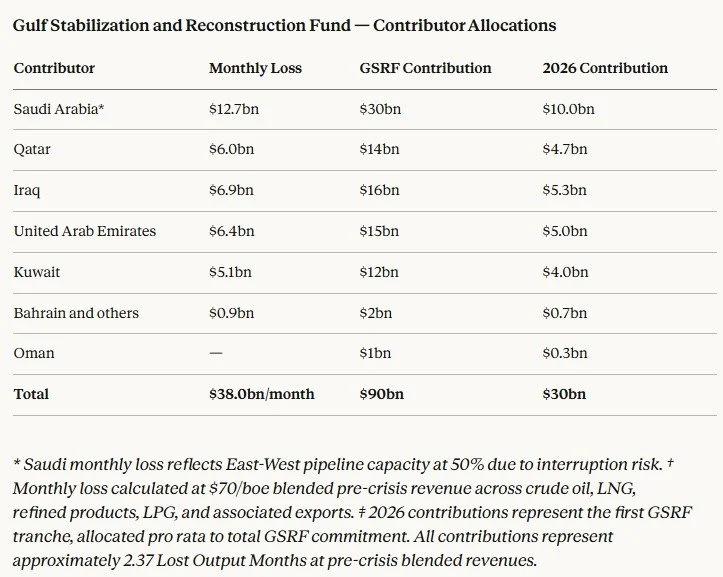
This allows the US to avoid the reparations issue, even as something like reparations are paid to Iran.
The Strait of Hormuz
The Iranians want to set up a toll across the Strait of Hormuz. This is unacceptable to both the US and the international community. The various forms of payment — the lifting of sanctions, the GSRF, and free oil exports — compensate Iran for agreeing to free transit across the Strait.
Proxies
Iran would like recognition of proxies like Hamas and Hezbollah. The US will resist it. We finesse this by offering that both sides will restrain their proxies – Hezbollah, Hamas and the Houthis on the Iranian side, and Israel on the US side – from aggressive actions for the life of the agreement, ie, three years. This is really a stand-down agreement, rather than a permanent solution. Tying the Hormuz Agreement to recognition of the various parties would take years. The US does not have the time; it is best to keep the topic off the table.
The Iranians should also agree to withhold any military supplies, aid or support to Russia during the agreement.
Regional Security
Iran would like recognized control over the Strait of Hormuz and the eviction of the US from the region. Neither will happen. In truth, Iran does not require de jure recognition when it has demonstrated de facto control over the Strait. If Iran insists on formal recognition, it will peg itself as a problem needing a solution, very possibly a military solution. Given Iran’s control of the Strait in practice, formal recognition would not appear critical in this round. Everyone now knows that Iran can close the Strait at will.
Regime Change and the National Prosperity Fund
Regime change can happen on three levels: personnel, systems, and incentives. The US has attempted regime change in Venezuela and Iran by eliminating top leadership. However, the underlying regimes remain in place in both countries. Only personnel have changed. In Iran’s case, incoming Iranian leadership appears all of younger, more energetic and more radical than the late Ayatollah Khamenei.
Many observers of both Venezuela and Iran were hoping that regime change meant a return to democracy, or at least a regime better aligned with western values. It has not happened, and the Trump administration does not seem particularly interested in this outcome in either country.
Finally, and importantly, regime change can be achieved by changing behavior of existing leadership. This can be accomplished through coercion, partly as has been achieved in Venezuela, or through altered incentives. Our proposal focuses on changing incentives.
One of the striking features of Iran is its chronic economic under-performance.
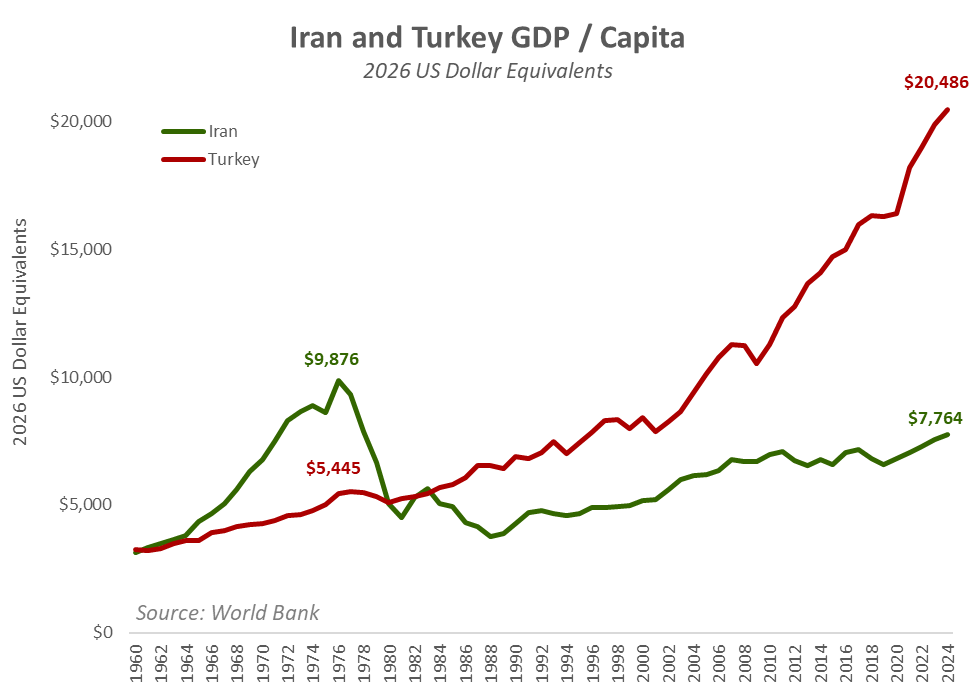
Iran’s GDP per capita, in real terms, remains below its level of fifty years ago, towards the end of the Shah’s reign. For purposes of international comparison, Turkey at that time had only 70% of Iran’s per capita GDP. Today, it is 2.6x that of Iran.
By any reasonable measure, Iran’s economy has been woefully mismanaged since it became a theocracy in 1979.
Instead of improving the condition of the public, leadership is militaristic. Iran’s leadership defines that country’s prestige not by its own achievements, but in negative terms, in its ability to harm Israel in particular.
Our proposal seeks to provide a counter-weight by tying benefits from the agreement, notably releases of frozen assets and flows from the GRSF (above), to GDP growth. The top 500 decision makers will be generously compensated to produce prosperity. Prosperous countries can, of course, go to war, but most pariah states are poor. For example, North Korea, Cuba, and Venezuela are grindingly poor compared to their neighbors or their historical prosperity. A focus on growth almost by definition implies a tendency towards openness, rule of law, a respect for individual rights, and peace in international relations.
This is the gist of our proposal, called the National Prosperity Fund, which seeks to encourage constructive behavior from Iran’s leadership by rewarding them for creating prosperity while not constraining policy options.
Summary of Financial Benefits
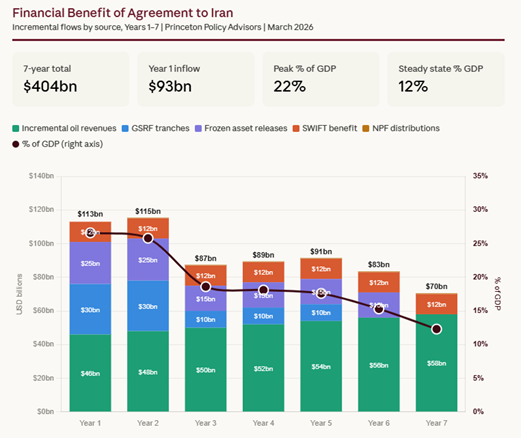
In aggregate, the financial benefits to Iran are notable, cumulatively $400 bn over seven years if Iran abides by the agreement.
Cheap, Fast or Good
In negotiating with Iran, the US will face that project management truism: “You can be on time, on budget, or on spec — pick two." Given the situation, the US needs a quick solution that is acceptable, even if the cost is relatively high. That’s the essence of our proposal, one which opens the Strait, does not require reparations from the US, inhibits Iranian nuclear development, stops Iran from attacking Israel directly or with proxy forces, and does contain an element of regime change. It may meet a minimum standard for the US. Iran can also claim a win: It gains substantial funding, sanctions relief, an end to hostilities for the next three years and does not irretrievably compromise its nuclear ambitions, even if it puts the program on ice for a few years.
On paper, both parties could live with this deal.