The Hormuz toll is worth about $500 billion to Iran on a present value basis.
Most recent analyses have anticipated that Iran would charge a toll of $1 / barrel or a maximum of $2 million per vessel to cross the Strait of Hormuz. At 20 mbpd of crude oil and refined products peacetime exports through the Strait, this amounts to, in round numbers, $20 million / day or $7.5 bn / year. All things considered, this would not meaningfully alter Iran’s financial situation nor the fundamental nature of negotiations to end the war.
For purposes of an agreement with Iran, however, the underlying economic value of the toll should be the prime consideration. And this is large.
The media tends to focus on tankers, but in fact several types of vessels use the Strait, including crude and refined product tankers, container ships, bulk carriers and specialized vessels like LNG (liquefied natural gas) and LPG (liquefied petroleum gas) carriers. All of these are likely to be subject to tolls, sooner or later.
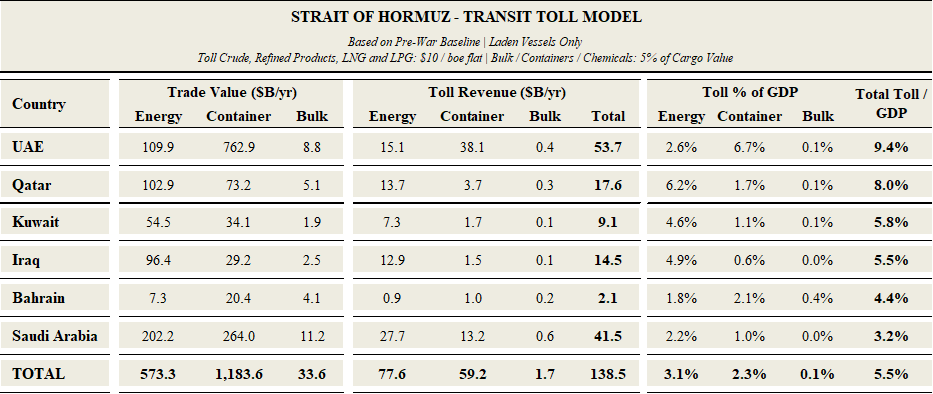
Collectively, crude oil, refined products like gasoline and diesel, as well as liquefied natural gas (LNG) and liquefied petroleum gas (LPG) represent $600 bn in annual exports from the Gulf.
This is, however, small change compared to the value of goods imported in containers. This is estimated at $1.2 trillion, twice energy exports by value.
Bulk carriers and specialty tankers represent the balance, but these do not materially change the total of nearly $2 trillion in laden vessels entering and exiting the Strait annually.
Iran, if it is allowed control over the Strait, would be in a position to toll all of it.
Current Iranian pricing be should not be deemed indicative of tolls after any agreement is signed. Monopoly service providers — and that is what Iran would be with respect to passage through the Strait — inevitably raise their rates to the level the market will bear. There are different ways to set prices, depending on how much political friction and alternative route development the Iranians are willing to tolerate.
We estimate a ‘friendly’ toll at 11-13% of the value of energy exports, equivalent to $10 / barrel of oil equivalent. With such a toll, the oil exporters would still make hefty profits. A $10 / boe toll on energy exports would net Iran nearly $80 bn in toll revenues per year.
Container ships promise hefty returns as well. A 5% toll on the value of cargoes — a kind of tariff, to be more familiar to readers — would net Iran $60 bn in annual revenues.
In all, our estimates put Iran’s potential Hormuz toll revenues at nearly $140 bn per year.
Iran’s 2025 GDP in US dollar terms is estimated by various sources in the range of $350-420 bn. In other words, prospective toll revenues would exceed one-third of Iran’s GDP as measured in US dollar equivalents. This sum would be transformative to the Iranian economy.
For negotiating purposes, one might value the toll at three times its annual value — a three-year payback period is a common ‘rule of thumb’ — which would imply Iran opening negotiations with a target value around $500 billion for waiving its rights to the Strait.
Given the sums involved, the hope that Iran will accept, say, $20 bn or just the lifting of sanctions for waiving control of the Strait is unlikely to be realized.
If the Trump administration is finding that its offers are being rejected one after another, it’s time to wake up and recognize underlying realities. A toll on the Strait of Hormuz has immense value to Iran. Any agreement to cede control over the Strait will have to provide commensurate compensation.