Last week, Mohammed Ghalibaf, the Speaker of Iran's Parliament (the Majlis), posted a threat to the US in the form of an equation. It provides critical insight into Iranian leadership's thinking. The post:
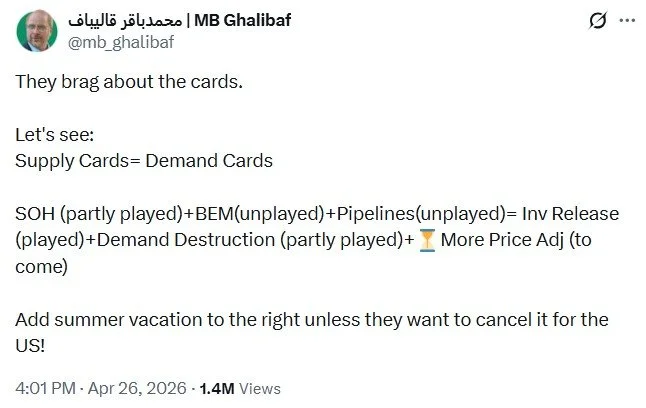
If you're a layman, or anyone in the Trump administration, Ghalibaf's post probably does not mean much to you. But if you understand oil markets, it tells a great deal about Iranian assumptions and negotiating tactics.
In the post, SOH is the Strait of Hormuz, which Ghalibaf describes as partly played. The Strait is materially closed, but a few ships are still getting through. Even that could be reduced a bit further.
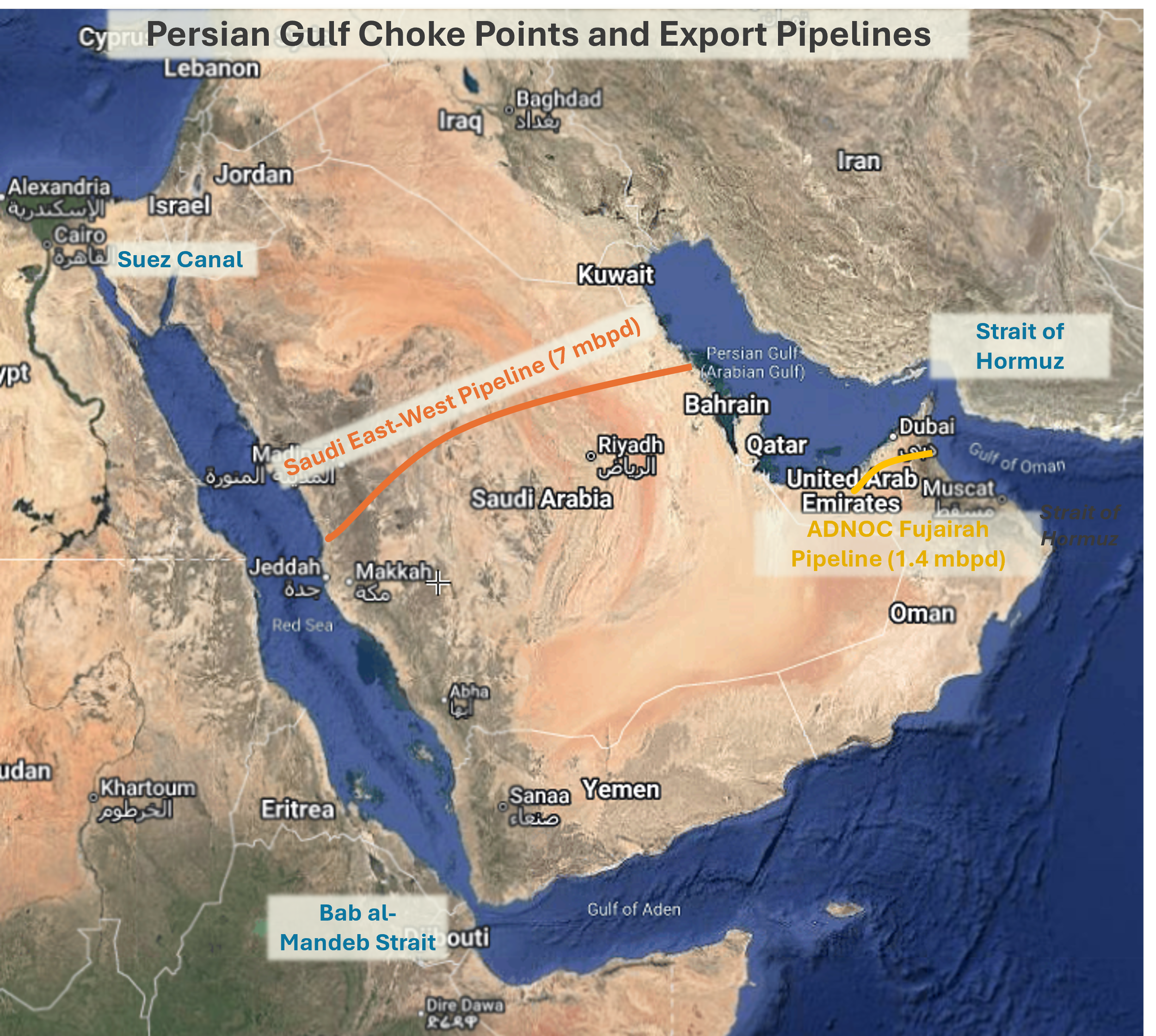
BEM is the Bab el-Mandeb Strait at the southern exit of the Red Sea (see the map below). The Houthis control the approaches to this chokepoint. It is listed as unplayed — Iran has not yet directed the Houthis to close it. If it were closed, Saudi Arabia's East-West Pipeline exports could not reach Asian markets. The largest tankers cannot transit the Suez Canal at the Red Sea's northern end, making the Bab el-Mandeb exit essential for loading VLCCs (very large crude carriers) bound for Asia.
Pipelines refers to the Saudi East-West Pipeline and the UAE's Fujairah bypass pipeline. Both are listed as unplayed. The Saudi pipeline currently carries approximately 4-4.5 million barrels per day for export at the port of Yanbu on the Red Sea — the primary bypass route for Saudi crude avoiding Hormuz. The UAE's Habshan-Fujairah pipeline carries approximately 1.5-1.6 million barrels per day to the Gulf of Oman, bypassing Hormuz entirely. Both are potential targets.
These are designated as unplayed cards. Ghalibaf is implicitly threatening an Iranian attack on Saudi and UAE pipeline exports in retaliation for any US or Israeli strike, putting an additional 6 mbpd – 6% of global consumption – at risk. If fact, at writing on May 4th, Iran had struck the Fujairah Oil Industry Zone in the UAE, partially playing that card, as Ghalibaf might say.
On the demand side of the equation, the cards are not Iran's to play. They are market forces already operating in Iran's favor.
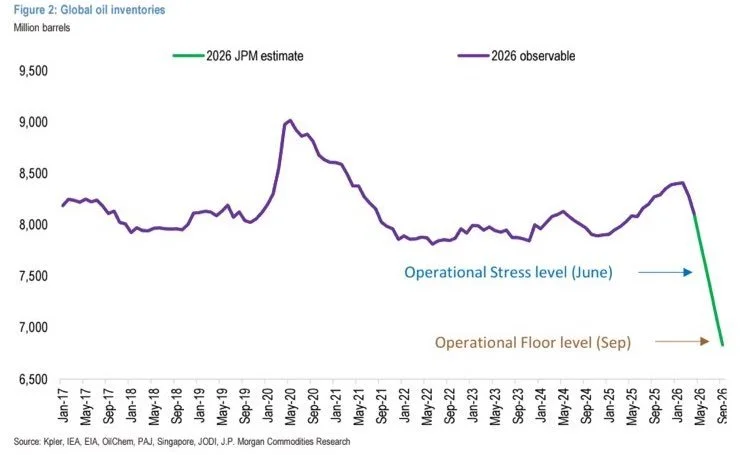
Inventory release is listed as played. Oil prices have remained comparatively contained because governments and commercial players have been releasing crude and refined product inventories on the assumption that Hormuz would shortly reopen. That assumption is increasingly untenable. Inventories are drawing down toward operating minimums. The release card is nearly exhausted. By the end of May at the latest, it will not be possible to sustain oil consumption levels using inventory draws.
Demand destruction — reduced oil consumption — is listed as partly played. When inventories can no longer cover demand, prices must rise until consumers reduce fuel purchases. Rationing is already emerging in parts of Asia and Europe. In the United States, the demand destruction threshold — the price at which consumers materially change their behavior — is approximately $5.50 per gallon at the pump, compared with $4.46 per gallon at writing. At the current pace of oil price increases, WTI will reach approximately $160 per barrel around Memorial Day. That puts US pump prices above $5.50 per gallon entering the summer driving season, right at the oil shock threshold for the economy.
Which is precisely what Ghalibaf means by his closing line. Summer vacation is the seasonal demand surge that amplifies the right side of his equation without Iran needing to do anything. He is pointing out that the calendar is working in Iran’s favor for the next ten weeks or so.
As the graph above from JP Morgan shows, Ghalibaf's analysis is largely in line with that of most oil market analysts. We know, therefore, that Ghalibaf has a quantitative feel for oil markets. Specifically, Ghalibaf's equation indicates that oil prices will continue to rise and become untenable for the US during the summer driving season. Consequently, the Iranians are willing to wait, because they believe time is on their side in the short to medium term.
Nevertheless, Ghalibaf and others want to end the conflict in the short term. First, blockage is obviously painful for Iranian society and a risk for Iranian political stability. Renewed conflict also risks death and destruction. Finally, closure of the Strait is destructive to global society. While the plight of Filipino farmers and Thai office workers may not register at the White House, Ghalibaf appreciates it. He is a certified Airbus pilot, a former mayor of Tehran, and a college professor. The people in these roles are typically highly intelligent and responsible. A person like Ghalibaf cannot sit on a closed Strait and not comprehend the economic destruction cascading around the globe. (This will not be true of all Iranian leadership, to be sure.) I believe the continuing variety of proposals coming from the Iranians reflects, in part, an understanding of the global stakes.
Finally, a word on timing. Many commentators insist that Iran is about to collapse and the US is winning. This view currently rests on two premises: 1) the blockade is working and Tehran is bankrupt, and 2) Iran is reaching tank tops on crude oil storage. If the tanks fill, oil wells will have to be shut in and may never return to production, or at least not to current levels. By extension, this implies either that Iranians will rebel and overthrow the government or that the government will become too weak to control the Strait of Hormuz. Outsiders have limited access to Tehran's financial data and conditions, but historically, blockades have taken years to work, if at all. Further, Iran has shut in wells before, and these came back on line much faster than analysts predicted at the time. Neither of these is a compelling argument that the Iranian regime is somehow days away from collapse. But if one believes it, then the US can afford to wait and let the Iranians beg for a deal.
On the other hand, if this view is in error, the Trump administration will face catastrophic economic conditions within weeks and be forced to either 1) ration gasoline and make US drivers wait in line, as was the case in 1973-1974; 2) begin a major ground invasion of Iran, which would require 6-12 months of preparation and Congressional approval; or 3) conclude a highly unfavorable deal with Tehran. The latter option seems the most likely. Indeed, if US drivers are forced to wait at gasoline stations, the Iranians might expand their demands to include the resignation of Trump and Netanyahu. Rest assured, someone as smart as Ghalibaf has already entertained the possibility.
I sense my agreement concept from March 27th is still sound. The Iranians would agree to terms sketched out there within a week or so. On the other hand, that leaves the theocracy in place. Those looking for regime change will find their best alternative here.