
Ideology as a consulting tool
I would like to use our model, a principal-agent framework for ideology (PAFI), to show how it handles a libertarian debate that has been swirling in the last week. Tyler Cowen, a professor of economics at George Mason University, has discovered that libertarianism does not adequately handle climate change. Presumably, he thinks climate change is due to excess CO2 emissions -- pollution, if you'll have it -- from various human activities. Back in the day, pollution was treated as an externality, to be handled by the government because individuals lacked the incentive to address the issue, hence 'externality'. Today, this newly novel problem requires a new approach: 'State Capacity Libertarianism', or as Henry Olson of the Washington Post might put it, conservatism.
Olson writes:
Conservatism and libertarianism have long been locked in a symbiotic embrace. [The State Capacity Libertarianism] essay by libertarian leaning economist Tyler Cowen suggests the embrace will end soon. [The issue with] libertarianism is that people do think public entities should address public problems. Old style, "big L" libertarianism rejects this view, contending that any form of government action is inherently unjust and creates more problems than it solves... Encumbered by the belief that [libertarians] must be kowtowed to, most Republican office holders remain unable to voice any significant alternative to progressive visions for health care policy [or] climate change... That requires saying that government can do some good, [even though] those who do speak are uniformly -- and often stupidly -- castigated as 'statists' or even 'fascists'. If even [Cowen] thinks government can and should act to solve problems, then advocates of [a libertarian] view have to stand up and pay attention. That, in turn, lends intellectual respectability to conservatives...who are slowly breaking the ice that has frozen conservative thinking for so long. The hard core [libertarians] will try to keep the rest of us in the shadows, but...more and more conservatives...will break free from their frozen slumber.
In other words, libertarians and conservatives are increasingly on opposite sides of the political divide. In Hungary, where I developed PAFI, this split occurred in the early 1990s, not long after the fall of communism. The anti-communist coalition of the conservative Hungarian Democratic Forum (MDF) and free-market Alliance of Free Democrats (SZDSZ) splintered soon after Hungary returned to democracy. The fiscally conservative SZDSZ — rather shockingly at the time — chose to cohabit on the left with their former oppressors, the Socialists.
In important ways, this split also happened in the US and UK with the Clinton and Blair governments, to be temporarily reversed during the Great Recession (which we refer to as the China Depression).
So let's take a look at State Capacity Libertarianism using PAFI.
Note that we define 'conservative' for the first time. The term has historically drawn a number of descriptors like 'traditional', 'backward looking', 'resistant to change' and 'illiberal'. All these are true, but none of them is a definition. We define conservatism as pertaining to the group; seeking to maximize the utility of the group (and its members); and with property rights vested in the group, not the individual. By contrast, liberalism is defined as pertaining to the individual, maximizing the individual's utility, and with property rights (freedom) vested in the individual. That's the organic left-right split: the individual versus the group; desire versus duty.

As the chart suggests, the fiscal conservatives -- more or less classical liberals or libertarians -- are structurally on the left, not the right. Notwithstanding, if you speak to the professionals at CATO or the Niskanen Center, for example, they think of themselves as center right. Nevertheless, if you ask them whether they speak to social conservatives, they do not. They are not on the same team. Emotionally, they have already gone through the divorce that Olson says is only coming now. Cowen is trying bridge the divide by putting libertarians on the center right with State Capacity Libertarianism, in essence because he has no working definition of the term 'conservative'. Consequently, Cowen trying to incorporate conservative ideas into libertarianism. The chart above suggests this will prove a dead end.
Liberals and conservatives will be structurally at odds with each other. Both libertarians and egalitarians (progressives) represent the individual against the system, against power and against the patriarchy. To concede the primacy of the individual is to concede a critical issue of principle, for the individual will always be in a weak position against the establishment. Libertarianism must stay distinct and uncompromised. CATO in particular has a very clear philosophy well aligned with neoclassical economics.
On the other hand, theoretical conservatism has no champion at all, because, no coherent theory of conservatism — other than ours — has been proposed to date. Conservative theory in our framework is the mirror to that of CATO, with solid philosophical and theoretical foundations consistent with established economic theory.
Our theory asserts that libertarianism will find its home on the left. If the median voter boundary falls to the right of the classical liberals -- and it does -- then the classical liberals will dominate the left, because policy must be near the median voter boundary to pass into legislation. Thus, the fiscal conservatives will marginalize the egalitarians in the future just as they marginalized social conservatives during the Soviet era. There will be lots of talk of progressive policy, but the actions will look fiscally conservative, says the theory. We will see the return of Bill Clinton-style administration, perhaps in the form of Joe Biden, Amy Klobuchar, Michael Bloomberg or Pete Buttigieg. The model suggests that Elizabeth Warren and Bernie Sanders come up empty, because the balance of Democratic voters will increasingly be those suburban independents -- the fiscal conservatives -- whom Henry Olson and the Republican Party have been so assiduously purging. It is not time to cashier libertarianism, but to recognize that it must find a new home.
It is also time to put conservatism on a sound, theoretical basis. We have the theory. Where should it go? The Heritage Foundation could be a natural home, although Heritage is positioned perhaps more as a Republican shop than independent think tank. The Hoover Institution, arguably a more brainy place, could also be a good home. Be that as it may, our model suggests that the social conservatives are on the median voter boundary — there because communism collapsed. Consequently, conservatives could crowd the boundary for a very long time to come, literally centuries. Unlike liberalism, conservatism contains very serious risks for civil society domestically and for conflicts abroad. It is power over money, and power is more dangerous. As a result, we need to improve theory to ensure we draw the best from conservatism while avoiding its pitfalls. And Tyler Cowen is right about another thing: libertarianism for now is hollowed out. Twentieth century liberalism has run its course. For the next generation or two, the interesting running will be made on the conservative side. That's where the action will be.
To close with our opening point: A principal-agent framework for ideology is a very useful tool. I have relied on it for 15 years and use it almost every day. Our framework has both great explanatory and predictive power. The tool is not hard to learn or apply, and integrates well with both liberal theory and neoclassical economics. Many of the readers on our email list are academics, think tank professionals, brainy journalists or ideology junkies. All of you will find this framework helpful in better understanding the world and the possibilities for successful policy initiatives.
I am always happy to make a presentation on the topic.
How market-based visas meet political needs
Princeton Policy Advisors advocates for a market-based approach to solve illegal immigration across the US southwest border.
In this post, we consider some of the related analytical tools.
Bills pertaining to immigration struggle to find sufficient political support in Congress to pass into legislation. The prospects for such support can be assessed ex-ante using stakeholder analysis, historically taught in public policy schools like my alma mater, Columbia University's School of International and Public Affairs.
In the business world, everything ultimately boils down to a single objective function, some version of return on equity. In the world of politics, we have three separate objective functions which align with the major ideologies. Egalitarians would like everyone to be equal, even if all are poor. Classical liberals (libertarians) want maximum scope for the individual (which is not conceptually dissimilar from ROE in practice). And conservatives want to maximize the benefit to the group and its members. These objectives cannot be reconciled mathematically, which is why politics is so...political.
For any given policy, usually two ideologies are for and one against; or two against and one for. For example, Medicaid can be justified in egalitarian terms as taking from the rich to uplift the sick and poor; or it can be justified in conservative terms as fulfilling our duty to take care of society's weaker members. The egalitarian approach is bottom up, and the conservative approach is top down, but either can lead to essentially the same policy. (And that's how Republicans become big spenders, by the way.)
In addition to the three ideological groups, stakeholder analysis also considers economic interests, in this case, Hispanics, businesses and unions. Hispanics want legal status, market access, and to maximize take home pay. Businesses want ample, low cost labor. Unions want to protect US workers by limiting foreign competition. As a practical matter, Hispanics can be lumped with Democrats, business with classical liberals (libertarians) and unions perhaps fit best with social conservatives today.
With respect to illegal immigration, each of the stakeholders has a list of specific goals they would like to achieve. Our version of this criteria list by stakeholder group can been seen below.

Any policy proposal -- including HR 5038, the various Goodlatte bills, a universal immigration bill like the ‘Strengthening America’s Workforce Act’, or market-based visas -- can be assessed using this list.
Ideal's Proposal
For example, Ideal Immigration advocates for a universal immigration policy which lets in as many immigrants as businesses care to hire at a visa price of $2,500 / year. On the chart below, we can assess the prospects for this proposal by each stakeholder’s specific criteria.

Such a proposal largely serves libertarian and business interests. Conservatives, however, will flatly reject any unlimited immigration proposal. Thus, at a minimum, both houses of Congress and the White House must be held by Democrats for unlimited immigration to pass. But the situation is much worse than this. The Ideal proposal was largely embodied in a draft bill entitled the 'Strengthening America's Workforce Act' (SAWA). After this bill was sent around for comment, it picked up a clause which prevents undocumented immigrants from participating, ie, no amnesty. This implies businesses could import, say, legal, lower cost Asian labor to displace undocumented Hispanic workers in the US. This is a deal killer for Hispanics. And unions will reject the proposal because it opens the US labor market to unlimited foreign competition. Thus, our framework shows that Ideal's proposal is unlikely to garner material support on either left or right. It is a non-starter by a very large margin.
Market-based Visas
Market-based visas are predicated on the assumption that employers are entitled to hire employees; that we will never deport undocumented immigrants in material numbers; and that conservatives are entitled to limit guest workers to the lowest number which ends the black market in Hispanic labor.
As the chart below shows, MBVs achieve conservative goals with the exception of mass deportation and with the requirement to increase the migrant headcount by 500,000 to allow for the demand effects of legalization. Businesses have to accept that they will have to provide pay and working conditions at levels comparable to those for unskilled US labor -- but employers can access more workers faster as compensation. Democrats and Hispanics receive legal status for seven million undocumented Hispanics and on demand access for migrant labor, subject to visas numbers set to conservative preferences and the resulting market price for a visa. Everyone has to make a concession, but these are the necessary steps associated with lifting a prohibition. After a one-time adjustment is absorbed, the system should work reasonably well for most stakeholders.

Thus, MBVs can meet the requirements of all the major stakeholder groups with one material concession from each.
This is a political oddity. Legislation is ordinarily a partisan affair. Nevertheless, those who care to look -- and we have -- will quickly find that black markets arising from prohibitions — including the prohibition in migrant labor — generate such incredibly bad side effects that it is in fact possible to make policy which is Pareto optimal for all. By Pareto optimal, we mean better than current policy or any likely alternative which could be passed in the next, say, five years. In the case of illegal immigration, MBVs provide each and all ideological and economic interest groups a Pareto optimal solution. Ending prohibitions is the equivalent of ceasing to hit yourself on the head with a hammer: not that much of an achievement in terms of insight or technique, but boy, you feel a lot better afterwards. Strange as it may seem, fixing illegal immigration is conceptually trivial, and, on paper at least, achievable with all the major stakeholders participating in the process.
Market-based Visas
A market-based visa (MBV) approach would allow background-checked migrants from Mexico and the Northern Triangle countries to purchase a work visa at a market rate and enter and work in the United States on demand.
Program Goals
Such a program would seek to:
Close the unsecured southwest border to illegal immigration
End the black market in undocumented Hispanic labor without mass deportations
Create an orderly guest worker program and achieve market-level compensation for the U.S. government for providing labor market access, thereby generating both public confidence and visa revenues in excess of related migrant social costs, in turn laying the foundations for a more constructive dialogue on immigration policy
Recognize and accommodate conservative concerns with respect to migrant numbers, status and comportment.
Create tolerance and dignity by ending the impact of black markets – the lawlessness, victimization, racism and simmering ideological civil war – on employers, migrants, the policy community, and the U.S. public
The Black Market in Migrant Labor
Black markets arise when the government attempts to prohibit willing buyers and sellers from consummating a transaction. For conservatives, this arises for issues of perceived morality, social nuisance, or threats to the group. Typical prohibited items have included alcohol, marijuana, hard drugs, gambling, prostitution – and migrant labor.
Black markets are characterized by a predictable set of pathologies. These can be addressed with either enforcement or, alternatively, legalization coupled with taxation. Enforcement in turn can be applied to the supply – in this case, the migrants – or to demand, their employers. Almost without exception, enforcement against supply is the default option for handling black markets. This inevitably fails, as it did with Prohibition for alcohol (1920-1933) and the other vices before and since. The war on drugs, for example, has been raging for fifty years, and we are no closer to winning than we were during the Nixon administration.
The United States has, by contrast, experienced repeated success with liberalizations, notably with Repeal in 1933, gambling legalization outside Nevada from the 1970s, and marijuana legalization in the last decade. Indeed, marijuana legalization has led the quantity of marijuana smuggled over the unsecured U.S. southwest border to fall by an astounding 81 percent just during the Trump administration, and 93 percent since its peak in 2009.
Market-Based Visas
Market-based visas are a type of legalize-and-tax approach to ending the prohibition in migrant labor. Rather than regulating the market using quotas or quantitative restrictions, a market-based approach seeks to regulate the market by either setting visa prices and allowing visa volumes to adjust accordingly, or setting the number of visas to be issued and allowing the market to set the price.
As noted above, a market-based visa (MBV) approach would allow background-checked migrants from Mexico and the Northern Triangle countries to purchase a work visa at a market rate and enter and work in the United States on demand.
In terms of mechanics, the system might work as follows: A Mexican decides he would like to work in the United States. He visits the local U.S. consulate and fills out the associated paperwork, much as for an H2 visas, but leaning more heavily on biometrics.
The United States would conduct the usual screenings. If the migrant passes the background check, he would only receive the right to purchase a work visa (here dubbed the H2-M) at a market rate.
He would then seek to obtain a work offer, or barring that, plan to enter the United States speculatively and look for work. He could, for example, go to the Spirit Airlines website, buy an air ticket and a U.S. work visa at the same time for the duration of his choosing to the maximum permissible. With that, he could hop a flight from, say, Guadalajara and enter the United States at his discretion, with his visa tab running at an estimated $20 / day. When he exits the United States, the meter would stop.
In this system, we substitute ‘cheap’ for ‘easy’. In the current system, it is not too expensive to enter the United States, but it is not easy. In the proposed system, it is easy, but in no way cheap. We are, in effective, monetizing the cost of crossing the border and working illegally.
The H2-M would grant the rights of a standard H2 visa: ability to open bank accounts, obtain driver’s licenses, and rent property, among others. It would not allow participation in any Federal welfare programs, and health insurance would be mandatory.
The H2-M visa would not – and cannot – provide a pathway to permanent residency. As the visa would be purchased at a market price, any future benefits deriving from the visa would be reflected in its market value. Permanent residency in the United States is an extraordinarily valuable right, by our calculation, worth more than $4 / work hour even if promised for 15 years in the future. Were the option of permanent residency included in the H2-M program, participants would be reduced to penury by facing the trade-off between eating today and becoming citizens years hence, and the program would fail politically.
The Importance of On-Demand Entry
On-demand entry to work in the United States at the discretion of the migrant is a cornerstone of the market-based approach. Today, migrants come across the border illegally because they cannot enter legally. To close the unsecured border to illegal immigration, therefore, the most direct solution is to allow migrants to enter at will.
But how then to limit the quantities? A fully open border would see millions cross in short order. Fortunately, the market provides a solution in the form of a price, the same mechanism used by every business the world over. A market price rations access without discrimination or preference.
In this system, the U.S. government does not choose who enters the United States to work, it only qualifies a pool of potential workers via a background check. Having passed that, however, the migrant is in full charge of the decision to enter, subject to the visa fee. A price-based system ensures that visas are readily available on demand at any time, leaving the migrant in full control over his options. For the migrant, the key to working in the United States – as it is for Americans themselves – is finding a good job, getting good references, and staying in good standing with the U.S. authorities. This is the means to close the U.S. southwest border: allow migrants to enter legally at will.
Status for Undocumented Hispanic Residents
A guest worker program like the proposed H2-M is, of course, not ideal for undocumented migrants who are for practical purposes permanent residents. Nevertheless, since negotiations regarding the status of DACA and Dreamer participants seem at an impasse, market-based visas (MBVs) can serve as a substitute, even if an imperfect one.
Providing market-based visas just for incoming migrants is less than ideal. Even assuming the border can be sealed with this approach, incoming migrants will end up working alongside undocumented immigrants. In such an event, either the value of the visa may remain low or a migrant who entered on H2-M visa may allow it to lapse and join the black market to improve his personal economics. Moreover, the American public will remain unsatisfied if 90+ percent of the migrant market remains illegal.
As a consequence, extending the H2-M program to undocumented migrants already resident in the country makes sense. This would materially wipe out the black market in labor over time and ensure the unsecured southwest border remains closed to undocumented economic migrants.
The process of issuing and purchasing visas could be identical for undocumented residents as it is for incoming migrants. Both could purchase visas online, although the pools would likely be segregated (an H2-MR visa for residents).
If the government intends to provide status to undocumented migrants in the country, it will have to accommodate administrative violations of U.S. law in order to ensure widespread adoption of the program. This, of course, does not apply to those known to have committed serious crimes representing a tangible danger to the community. Indeed, the entire point of leniency for administrative crimes is to ensure a high level of program adoption and compliance while isolating hardcore criminals and depriving them of social support and work opportunities.
The Number of Visas
Migrants from just four countries – Mexico, Guatemala, El Salvador and Honduras – constitute 96 percent of attempted crossings at the U.S. southwest border. The citizens of these four countries (‘the MCA countries’), therefore, must be included in any program seeking to close the border. The remaining 4 percent, from a variety of countries, would be excluded simply as a matter of practicality.
The number of visas would be set by the price which reduces apprehensions at the U.S. southwest border to approximately 150 / day, compared to the current level of 2,000 / day. This represents a reduction of approximately 93 percent, which is a fairly typical reduction in pathology associated with the repeal of prohibitions.
The end of a given prohibition has historically led to an increase in demand for the now legalized good or service by 10-15 percent. Assuming 5.0 million undocumented Hispanics work in the United States, legalization would increase demand for migrant labor by 500,000 – 750,000 persons, on approximately two million open jobs in the category, per our analysis of JOLTS data from the Bureau of Labor Statistics.
Over the longer term, demand might increase with GDP, or perhaps an additional 100,000 – 150,000 incremental visas per year. The point, however, is to demonstrate that the system can function acceptably over a relatively short horizon of perhaps 3-4 years. Within that time, either the virtues of the system will become apparent, or it will fail.
Visas must also be granted to resident undocumented aliens in the country. Of the 10.5 million undocumented immigrants estimated by the Pew Research Center to be living in the United States in 2017, 7.0 million (67 percent) originate from the MCA countries. Non-MCA countries would be excluded from this program in its pilot phase as a matter of practicality.
Setting the Visa Price
In the MBV plan, the price of the visa is set by the market. This is a central component of the Plan and critical to its success for many reasons.
First, while we estimate the visa value at $3.50 / work hour, the market value could be higher or lower and could change materially over time, with seasonality and with the business cycle.
If Mexicans and other Central Americans are allowed to set the price in an open market, then they will essentially convert the value of legality into the visa price. On average, therefore, the undocumented migrant should be no worse off than they are today, and economics ensures that a producer surplus will exist for all participants.
The Visa Issuing Authority
Unlike price-based approaches, a market-based approach does not allow unlimited quantities of migrants to enter the United States. To achieve that goal, price / quantity pairs must be actively managed, unlike a fixed price system.
This in turn requires a management capability, in this case, a visa issuing authority which has flexibility to respond to market and social conditions. We refer to this as the Visa Oversight and Management Committee, the VOMC, not coincidentally similar to the Federal Open Market Committee (FOMC) which conducts U.S. monetary policy.
Like the FOMC, the VOMC would have a mandate to manage prices and volumes, notably to
Issue the number of visas which closes the unsecured southwest to illegal immigration and ensures material visa coverage of all non-violent, undocumented Hispanics in the country with the goal of reducing ‘no match’ Social Security numbers by perhaps 80%
Limit incoming migrants under an agreed cap (for example, no more than 400,000 additional visas in Year 1, and no more than 200,000 additional visas in any subsequent year)
Adjust visa price, terms and conditions to ensure compliance with payments and other requirements
Monitor, report and make recommendations to Congress on
Key program performance indicators (visas issued, retired, outstanding; border apprehensions)
Financial indicators (revenues; expenses; direct and indirect social costs; net revenues)
Migrant employment, wage, remittance and societal indicator trends (incarceration, use of social services, health and well-being indicators, etc.)
Employer conditions and compliance (new hires, wages paid, job titles; Social Security ‘no match’ rate, employment rates, etc.)
Services utilization and compliance (healthcare, education, etc.)\
Impact of visa policies on U.S. unskilled wages and employment
Societal impact (public opinion on migrant numbers, comportment; protests, etc.)
Put another way, the VOMC would be responsible to manage a government profit center generating $30 billion of net revenues per year, making it an economic entity with an impact comparable to Facebook or Amazon in dollar terms. The VOMC would be mandated to ensure key stakeholder objectives are met, including those of migrants, employers and the public, and in particular, conservatives.
Political Considerations
The key political challenge is persuading conservatives to consider a price-based approach.
Conservatives, and perhaps most Americans, feel most comfortable with controlling the country’s borders with quantitative restrictions, boundaries to be protected with force using Border Patrol or Customs. The intent is to keep foreigners apart from citizens, ‘them’ from ‘us’, unless permission is specifically granted.
Nevertheless, quantity-based restrictions, whether at the border or in policies like affordable housing, always bring markedly suboptimal outcomes and promote corruption and cronyism. They are to be avoided, as a matter of policy, whenever practicable.
The alternative is a price-based regime. Rationing by price is highly efficient, paradoxically much fairer than quantity restrictions, and does not require force.
That said, switching from a conservative to liberal mindset is inherently unnerving, because items perceived to exist outside monetary value are suddenly monetized, where ‘everything has a price, but nothing has value.’ Letting go risks a venture into the unknown.
Nevertheless, it is also true that black markets are phenomenally destructive, and condoning them is not conservative, but anarchic. And prohibitions inevitably fail.
Therefore, the hope is to persuade conservatives to accept a price-based approach, while acknowledging key conservative values. First and foremost is a limit on incoming migrants, and we achieve this by providing a management capability which allows conservatives to retain control over visa issuance within a price-based framework, hence ‘market-based’ visas.
Conclusion
An MBV program does not constitute ‘comprehensive immigration reform’, nor does it address other immigration programs which may have merit in their own right. It is, in essence, not even an immigration program, but rather the repeal of a prohibition on migrant labor. This is its strength. Black markets are easy to fix. Both the theory and practice of market liberalization are well understood, and therefore, so is the expected outcome. Illegal immigration is a problem we can solve in a manner which both meets the needs of incoming migrants and undocumented Hispanics, and addresses and respects the legitimate goals of Americans as a whole, and conservatives in particular, to control our borders and ensure a safe, orderly and economically viable migrant policy.
Border Apprehensions Nov. 2019: Normal
Customs and Border Protection reported 33,510 apprehensions at the southwest US border for the month of November. This is about 2,000 below the prior month and 500 below our forecast, that is, actuals are essentially at forecast levels. The rate of apprehensions for November was average for the past decade.

The rate of improvement in apprehensions has been decelerating. Families have been largely discouraged, and the remaining traffic is primarily single men traveling alone to avoid detection. This traditional traffic is not much changed over several years, and if the Trump administration wants to claim improved border security over the Obama administration, then that result really has to be demonstrated in the single adult, traveling alone category. We would guess that this will be hard to do. Families are, as a practical matter, amateurs. Men traveling alone count as professionals.

Our model (60% apprehension rate, three tries) suggests that 200,000 migrants make it across the border undetected every year. The US government could achieve the same outcome by setting up a toll booth and allowing in 200,000 migrants. This would represent $1.4 bn in incremental revenue per year in an MBV program, as well as allowing a reduction in enforcement costs in the billion dollar range, all in representing a capitalized value around $15 bn. And the exact same number of migrants would be in the US in either case. We can enforce the border the hard way, or the easy way. The easy way is more fun. We might try it sometime.
Turning to inadmissibles, these are coming in again right on our forecast made in January of this year. In other words, the level of inadmissibles is also largely normal.

Ten Debate Points for Politicians
I often feel that political debates miss points that actually matter to me. I thought to write a few items down, in no particular order.
Tolls are Out of Control
Tolls on the east coast are out of control. For our family in central Jersey, tolls / vehicle amount to $700 / year. A person making $17 / hour will have to work for one week of the year just to pay their tolls. Here are some tolls versus gasoline costs:

Is the wear and tear on roads really as much as the gasoline we use? In the case of the Pennsylvania Turnpike, about half the toll goes to pay for other items in the state budget, and indeed, the legislature put such egregious requirements into the Turnpike's budget that, since 2008, cash tolls have risen 154%, compared to 25% for the CPI, and EZ Pass tolls have by 42% since 2011, compared to about 19% for the CPI. And tolls continue to rise by an unconscionable 6% annually.
Tolls should only be allowed to be used for the object which they support, eg, a bridge or a road. The Federal government should review toll costs and mandate downward revisions as indicated. This is reasonably important for the middle class and a big deal for low income, but not poor people, including many in the black and Hispanic communities. It's also a question of equality: rich people are allowed to cross the George Washington Bridge; people working for $15 / hour aren't. If a candidate told me we were going to knock the toll on the GW Bridge back to the $5 it is on the Tappan Zee, that would win my vote.
Tolls are out of control, and the Federal government needs to act.
One Day's Pay for Fines
I was caught speeding near Newark Airport. I chose to go to court in scenic Elizabeth, New Jersey. I was perhaps one of two white people in the courtroom, the rest being blacks or Hispanics. They seemed mostly low income, but working, people, and I struck up a conversation with a young black man next to me. Like me, he had been caught driving 20 mph over the limit. The fine is around $200, which he didn't have. So he didn't pay, was summoned, didn't go, was summoned again, didn't go again, and then a warrant was issued for his arrest. For him, $200 was probably close to two days' pay. If he wanted no points, he would have had to pay another $240 -- the cost of an indulgence in NJ and the reason I was there. So to save himself, he would have to pony up nearly a week's pay, and I would guess most of the people in that courtroom were in similar shape. If you are a finance professional, a fine like this is a nuisance. If you're in the lower 50% of the population, it's crippling.
Fines for other than serious safety violations should never be more than one day's pay.
Be Careful with those Green Promises
I think one could make a plausible case that California's renewables policies were a major contributor to burning down Paradise. Similarly, NJ's and NY's rejection of a natural gas pipeline has led to a supply crisis in Westchester, NY, which has become a major political problem for Governor Cuomo. We're going to see more of this as green rhetoric starts to come up against bread-and-butter, real life considerations. Again, lower and middle income people will take the brunt of it--a theme of a number of the suggestions here. Green policies are morphing into class warfare. If Trump were a little more Evita Peron and a little less Francisco Franco, he could mop up a large portion of the Hispanic vote and find decent support in the black community.
Add Road Capacity
Baltimore has more takeaway capacity to the north on I-95 than does NYC. We need four more lanes north of NYC on both sides and frankly, a whole new Hudson River crossing. And there are many issues like this all over the country: I-90 west of Boston or Rt. 3 towards Cape Cod, I-93 into Boston. One could go on and on. But be specific and be local. The people who are suffering in traffic are not interested in 'infrastructure'; they want to know you're going to string up every Connecticut politician until I-95 is seven lanes each way to New Haven. A candidate could secure my vote with this single issue. Easily.
Can we not give some public housing to its residents?
About 600,000 people live in NYC public housing. That's the population of Baltimore City. Could we not find a way to transfer ownership of, say, 25% of the units to their residents? That should have some appeal, particularly to minority communities, who would be the principal beneficiaries.
Introduce Market-based Visas
No surprise to our readers. Here's how I'd pitch it: "We're going to give legal status without amnesty to seven million undocumented Hispanic residents; close the unsecured southwest border by lifting the prohibition on migrant labor, and use market mechanisms to keep the migrant headcount within limits acceptable to most conservatives. If we succeed in closing the unsecured border for a period of time, we can start to migrate long-term unauthorized residents to permanent status."
Note the Harm of Prohibitions
Democrats have spoken about legalizing marijuana, and indeed, hard drugs. This points deserves more than two minutes of pandering. The current prohibition on hard drugs, for example, is the cause of two-thirds of violent crime in Mexico and US inner cities. That is, prohibitions literally define the nature of these communities. Prohibitions are also the cause of 95% of opioid deaths. So, sure, cracking down on the drug trade has an appeal, but it carries a huge, huge cost, almost entirely borne by minorities. We need a more thoughtful--and less politicized--approach.
Limit State and Local Pension and Healthcare Liabilities to Three Years Post-Employment
Costs have to be expensed as incurred. You'll never hear that from a Democrat (maybe Mayor Pete?), but, well, this is my list. It's the most important reform you could give to Democratically controlled states.
Name a Commissioner for the Seas
A few issues here:
The Great White Sharks: These have become a significant issue from Nova Scotia to Mexico, in particular on Cape Cod. The local townships are clueless as to how to tackle the problem and need Federal help and guidance.
Garbage Islands: The giant islands of garbage floating in the Pacific are about more than plastic bags and disposable straws. The topic needs substantial research and a coordinated international effort.
Abandoned nets: This seems to be a major contributor to sea life fatalities. This is an issue we need to understand better.
All of these have symbolic meaning and emotional resonance. None of them is terribly expensive. All are pro environment.
Have a Suggestion Box
Put a suggestion box on your website. See what is actually bothering people in their daily lives. A lot of it is local. Some of it has a federal angle, but often people just want to hear the issue acknowledged. Put up an email address, for example, suggestions@candidatename.com. Ask not only for donations, but also what you can do for your country.
Market-based visas are the only option on the table
On Nov. 7th, the CATO Institute held a workshop on innovative approaches to both legal and illegal immigration, and invited me to speak on market-based visas (MBVs).
I would like to reflect on my takeaways from that event.
Before that, though, let me express my gratitude to Alex Nowrasteh of CATO for giving me the opportunity to speak. Also, please note that the comments here reflect only the views of Princeton Policy and not necessarily those of CATO or any other participant at the workshop.
The Approaches to Immigration
During a full day of presentations, experts presented on a variety of approaches to immigration, but overall their proposals could be categorized into three groups: incrementalists, utopians and radicals.
The Incrementalists
Incrementalists typically had sensible, limited proposals which are easily understood and derive from international or historical precedent. For example, one proposal called to increase work visas in line with population growth and GDP; another, to look at rural sponsorship of migrant workers. These can pass if the political winds are properly aligned and can improve policy at the margins. They also have the enviable advantage of simplicity. On the other hand, none of these approaches addresses root causes of illegal immigration. They offer no solution for the plight of millions of undocumented workers and hundreds of thousands of migrants coming across the border (nor were they necessarily intended to).
The Utopians
The utopian proposals typically called for unlimited immigration in return for low, fixed-price visas. Unlimited proposals have lacked adequate analytical elaboration and, in particular, convincing stakeholder analysis. Indeed, to the best of my knowledge, Princeton Policy is the only one to have prepared a formal analysis of such a proposal, the 'Strengthening America's Workforce Act' which was recently under consideration in the House.
Utopians face two deal killers. First, unlimited immigration will be categorically rejected on the right as a matter of principle. Second, while such policy will close the unsecured southwest border and end undocumented migrant labor, it is anti-Hispanic in practice. Undocumented immigrants will be prevented from participating in the program under Title 8 Sec 1182, and incoming Mexican and Central American migrants will lose out to larger numbers arriving from South and East Asia. Further, unlimited proposals will be opposed by unions because they expose US labor to large scale, low wage competition from immigrants. As a result, Democrats will not support it. Thus, unlimited immigration, low fixed-price visa proposals will fail to gain traction on either left or right. They are a non-starter.
At the same time, unlimited approaches tend to suck the oxygen out of the room, because they present a universal vision well aligned with libertarian values. Because they are priced-based models -- as are market-based visas (MBVs) -- they tend to have a negative impact on the MBV approach because they look superficially similar. From our perspective, it is high time for proponents of unlimited immigration solutions to clarify how these proposals will find political acceptance or move on to more pragmatic approaches. On a typical day at the border, up to three migrants will die, a few dozen women will be sexually assaulted and a similar number of migrants will be kidnapped and extorted in Mexico; and 1,500 migrants will be arrested by Border Patrol, of which 100 may serve real prison time. And that is not the complete list of pathologies of just another day at the border. I am unable to fathom why we continue to discuss options which fail any reasonable stakeholder analysis when one of the world's worst humanitarian crises unfolds on our border every day. Why is there no sense of urgency and a greater focus on pragmatism?
The Radicals
Market-based visas count as a radical proposal in terms of immigration policy. In terms of traditional black markets, MBVs are nothing more than the application of basic economic theory and a proven track record of legalize-and-tax solutions operating under a kind of Pigouvian tax to try to keep the migrant headcount in a range acceptable to conservatives. They are not radical at all, except in terms of migrant policy.
MBVs are crafted to solve major political issues: closing the unsecured border to illegal immigration and ending the domestic black market in undocumented Hispanic labor. They are Pareto optimal for every major stakeholder group, and they have received enthusiastic, if anecdotal, support from members of the public. There is a very long way to go, but we are systematically working down the checklist-- a key item of which is creating greater understanding and comfort on the conservative side.
MBVs were the only option presented at the CATO workshop which met all the criteria for managing illegal immigration.
The Real World Choices
Therefore, if you are interested in fixing illegal immigration, you must choose one of three options:
First, like the political right, you may pin your hopes on stricter enforcement: "Try harder." If only we try harder, we can close the border. This approach has categorically failed for the last half century for every black market, including the market in migrant labor. Moreover, this approach precipitated the asylum crisis of 2019, an absolute debacle in terms of conservative goals. Enforcement is a failure, and has been for a very long time--something which any competent economist could have easily predicted in 1965. If you're pinning your hopes on enforcement, you should expect 2040 to look a lot like 2020.
On the left, you may pin your hopes on amnesty. Senators Durbin and Hatch proposed the Dream Act in 2001, nearly twenty years ago. The only amnesty which has passed in any form since is Obama's 2012 Executive Order for DACA, and even that hangs by a Trumpian thread. And that was eight years ago. And even if DACA and the Dreamers were passed, it would not close the unsecured southwest border. If fact, it would likely do the opposite. DACA participants will probably obtain some sort of legal status, and some additional amnesty in the 2020s is possible. But maybe not. Amnesty does not address more than a small portion of illegal immigration challenges and has no systemic implications. Counting on amnesty is largely banking on the status quo for another twenty years -- if the last twenty years are to be our guide.
That leaves market-based visas. And that is all it leaves. There was no other suitable proposal at the CATO workshop. And the team at CATO -- Alex Nowrasteh and David Bier -- are very good at their jobs. If there were some Plan B, or C, or D -- they would have given it a hearing. They didn't, because there isn't. Consequently, if you are interested in actually fixing illegal immigration, then you're left with MBVs. It is the only option with the potential to meet the full spectrum of political and policy requirements.
That's my key takeaway from the CATO workshop.
Readers' Reactions to Market-based Visas
Our participation in illegal immigration policy derives directly from reader feedback to two articles I wrote for CNBC (here and here). I have written more than seventy articles for publication across a range of periodicals, and I have never received comments remotely similar, especially considering that neither my email nor mailing address was listed on the article. Reader reaction was not one of grudging acceptance, but unbridled enthusiasm. In their own words:
If possible please let [Steve Kopits] know that I read his article about how to end immigration without a border wall and it was simply the most brilliant and humane way of handling the illegal immigration issues that I have ever seen. If it could be implemented it would be a home run for all parties involved. Hope the powers that be, read it and not only consider his approach but implement it as well.
Kurt Ladd (Dallas, Texas)
I read your opinion piece regarding market forces to address illegal immigration. Great article! I believe the proposal is well thought out and could achieve the desired objectives if the decision makers in Washington really want to find a viable solution to this issue.
Please know that you are now on my must read list and I applaud you for the courage to offer a viable solution in a public forum that many would consider operates on the third rail.
Wayne Green
My wife Jane and I recently read and shared with many friends, your tremendous article re: Trump and the wall. Fabulous insights and ideas. I wish there was a way that we/you could submit this to the man. It makes total sense and is a perfect solution!
Mike and Jane Cappellio
Thank you for one of the best articles I’ve read in a very long time. I’ve believed for a long time that here must be better solution to the illegal immigrant issue that has been debated in Washington for so long without a resolution. Your solution is so simple and only a truly bright mind could “solve” such a complex issue. Maybe, just maybe, both parties could agree on your outline as a framework to an otherwise politicized topic.
Johan Scholdstrom
I read your article on issuing work visas with great interest, and believe it could be a true working solution…Thank you for an original and workable idea for this thorny problem.
Patricia Biczynski (Dallas, Texas)
I just happen to have read with interest your Mexican Wall article and I very much approve your suggestion of seeing the wall as a "gate" of having the approx. 11 Million undocumented immigrants who come from Mexico pay our government for entering. This would be a far less expensive undertaking than continuing to add to our outrageous national debt let alone the violence and death associated with illegal smuggling.
Nathaniel White (Multi-cultural teacher, Annandale, VA)
So how are you going to get Trump to use your brilliant idea about the virtual wall?
Gary Orlando
October Border Apprehensions: Back to Normal
Customs and Border Protection report that 35,444 persons were apprehended crossing the unsecured US southwest border in October. This was about 5,000 less than the previous month and essentially average for the last decade. It was also about 1,500 below our forecast for the month.

Almost all of the improvement, as in the last several months, has come from the 'families' category. That is, traditional illegal border jumping has not much changed, but families, particularly from the Northern Triangle countries of Honduras, El Salvador and Guatemala have been effectively deterred from attempting to cross Mexico into the US.
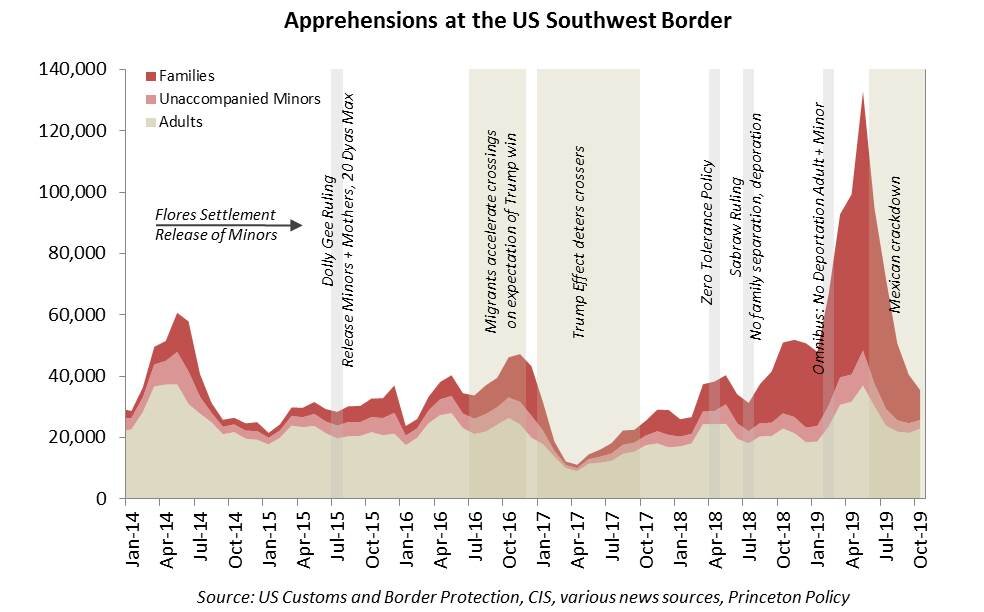
Interestingly, inadmisibles also came in low by recent standards. Inadmisibles are those who present themselves at official crossing points but are denied entry for some reason. These had been running above our January forecast all year, but have now fallen back to our a priori expectations.

The border appears to be coming back under control in terms of new apprehensions. Of course, there is still a massive backlog in the courts and with respect to migrants being held under various auspices, but the incoming flow has now normalized to more typical levels, and as last month, President Trump can take the credit.
If President Trump wants to improve his odds with impeachment proceedings, he would do well to go on the offense -- for example, with market-based visas or some other interesting new initiative — to demonstrate that he is still on the job and working to develop new approaches to ongoing issues. It wouldn't be hard to draw up a list of interesting projects.
AMLO, Cartels and Death in Mexico
Cartels and US deaths in Mexico have been much in the news lately. Much of the associated blame has been put on Mexican President Lopez Obrador's abrazos, no balazos — "hugs, not bullets" — strategy. This seeks to de-escalate tensions with the cartels, but has been widely criticized, for example, in a Wall Street Journal op-ed:
Traffickers read this as weakness and do what they please. A string of recent law-enforcement defeats, including the murder of 14 policemen in the state of Michoacán, have undermined national confidence. On Oct. 17 in the city of Culiacán, security officials arrested Ovidio Guzmán, son of the notorious El Chapo, who is in prison in the U.S. But the Sinaloa cartel reacted by unleashing its paramilitary army against the city and forcing the release of Mr. Guzmán—a humiliating blow to the Mexican government.
What is going on down there?
As readers know, we treat illegal immigration as a black market in labor, and therefore we keep an eye on other black markets affecting the US southwest border, both because they affect immigration policy and because they serve as templates for what to do -- and what to avoid.
Mexico began its current war on drugs under pressure from the US back in 2006. This has had entirely predictable consequences. Murders, which had hovered around 10,000 / year through the first half of the 2000s, began to soar. This year, Mexico is likely to post a new record above 36,000 homicides. For purposes of comparison, Pew Research reports that the US recorded 14,542 gun homicides in 2018. That extra 25,000 Mexicans deaths in the war on drugs is more than six times total US gun homicides when adjusted for population. The principal achievement of the US-driven war on drugs in Mexico has been 200,000 excess deaths there in the last thirteen years, along with untold corruption and a society spiraling out of control.

But surely all this death and horror must have accomplished something great, perhaps the end of the drug trade in the US?
Alas, no.
Under President Trump, seizures of hard drugs in FY 2019 -- and the assumed volume of drug trade it implies -- have increased by 130% compared to the last two years of the Obama administration. Cocaine in particular is the hot product, with seizures -- and presumably smuggled quantities -- up by nearly 80% over 2018.
Thus, Mexico's war on drugs, those 25,000 excess deaths, have yielded a near doubling of cocaine imports. That's the big achievement, the value of the ultimate sacrifice we have asked of 25,000 Mexicans.
Given this unending and pointless stream of death and corruption, what should President Lopez Obrador do? The history of the US prohibition of alcohol provides some insight. Implemented in 1920, Prohibition ostensibly prevented the public from consuming alcohol until Repeal in 1933. That intervening thirteen years was the time necessary for prohibitionists and the wider society to concede defeat in the war on alcohol.
We are now thirteen years since the start of the War on Drugs in Mexico, and fatigue is setting in there as well. Clearly, President Obrador wants to end the conflict. Without legalization, however, this will be hard to do, and even harder to maintain. Even now, the Mexican military is chafing at the bit to take the stick to the cartels. Sooner or later, the impulse to re-establish sovereignty over territory now controlled by the cartels will erupt in fierce fighting and yet more deaths.
The only viable alternative is some sort of legalization. This is not a panacea. Some problems will become worse, but most will improve. Specifically, historical precedent tells us that legalization would:
increase drug usage, and presumably the number of addicts, by 10-15%
decrease mortality related to hard drugs by 95%, just as the experiences of the Netherlands and Portugal show
reduce the Mexican murder rate by 2/3, saving 170,000 lives over the next decade and almost 500,000 to 2040, and
vastly improve the security situation in Mexico and the Northern Triangle countries, fostering better governance, faster GDP growth, and fewer migrants looking to settle in the US

Of course, legalization does not mean a lack of regulation--the purpose of this analysis is not to argue for legalization per se, just as we are not arguing for unlimited immigration. Further, demand suppression -- going after users -- is historically effective if properly applied, just as it would be to prosecute the employers of migrant labor. Since the customers for Mexico's hard drugs and migrant labor are essentially all in the US, the US must lead such an initiative. But either way, Mexico must end the war on drugs. Mexican society simply cannot handle the destruction wrought by the black market. The cost/benefit is not close. Even in the most liberal environment, nothing like half a million Mexicans would die of drug overdoses in the next twenty years, not by an order of magnitude. The war on drugs, however, will kill them in all certainty. The historical record is not ambiguous.
Indeed, the black markets on the southwest border with the most aggressive enforcement -- hard drugs and migrant labor -- have seen the greatest increases in activity in the last year and are well up on the Obama era. Enforcement, far from working, is inevitably facing a losing battle, as it always has.

By contrast, marijuana smuggling over the unsecured southwest border has collapsed, even though it has been legalized in only eleven states. Border Patrol seizures have dropped by 42% in FY 2019 alone, and 81% since President Trump took office. Since 2009, marijuana smuggling is down 93% -- exactly the result a liberalization might be expected to deliver. And yet, no disaster has followed. Neither the economy nor US society has ground to a halt because pot is legal.
Nor would it grind to a halt if we ended the Prohibition in Migrant Labor and instead used a market-based system with a soft cap. All the pointless suffering and expense would be saved, no one would die crossing the border, millions would be spared existential uncertainty, and hundreds of thousands would avoid crushing incarceration. And the US does not have to be overrun with migrants to achieve that goal.
Black markets are phenomenally destructive -- an order of magnitude worse than you think. Mexico will only escape the cartels with some sort of legalization, however difficult and unpleasant that may be for all of us.
But let us start with illegal immigration first. The stakes are so much lower, and the outcome so much more positive. Migrants are not heroin or cocaine, but rather poor people looking to work hard in the hopes of a better life. Both theory and history tell us this is a problem we can solve without undermining the foundations of our society.
September Border Apprehensions: The Crisis is Over
Customs and Border Protection finally reported border apprehensions on their official website for the month of September, and with it, full year data for Fiscal Year 2019 ending Sept. 30th.
In the month of September, Border Patrol apprehended 40,507 persons at the southwest border, a decline of 20% from the previous month, and the lowest level in a year.

Of particular interest, apprehensions came in below the level of September 2018, signaling that the surge begun in July 2018 is coming to an end. We expect apprehensions to fall back to more typical levels for the balance of the year.
For Fiscal Year 2019, total apprehensions at the southwest border came in at 851,507. This still represents the highest number of apprehensions since 2007, before the start of the Great Recession, and far higher than any year in the last decade.

Once again, President Trump is due credit for the reduction in apprehension rates. His pressure on Mexico has led that country to take effective steps to prevent Central American migrant families from transiting through Mexico to the US border.
Commentary on the 'Strengthening America's Workforce Act'
Apprehensions, Illegal Entries Forecast for 2019 (August)
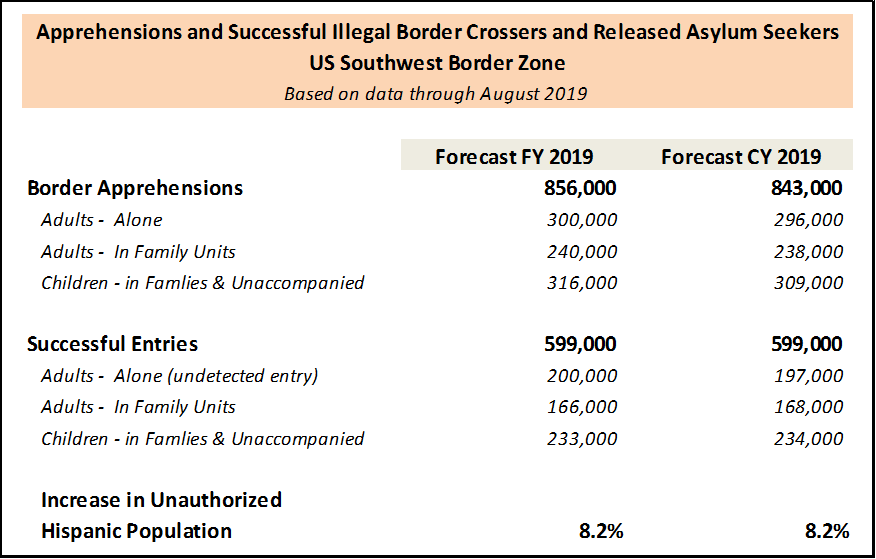
The reduction in border apprehensions in the last few months has, predictably, affected families and unaccompanied minors the most, with apprehensions of adults -- the traditional source of illegal border crossings -- returning to near longer term averages.

On the basis of August data, we have updated our forecast for apprehensions for fiscal and calendar year 2019. For fiscal year 2019 ending September 30, we anticipate 856,000 border apprehensions, of which 316,000 will be minors.
We further project that just under 600,000 illegal border crossers and released asylum seekers will successfully enter the US in FY 2019, representing an increase of 8.2% of the undocumented Hispanic population, if apprehended asylum seekers are included in the count. Of total successful entries, 233,000 are projected to be minors.
Border Apprehensions August: Returning to Normal
For the month of August, Customs and Border Protection reported 50,693 apprehensions at the US southwest border. This was a reduction of 21,289 (-30%) compared to the prior month, and 87% below the May high of approximately 133,000. This decline continues to be attributed to a crackdown by Mexican authorities at the behest of President Trump.
Notwithstanding, August apprehensions remain up 35% on last year and are the highest for the month since 2007.
We forecast the pace of apprehensions to continue to decline, returning to recent averages for the balance of the year.

A portion of the illegal traffic has been visibly diverted into inadmissibles, with migrants trying alternative means to enter the US. At 13,300, inadmissibles for August are 40% above our forecast made early this year, but are still relatively small in absolute terms.

Again, the Trump administration deserves credit for the reduction in the pace of apprehensions at the southwest border.
White Paper - A Market-based Approach to Illegal Immigration (Sept. 2019)
Japan's Lessons for US Immigration Policy
The National Interest and Yahoo recently re-published an article I wrote in 2017 on Japan's long-term demographic, economic and fiscal outlook (version with graphs, here). Those interested in the strategic context for US immigration and fiscal policy will find this article uniquely helpful.
*****
Japan is preceding the US in demographic trends by about 15 years. Some version of events there will happen here, influencing US policy towards both legal and illegal immigration.
Indeed, some trends are already manifest. In the US, the growth of the 65+ aged group began to surpass that of the core 15-64 aged workforce in absolute numbers in 2012. In the next decade, the core workforce is forecast to expand by three million, while the 65+ age cohort is expected to rise by 17 million.
This has a number of important implications, specifically:
structurally low GDP growth
structurally low unemployment and chronic labor shortages, particularly at the low end
structurally low interest rates
large, sustained federal budget deficits and on-going fiscal pressures
a need to find cost effective alternatives to manage the well-being of seniors
The immigration-related challenges:
Caring for Seniors
Some parts of the country are already critically short on home health care, as described in this article, ‘Catastrophic’ shortage of caregivers in Maine expected to be mirrored nationwide
The disconnect between Maine’s aging population and its need for young workers to care for that population is expected to be mirrored in states throughout the country over the coming decade, demographic experts say. And that’s especially true in states with populations with fewer immigrants, who are disproportionately represented in many occupations serving the elderly, statistics show.
A coalition of progressives, elderly conservatives and fiscal conservatives will be motivated to increase guest worker visas to help ease shortages of those caring for the elderly. Market-based visas would provide a template for such an eventuality, and do so in a context in which conservatives remain in material control of migrant headcount. In other words, MBVs would provide a program which should meet conservative requirements while accommodating at least some of the needs for incremental migrants to take care of our elderly.
The Southward Invasion
We are accustomed to thinking about migration flows principally as south-to-north. In the coming decade, the greater flows may be heading south. Fiscal pressures will limit the amount of government support available for retirees, who will be increasingly pressed to look for low cost living alternatives, with Mexico and Central America key potential destinations. The numbers are large, with twice the population of New Jersey turning 65 in the 2020s. Even a small portion of these could mean one or two million Americans heading to Mexico or Central America in the next decade or so -- at a pace not too different from illegal Latin Americans heading to the US. The US government's interest is to insure the greatest scope for expat retirees' security, health, infrastructure and convenience in Latin America in order to protect the domestic consensus around and the viability of Social Security and Medicare. This can be achieved as a function of a market-based visas approach to improve Latin American governance, but in any event, the US interest is in closer integration with Mexico and Latin America, not the building of walls and barriers.
The Fertility Crisis
When I was in college, economics courses hailed Social Security as an advance which eliminated the need for people to raise children to provide for them in their old age. As it turns out, this logic suffers an internal inconsistency, in that even Social Security depends on someone having children to provide for the elderly collectively. Well, women in the advanced economies and China are having far too few children to maintain population levels, and this is emerging as a key conservative issue in the 2020s, with Russia, Poland, Hungary, and France already providing financial incentives for incremental children. This is a new kind of conservative feminism in which women can essentially name their price to provide children for society's benefit.
This has two important implications. First, taxing women and families -- and these are a critical portion of the tax base -- is going to become harder and harder, and the net burden there will have to be progressively lowered not raised. That will put incremental pressure on the federal budget. The second implication is that a failure to reproduce will create increasing demands for immigration. Thus, fertility and immigration are going to be inextricably intertwined, with outfits like CIS and FAIR likely to expand their expertise and political advocacy around fertility issues.
All this deserves a specific analysis for the US, not just Japan. For now, the key point is that the immigration debate insufficiently recognizes that the world of the 2020s will look materially different than that of the 1990s, or even 2000s. Whereas twenty years ago we could speak of excess labor, we today are facing structural shortages as far as the eye can see. Policy should not focus on withdrawing from the world, but on engaging, particularly with Mexico and Latin America, to insure that US retirees have the best prospects for a happy, safe and prosperous old age and that a sufficient supply a guest labor is available to care for our aging society.
We have an opportunity to build out controlled channels for guest workers and influence governance in Latin America with an approach which leaves conservatives in material control and demonstrates to both them and the wider US public that we can interact safely with Mexico and Central America to the benefit of their citizens and ours.
We should seize the opportunity and try a new approach, which not only addresses today's issues, but also anticipates the challenges of the 2020s.
A Principal-Agent Framework for Ideology
Excess Migration Premium
The path of illegal immigration and domestic worker exploitation depends fundamentally on the Excess Migration Premium (EMP), the extra earnings a migrant can access by coming across the border illegally.
The Excess Migration Premium is the difference between the Prevailing US Unskilled Wage and the migrant’s Relocation Wage.
The Prevailing US Unskilled Wage
The prevailing unskilled wage in the US is approximately $10 / hour. About 20 million Americans work at this wage. For the US employer, the alternative to hiring a Mexican or Central American immigrant is to pay $10 / hour to a US citizen (assuming an employer can find US workers to fill certain jobs at any price). Therefore, at anything up to $10 / hour, an employer is willing to hire a migrant, illegally if necessary.
The Relocation Wage
The migrant’s Relocation Wage is the sum of
The migrant’s home country unskilled wage, about $2.50 / hour in Mexico and $1 / hour in Honduras,
A Relocation Premium sufficient to induce the migrant to leave his home country, which we calculate subjectively at 60% of the home country wage, and
An adjustment to cover the higher cost of living in the US. We estimate this at $2.50 / hour.
Thus, the Relocation Wage for an unskilled Mexican is about $6.50 / hour, and in the range of $5 / hour for Central Americans.
The Relocation Wage can change depending on home country circumstances. For example, an unemployed Guatemalan with dim jobs prospects at home might count his domestic wage (opportunity cost) as $0 when considering his Relocation Wage. Similarly, if one were fleeing violence, then the Relocation Premium could theoretically be a negative number, that is, a migrant may be willing to work for less than their home wage just to enjoy greater safety in the US.
Notwithstanding, a stylized Relocation Wage can help us understand the motivations of migrants.
The Excess Migration Premium
On the table below, we can see the excess migration premium for Mexico and Honduras, about $3.50 /hour for Mexicans, and almost twice as much, $6.15 / hour for Central Americans.
How motivated a migrant might be to come into the US illegally is a function of the multiples they can earn compared to their domestic wage. Mexicans can almost triple their net salary, and roughly double it if we include the inconvenience of having to leave their home country.

In the US, Central Americans can earn nearly eight times their home wage net of US expenses, and about five times as much even if compensating for the inconvenience of having to leave their homes.
The Economics of Illegal Entry
With this information, we can calculate the economic incentive to try to cross the border illegally. We have elsewhere calculated the expected cost of crossing the border — including cartel and guide fees, and the risk of death, kidnapping, extortion, rape, injury, arrest and incarceration — at approximately $13,800. This could vary depending to the values and probabilities one wishes to assign to certain adverse events, but it likely comes out in the $10,000 - $15,000 range.
We estimate the value of an illegal crossing at three years of earning the Excess Migration Premium. For example, a Mexican coming across illegally would hope to earn $3.50 / hour more than the number he would require to relocate to the US legally. That $3.50 / hour has to compensate for the risks of entering the US illegally. We know that consumers typically discount benefits — like buying a car with better fuel economy — over three years, and that’s what we use here. Three years works out to 6,000 work hours at $3.50 / hour, or about $21,000. That is the expected benefit of illegal entry. From this the Mexican migrant will deduct a subjectively estimated $13,800 in expected crossing costs, leaving a net benefit of $7,200 for coming across illegally. Note that it’s still worth it, but not that great. If the Mexican had stayed home, he would have earned $5,000, so a risk-adjusted benefit of $7,200 is about 17 months of pay. It’s better, but not hugely better.
Not so for Hondurans. Under similar assumptions, the expected value of crossing the border illegally represents nearly 12 years of home country income. That’s a big incentive.
The Rationality of Oscar Martinez

As a case study, we can use this framework to assess the reasoning of Oscar Martinez, who drowned along with his daughter in Rio Grande as they were trying to enter the US this past April.
As reported by the Daily Mail, in El Salvador, Oscar worked at a Papa John’s pizza restaurant, where he earned $350 a month. He and his wife Tania lived off this $10 / day, because Tania had already quit her job as a cashier in a Chinese restaurant to care for Valeria, their only child. According to Tania’s mother, they were not fleeing violence, but were in desperate search of a life where they could earn more. Their plan was to spend a few years in America to save up enough money to eventually return to El Salvador and buy or build their own house.
Did it make sense for Oscar Martinez to attempt to ford the Rio Grande? As it turns out, the payback potential — even allowing for the risks associated with crossing the border — was highly attractive. He took the risk and lost. Some of those attempting entry will die as a matter of absolute certainty. But from the individual’s perspective, it was the right call, with the expected benefit equal to five years’ wages.
Now, my conservative friends will chide me for seeming to endorse illegal immigration: “Migrants should follow US laws!” While I appreciate the sentiment, US laws are just one of several obstacles migrants must overcome to enter the US. What looks like morality for US conservatives boils down to a hard-nosed cost/benefit analysis — yes, informal and inexact — but a subjective cost/benefit analysis for migrants choosing between staying in their home countries and taking a shot at getting into the US. This is no different than the logic of the English colonists at Jamestown, the Pilgrims in Massachusetts, or the pioneers heading out west. All of them suffered from imperfect information and likely lacked formal quantitative analysis. But they made their best subjective estimate and decided. For some, the colonists at Jamestown or the pioneers at Donner Pass, the result was tragedy. But those on the Mayflower effectively became the founding families of the United States. They all took risks. Some won. Some lost. Just like Oscar Martinez.
In the end, Oscar Martinez was rational, just unlucky. It is US policy which is irrational, because it persists, on the one hand, with tactics which frankly have never worked, while ignoring migrants’ hard economic realities, on the other.
Ending Illegal Immigration: The Drive for 325

One of the interesting conclusions of our model is that we can calculate when illegal immigration is no longer worth it. This occurs at a surprisingly low wage. At a hourly pay of only $3.25, it no longer makes sense to jump the border. At this wage, the excess migration premium is no greater than the expected cost of crossing the border illegally. This is not that much higher than unskilled wages in the northern half of Mexico. That is why we increasingly see stories of Mexicans saying that they’ll only work in the US with official documentation, or not at all. That’s not true of Central America, though, where wages are much lower than in Mexico. As a consequence, we see a surge from Central America accompanied by a restrained pace of illegal crossings of Mexicans.
*****
The debate over illegal immigration expends far too much effort on ideology, sentiment and mood affiliation. Policy analysis also has a place. We can achieve many, if not all, of our goals across a range of stakeholders if we employ quantitative analysis and honor established theory and practice.
Five Approaches to Illegal Immigration
It's an exciting time for migrant policy, with several related proposals circulating in DC right now. To help Hill staffers and other stakeholders make sense of the choices, we thought to categorize the various approaches.
Deport and Enforce
The favorite of conservatives, Deport and Enforce calls for the government to enforce the laws on the books: identify, gather and deport illegal immigrants, and seal the unsecured border to unauthorized crossing. Variants include building a Wall, hiring more border patrol agents and immigration judges, expediting immigration hearings, and taking various steps to dissuade migrants, among others.
Enforcement against economic migrants falls into the category of supply suppression for black markets. Supply suppression rarely works. Indeed, for the traditional vices of alcohol, marijuana, hard drugs, prostitution and gambling, it has never worked. Having said that, crossing the border illegally undetected appears to have become more difficult in the last decade, with apprehension rates rising from an estimated 40% to the 55-70% range under the Trump administration.
The problem, of course, is that migrants adapt, transitioning from single Mexican men traveling alone to Central Americans traveling in caravans and families claiming asylum. Supply suppression inevitably devolves into a game of whack-a-mole, with each new enforcement initiative countered by some change in black market tactics. As long as there is work to be had and US wages are multiples of those in Central America, enforcement will always be a challenge and victory will be fleeting. Indeed, the migrants are winning handily in 2019. We estimate the illegal Hispanic population will have increased by more than 8% in FY 2019 if asylum seekers are included.
Be Nice
The Democrats' rhetoric, if not strategy, comes down to 'Be Nice'. The left calls for easy, if not unlimited, access by migrants to the US interior, with full access to the social safety net, including welfare, healthcare and schooling for minors. The intent is to eliminate all accountability and ignore the nearly 80% of American who believe the country needs secure borders. This is manifest for example in Democratic presidential candidate Julián Castro's call for making illegal crossing of the border a civil, not criminal, offense. With a 60% apprehension rate -- which is very good -- nearly 80% of crossers would successfully enter into the US interior within three tries. If the only downside is getting the equivalent of a jaywalking ticket, crossers have every incentive to keep trying the border until they get through. With only a fraction of the public supporting open borders, such liberalism will gain no more traction than will the conservatives calling for mass deportations and building a wall.
Volume-based Approaches
Historically, work visa volumes are determined by legislation. For example, last year's Goodlatte bill anticipated increasing H-2 visa counts by 450,000. Fixed volume legislation has the benefit of limiting the risk for conservatives as the number represents an upper limit. It is also easier to negotiate, because negotiations can focus heavily on this one number. On the downside, because H-2 visas are structurally under-priced, they are a subsidy to employers and migrants, with taxpayers picking up the associated costs. For this reason, the number of visas agreed is inevitably fewer than the underlying market demand. Consequently, although such initiatives may reduce illegal immigration for a while, they do not fix the problem in any meaningful sense; indeed, they are not directly intended to close the southwest border to illegal immigration. Further, they do nothing for the undocumented immigrant market. In terms of simplicity and ease of passage in Congress, volume-based initiatives have historically tended to dominate the discussion, but they are inevitably stop-gaps rather than durable, structural reform. They have failed to materially alter the dynamics of illegal immigration in the last half century.
Price-based Approaches
The proposals of CATO, Ideal Immigration, the Rational Middle, and arguably Americans for Progress fall into this category. These organizations take the view that businesses need workers to fill certain jobs that Americans are reluctant to do. In their view, migrant workers and businesses coming together are legitimate and more of a benefit than cost to society. Thus, like market-based visas, price-based approaches represent an implicit legalize-and-tax view of immigration. However, because the price is fixed, it is inevitably set too low, such that these programs would see a dramatic increase in migrant numbers without a cap. A true market price cannot be imposed by Congress, because it fails the political optics test (leaving aside the consideration that we do not know the right price in practice). This in turn would prompt conservatives to demand a cap on visa numbers, thereby converting the matter back into a volume-based approach, with all the problems attendant.
I would add that price-based approaches tend to want good workers to be afforded permanent residency over time. That is, they tend to combine worker visas with permanent visas, which makes the politics even more challenging.
Market-based Approaches
Market-based visas (MBVs) essentially fuse conservative and liberal objectives. Like price-based approaches, MBVs acknowledge the legitimacy of migrant workers and businesses coming together. On the other hand, the approach uses a price mechanism to adjust visa volumes to maintain migrant numbers at levels not much different than those achieved under current conditions. This allows the system to operate under either a soft or fixed cap in visa numbers, a key consideration for those hoping for conservative support.
We also acknowledge conservative objectives, specifically and in order: 1. safety, 2. permission, 3. identity, 4. standards, 5. self-sufficiency, 6. culture, and 7. demographics. Of these, MBVs deliver the first five, but not the last two. Indeed, MBVs represent the most liberal entry form of any of approach listed here. Background-checked migrants from select countries can enter, exit and work in the US at will for a duration of their choosing, whether or not they have contracted with an employer at the time--for an estimated $20 / day.
This is the best option conservatives will see, by far. While MBVs do not end migrant labor as such, the approach achieves ten critical goals for conservatives that they would not attain otherwise. Notably, MBVs
close the unsecured southwest border (the upside of allowing on-demand entry)
end the black market in undocumented immigrant labor
keep migrant numbers near levels they would otherwise be (and MBVs would have prevented the asylum surge entirely)
retain control over visa issuance numbers -- even below any cap
meet five basic conservative objectives, from safety to proper documentation, better conformance with laws and social standards, and self-sufficiency
provide market-level compensation for allowing labor market access
encourage migrants to leave their families in their home countries and return there when not working in the US
provide no path to permanent residency (as a structural matter)
insure wide-spread compliance by both employers and migrants
permit the program to be unwound in a year at a profit if the approach proves unworkable
For conservatives, no other option comes close in practical terms.
Just as for conservatives, MBVs provide Hispanics and Democrats the best offer they will see in the next ten years -- by far. MBVs will provide status for up to 7 million undocumented Hispanics, allow free movement of background-checked migrants across the border, eliminate the vast scale of pathology -- including death, rape, kidnapping, extortion and incarceration, among others -- associated with crossing the border and working illegally, and will represent the biggest gain in Hispanic pride and prestige in a century.
For business, it means protection from arbitrary ICE raids and access to unlimited quantities of migrant labor on demand at the market price for any duration they choose, with confidence that these workers are properly documented, have health care coverage, and have committed no serious crimes.
*****
The traditional left-right divide highlights the limitations of current policy. Because the government has no carrot -- no legal way for economic migrants to enter the country in a timely and predictable fashion of their own choosing -- deterrence is left to employing sticks. But keep in mind that these sticks are deployed against migrants whose principal crime is wanting a better life in America and a willingness to take a 'dirty' job that Americans do not want. These are not bank robbers or murders, but largely unemployed or poor peasants trying to feed their families. Deterrence therefore degenerates into a farcical and self-defeating cruelty, for example imprisoning, at the cost of $40,000 / year, otherwise harmless illegal border crossers who could be providing needed services and creating $50,000 of GDP on average in the US.
But what is the alternative? The Sabraw ruling of July 2018 and Section 224(a) of the February omnibus effectively gutted border enforcement for families traveling together from Central America. The result was the surge we have seen for the last year. A permissive system will bring migrants by the hundreds of thousands in short order, because the economics are compelling.
Thus, in an enforcement-based system, the choice is impotence or cruelty. It is not that one of these choices is better, but rather that the entire framework of analysis is wrong. The whole approach is bankrupt.
The alternatives include issuing more visas, which will never be sufficient because the visas will be under-priced, providing insufficient motivation for conservatives to grant an adequate number.
A broader liberalization with a fixed price would work, but would allow in migrants in such numbers that the initiative will fail to get traction.
This leaves a hybrid MBV approach using a floating price to maintain migrant numbers in a range broadly acceptable to conservatives while providing a safe, transparent and on-demand means for migrants to access the US labor market. That should work, bearing in mind that MBVs are not a concession, a subsidy, an entitlement or a gift. They are a trade.
Everyone wants better terms: cheaper labor, free entry, entitlements and amnesty. But for every winner in such a world, there are as many losers, and no deal will come together. On the other hand, if the parties can agree to trade at market value, then we can solve illegal immigration in short order.
Baltimore, Border problems share common cause
During a hearing on July 18th, House Oversight Chairman Elijah Cummings took Acting DHS Secretary Kevin McAleenan to task over the conditions of detention facilities for migrants at the U.S.-Mexico border.
The President shot back this past Saturday, tweeting that “Rep. Elijah Cummings has been a brutal bully, shouting and screaming at the great men & women of Border Patrol about conditions at the Southern Border, when actually his Baltimore district is FAR WORSE and more dangerous. His district is considered the Worst in the USA......”
Forget the border. Baltimore's murder rate is actually higher than those of Guatemala, Honduras or El Salvador.

Source: Princeton Policy analysis based on multiple sources
Baltimore is on track for 340 murders in 2019, on a population of about 610,000, representing a murder rate of 56 per 100,000. Guatemala's murder rate in 2018 was 22. El Salvador's was 50, and declining. Honduras was tracking a pace of 38 through the first four months of the year. That Baltimore's murder rate is higher than the most dangerous countries' in Central America is frankly appalling on many levels, and as someone who grew up in Baltimore, I believe increased accountability is long overdue.
Having said that, half of the violent crime rate in Baltimore and other major US cities, as well as 95% of the entire suite of pathology at the southwest border -- and 22,000 of Mexico's record pace of 34,000 murders this year -- are the direct result of US prohibitions in drugs and migrant labor. Black markets resulting from prohibitions are well understood and easily documented through historical precedent, for example, Prohibition in the 1920s and Mexico's war of drugs since 2006. The coefficients of pathology -- rates of murder and rape, for example -- can be modeled in advance.
Baltimore's "disgusting, rat and rodent infested mess" has been projected through the lens of race. In terms of problem-solving, however, we believe the situation is better appreciated as safety-related. People don't want to work, study or live in dangerous neighborhoods. That means businesses and employers will be few, incomes will be low, and crime and blight will spread. A more constructive approach to illegal drugs would see violent crime rates fall by half in Baltimore and the city's prospects improve commensurately.
Moreover, there is nothing immutable about murder rates. Many readers will no doubt be surprised to read that Baltimore has a higher murder rate than the Central American countries whose violence the left has claimed led to the asylum crisis. Central America used to be much worse. As late as 2015, El Salvador's murder rate was about 100 -- almost twice that of Baltimore. But security is much improved across the Northern Triangle countries (one reason we concluded that the asylum surge was caused by a change in US policy, rather than push factors in Central America). With better governance, crime rates can be reduced substantially.
The results at the border could be much more impressive. A market-based approach for migrant labor would reduce related crime and victimization -- including death, rape, kidnapping, robbery, human smuggling and trafficking, incarceration, illegal immigration, and migrant wage theft and exploitation -- by 95%, and would do so in as little as two years even as enforcement is substantially curtailed. From the policy perspective, repealing Prohibitions is not hard and the dynamics are well understood.
With all the charges of racism over the last few days, it is worth keeping in mind that prohibitions relying primarily on supply suppression (enforcing principally against economic migrants, for example) represent the key form of institutional racism in the country, by far. Prohibitions are central both in determining the culture and economic prospects of inner cities and in setting public perceptions of the Hispanic community.