This document lays out a vision for regime change in Iran based on constitutional reform. The US administration will find this a challenging approach, but the rewards are great.
The Problem with Regime Change
The United States and Israel both declared regime change as a key goal at the outset of the Iran conflict. The results have been instructive in what does not work. Bombing eliminated the incumbent leadership but produced more radical successors. Demands for unconditional surrender and the right to name Iran's new leaders were rejected. A naval blockade of the Gulf of Oman has imposed economic pain without producing political capitulation. Iran has not been starved into submission.
The Israeli prescription for regime change has settled on a strategy of periodic intense bombardment — of military assets, governance institutions, and civilian infrastructure — designed to destroy Iranian organizational capacity and return to bombing whenever recovery appears imminent. Known colloquially as “mowing the grass”, this is the Gaza model applied to a country of 90 million people. It is a strategy for destruction, not transformation.
Most Americans understand regime change differently — as the replacement of a dictatorship with a functioning democracy. On that definition, the administration’s current approach offers no path to success. Bombing does not produce democracy. Blockades do not write constitutions. If the goal is a democratic Iran that no longer threatens its neighbors, finances proxy armies, or pursues nuclear weapons, a different instrument is required.
Iran's Democratic Foundation
Iran has something that most countries targeted for regime change do not: a functioning elected parliament. The Majlis — Iran's 290-member legislature — has operated continuously since 1980, holds genuine elections, and produces real political competition within its constrained space. It is the institutional foundation upon which a functioning democracy can be built without starting from scratch.
The current Speaker of the Majlis is Mohammad Bagher Ghalibaf — the key figure who led Iran's negotiating delegation in Islamabad on April 10 (since removed). Ghalibaf is a former mayor of Tehran, a certified Airbus pilot, a professor at the University of Tehran, and a four-time presidential candidate. He is a pragmatist by the standards of the Islamic Republic and has demonstrated willingness to engage with the United States when the incentives are right. He is also a man who has watched two consecutive IRGC commanders killed by Israeli missiles in the past year. Ghalibaf understands the stakes.
The Majlis is the counterparty for democratic transformation. Its 290 members represent genuine constituencies with genuine economic grievances. And under the National Prosperity Fund framework, described separately, those 290 members would receive $500,000 per year in direct payments tied to continued economic normalization — giving them strong personal financial incentives to support constitutional reform.
The Theocratic Obstacle
In addition to the Majlis, Iran has another, dominant layer of governance. Iran's 1979 constitution designated the Supreme Leader — now Ayatollah Mojtaba Khamenei, wounded and partially isolated following Operation Epic Fury — as the supreme authority over the military, judiciary, state media, and all major policy decisions. His word is decisive.
He is supported by the Guardian Council, whose six senior members are Supreme Leader appointees. The Council vets all candidates for office and vetoes legislation it deems contrary to Islamic law. Together, the Supreme Leader and the Guardian Council have systematically blocked democratic expression for forty-five years.
The most dangerous theocratic force is the Islamic Revolutionary Guard Corps — Iran's Praetorian Guard. The IRGC controls Iran's intelligence apparatus, missile programs, and an estimated 40-50% of the Iranian economy through its construction conglomerates, energy interests, and black-market networks. It finances and directs Hezbollah, the Houthis, and Iraqi militias. Two consecutive IRGC commanders have been killed by Israeli strikes in the past year — Hossein Salami on June 13, 2025, and Mohammad Pakpour on February 28, 2026. Ahmad Vahidi, the current commander, is engaged in what appears to be a palace coup — limiting access to the injured Supreme Leader and positioning the IRGC as the dominant power in the current vacuum.
The IRGC is the primary obstacle to reform. It stands to lose the most in a democratic transition. At the same time, it has no answer to Iran's structural economic crisis — 40-45% annual inflation, currency collapse, 80% state ownership, price controls, and the kind of institutional exhaustion that preceded the fall of communism in Eastern Europe. Its leadership knows the current system is failing. That knowledge is a source of both danger and opportunity.
The Constitutional Solution — 12 Amendments
A democratic Iran does not require a new constitution. It requires specific modifications to the existing one. Twelve articles stand between the Iran that exists and the Iran that is possible. If passed by a Majlis supermajority, these 12 amendments would convert Iran from a theocratic dictatorship into a constitutional theocracy — a system with historical precedent, theological grounding in Shia jurisprudence, and genuine democratic substance. The resulting constitutional structure follows established international precedent:
— The Supreme Leader becomes the head of nation and the faith, with ceremonial authority, but no governing power, analogous to the British monarch
— The President becomes the ceremonial head of state, appointed by Majlis vote rather than popular election, analogous to the Hungarian or Italian president — above partisan politics, without governing authority.
— The Speaker of the Majlis becomes Prime Minister, the head of government, elected by Majlis. He governs through Cabinet on all executive matters including budget, economic policy, foreign affairs, and defense. This is standard parliamentary democracy.
— The Majlis is the sovereign legislature, Iran’s parliament with all rights and duties implied
— The Guardian Council is reconstituted as the supreme court, reviewing legislation for constitutional conformity only. Members appointed through parliamentary process. No Islamic law veto. No candidate disqualification.
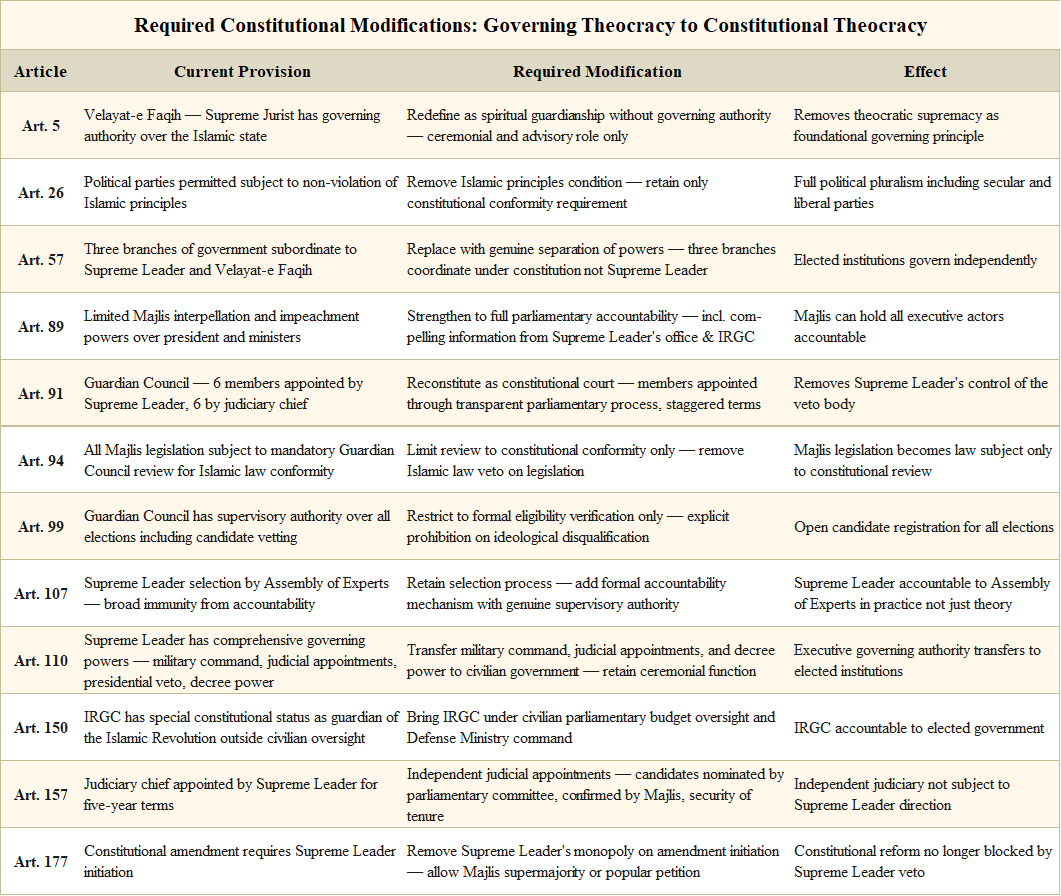
This is not the only possible model. But it is a coherent, achievable, and historically grounded one.
Why This Works
The Majlis has every reason to say yes
For the 290 members of the Majlis, the 12 Amendments is an offer that transforms their institutional position from a constrained rubber stamp into a genuinely sovereign parliament. Combined with the NPF's $500,000 annual payment per member, the personal and institutional incentives are aligned. Ghalibaf, who has sought the presidency four times and been blocked each time by Guardian Council interference and Supreme Leader preference, becomes Prime Minister under the new system — the governing head of state of a normalized Iran. The proposal converts his political ambitions from a source of frustration into a path to genuine power.
The Iranian public is ready
Iran's protest movements — 2009, 2019, 2022-2026 — have demonstrated consistently that a substantial portion of the Iranian public wants exactly what the 12 Amendments offers. The missing ingredient has always been a specific, achievable constitutional program rather than the vague call to "rise up." The 12 Amendments gives protesters, reformists, and ordinary Iranians a concrete agenda to organize around, specific articles to demand, and a named counterparty — the Majlis — responsible for acting. Six years of 40%+ inflation, currency collapse, and institutional failure have created a population with strong material incentives to support economic and political normalization.
The IRGC faces a credible threat
The IRGC will resist. Its entire institutional existence — economic empire, proxy network, political dominance — depends on the current system. But resistance carries a cost that has recently become concrete. Two IRGC commanders have been killed by Israeli missiles in the past year. Ahmad Vahidi, the current commander, is acutely aware that his predecessors' titles did not protect them. The US and Israel can credibly extend that threat: pass the 12 Amendments, or face the same targeted pressure applied to those who actively obstruct democratic transition. No need to bomb bridges and powerplants — just remove the specific individuals who stand in the way of a reform that serves Iranian, American, Israeli, and global interests.
This is not a threat that needs to be spelled out in diplomatic communications. It is a background reality that every IRGC commander already understands. Combined with an Iranian economy that the IRGC cannot fix and a Majlis that is financially motivated to move, the institutional calculus shifts.
Europe and the American public can support this
A proposal to transform a dangerous theocratic dictatorship into a constitutional democracy through specific constitutional amendments — rather than through bombing civilian infrastructure — is a proposal that European allies and the American public can endorse. It reframes the Iran conflict from a destructive military campaign into a constructive democratic transformation. President Trump, whose public support on the Iran war is weak, gains a historic achievement — the democratization of Iran — rather than an inconclusive military campaign. The political upside is significant.
The Ask
The ask is simple and specific. The United States and its allies call on the Majlis of the Islamic Republic of Iran to pass, by supermajority, the 12 constitutional amendments described above within a defined period — 90 days from ceasefire. The Majlis Speaker, Mohammad Bagher Ghalibaf, is identified as the responsible counterparty. The economic benefits of normalized relations — sanctions relief, frozen asset releases, the Gulf Stabilization and Reconstruction Fund, and NPF payments — are explicitly linked to Majlis action on the amendments.
IRGC commanders and Guardian Council members who actively obstruct the Majlis's exercise of its constitutional authority face targeted individual consequences. Those who stand aside face no consequences and receive NPF payments on the same basis as other designated decision-makers.
This is not a simple approach. It requires the United States to assert a position and hold it over weeks to months. It requires sustained engagement with the Majlis as a democratic institution, sustained pressure on the IRGC as an obstacle to reform, and sustained commitment to the economic normalization that makes the reform agenda viable.
A democratic Iran is an enormous strategic prize — one that resolves the nuclear threat, ends the proxy war, reopens Hormuz, and removes the primary source of regional instability. It represents an opportunity that arises once in a century. The 12 Amendments is the most direct path to that outcome available.
*****
The 12 Amendments: Regime Change in Iran
*****
Princeton Policy Advisors is an independent policy advisory firm. This paper represents the analytical views of its authors and does not reflect the official position of any government or institution.